USD/JPY falls off a cliff after US inflation miss
- USD/JPY declines over 2.0% after US CPI data misses estimates.
- The data means US inflation is a step closer to the Fed’s 2.0% target.
- This increases the likelihood of the Fed cutting interest rates in the near term weakening the US Dollar in the process.

USD/JPY is in freefall, trading over 2.0% lower, in the 157.90s, after the release of US Consumer Price Index (CPI) for June showed a cooling down of inflationary pressures in the US economy.
The CPI data brings US inflation a step closer to the Federal Reserve’s (Fed) 2.0% target and makes it more likely the central bank will reduce interest rates in the near-term. This in turn is negative for the US Dollar (USD) (and the USD/JPY) since lower interest rates attract less foreign capital inflows.
The Japanese Yen (JPY) meanwhile, finds support after Japanese factory-gate inflation data showed a sharp rise in June. PPI rose 2.9% year-over-year in June, beating the previous month’s 2.6% reading and in line with consensus expectations. It was the fifth consecutive month of increasing gains for the indicator, the 41st consecutive month of PPI inflation, and the highest reading since August 2023.
USD/JPY Daily Chart
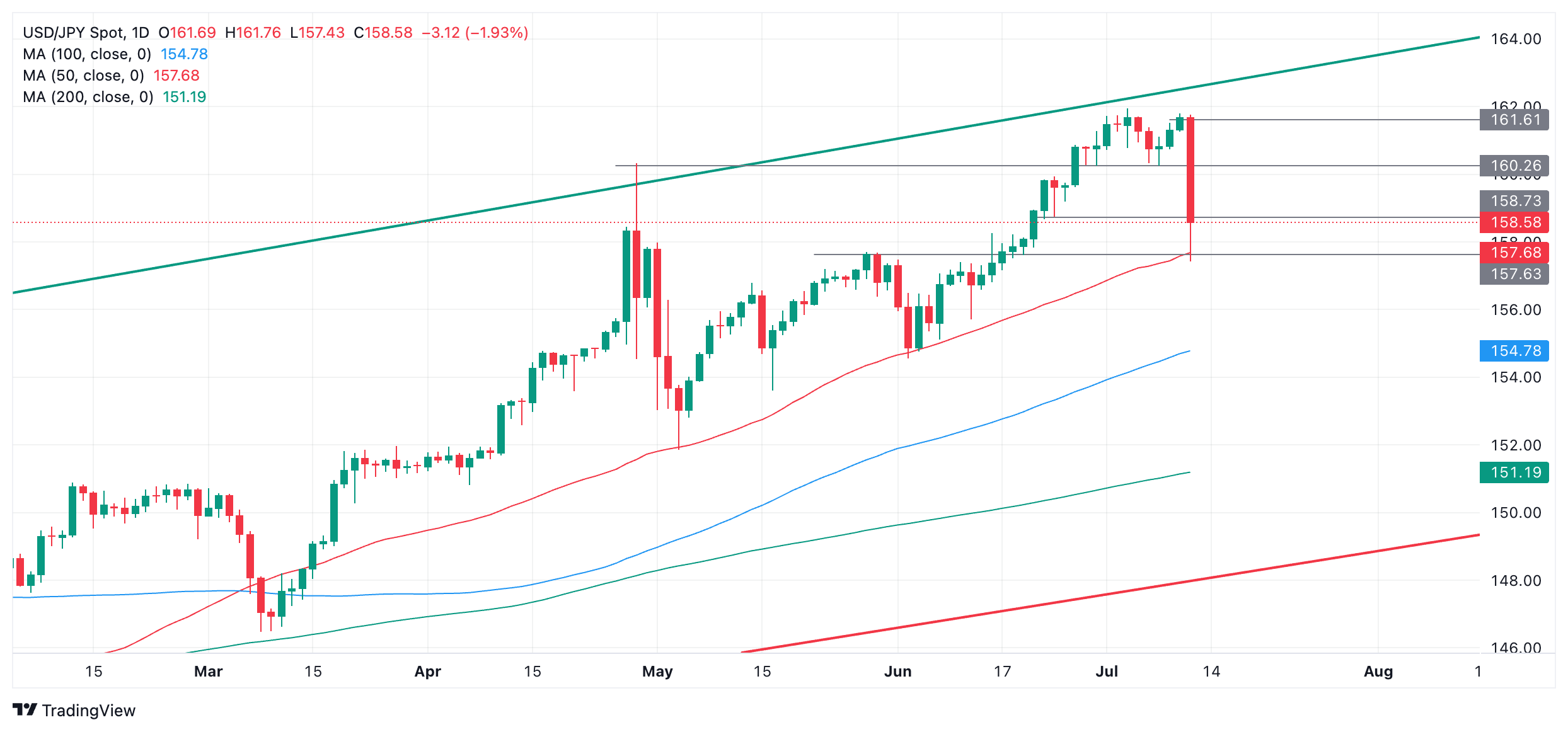
USD/JPY drops like a knife after US CPI data undershoots
USD/JPY is sinking rapidly after the release of US CPI revealed prices rose 3.0% year-on-year in June, which was below estimates of 3.1% and the previous month's 3.3%.
CPI declined 0.1% on a month-over-month basis in June, when economists had expected a 0.1% rise from 0.0% in May.
Core CPI, which excludes volatile food and energy components, cooled to 3.3% YoY, falling below expectations of 3.4% and the previous month’s 3.4%. On a monthly basis core CPI rose 0.1%, which was below the 0.2% forecast and 0.2% of May.
The data makes it more likely the Fed will begin cutting interest rates in the near-term – a negative for the US Dollar. Current market-based gauges suggest a circa 70% probability of a cut in September, according to the CME FedWatch tool.
Downside could be limited by outlook for Yen
Despite the decline in USD/JPY on the back of the lower US inflation reading and its contrast to higher Japanese PPI inflation data for the same period, the downside for the USD/JPY pair may be limited as the prospects of the Bank of Japan (BoJ) lifting interest rates substantially remain low.
Although the chances of the BoJ raising interest rates by 0.25% at its July meeting are high and this is supporting the Yen (negative for USD/JPY), the BoJ is not expected to begin an aggressive tightening cycle in which it ratchets up interest rates in meeting after meeting. Rather it is only expected to make 0.35% of interest-rate hikes in the next 12 months according to Dr. Win Thin, Global Head of Markets Strategy at Brown Brothers Harriman, so “upwards pressure” is likely to persist in Yen pairs.
USD/JPY faces a further risk of “stealth intervention” by the Japanese authorities, according to Sagar Dua, Editor at FXStreet. In late April and early May 2024, the Bank of Japan (BoJ) undertook direct market interventions to buttress the Yen. A too-weak Yen is seen as a financial stability risk for importers and encourages the “wrong kind” of inflation in the economy, according to Japanese policymakers, who have been warning of further interventions if the Yen continues depreciating. This continues to be a risk factor for USD/JPY.
Author

Joaquin Monfort
FXStreet
Joaquin Monfort is a financial writer and analyst with over 10 years experience writing about financial markets and alt data. He holds a degree in Anthropology from London University and a Diploma in Technical analysis.