|

USD/CHF Price Analysis: Faces selling pressure above 0.9100 after weak US PMI

  • USD/CHF faces pressure above 0.9100 as US Dollar drops after weak S&P Global PMI data for April.
  • The preliminary Manufacturing PMI falls below the 50.0 threshold.
  • The Fed advocates for keeping interest rates at their current levels longer.

The USD/CHF pair faces a sell-off above the round-level support of 0.9100 in Tuesday’s early American session. The Swiss Franc asset falls as the US Dollar Index (DXY) drops to 105.80 after the S&P Global reported weak preliminary PMI data for April.

The agency reported that both Manufacturing and Services PMI missed expectations. The Manufacturing PMI slips below the 50.0 threshold that separates expansion from contraction. The factory data lands at 49.9 lower than the expectations of 52.0 and the prior reading of 51.9. The Services PMI drops to 50.9 from the consensus of 52.0 and the former reading of 51.7.

Going forward, investors will shift focus to the United States core Personal Consumption Expenditure Price Index (PCE) data for March, which will be published on Friday.

The core PCE Price Index data is the Federal Reserve’s (Fed) preferred inflation measure. It is estimated to have grown steadily by 0.3% on a month-on-month basis, with annual inflation softening to 2.6% from 2.8% recorded in February. This will influence market expectations of Fed rate cuts, which are currently anticipated in the September meeting.

10-year US Treasury yields rise further to 4.64% as the Fed continues to argue that the current monetary policy framework is appropriate as stubbornly higher inflation in the first quarter of this year cannot be ignored.

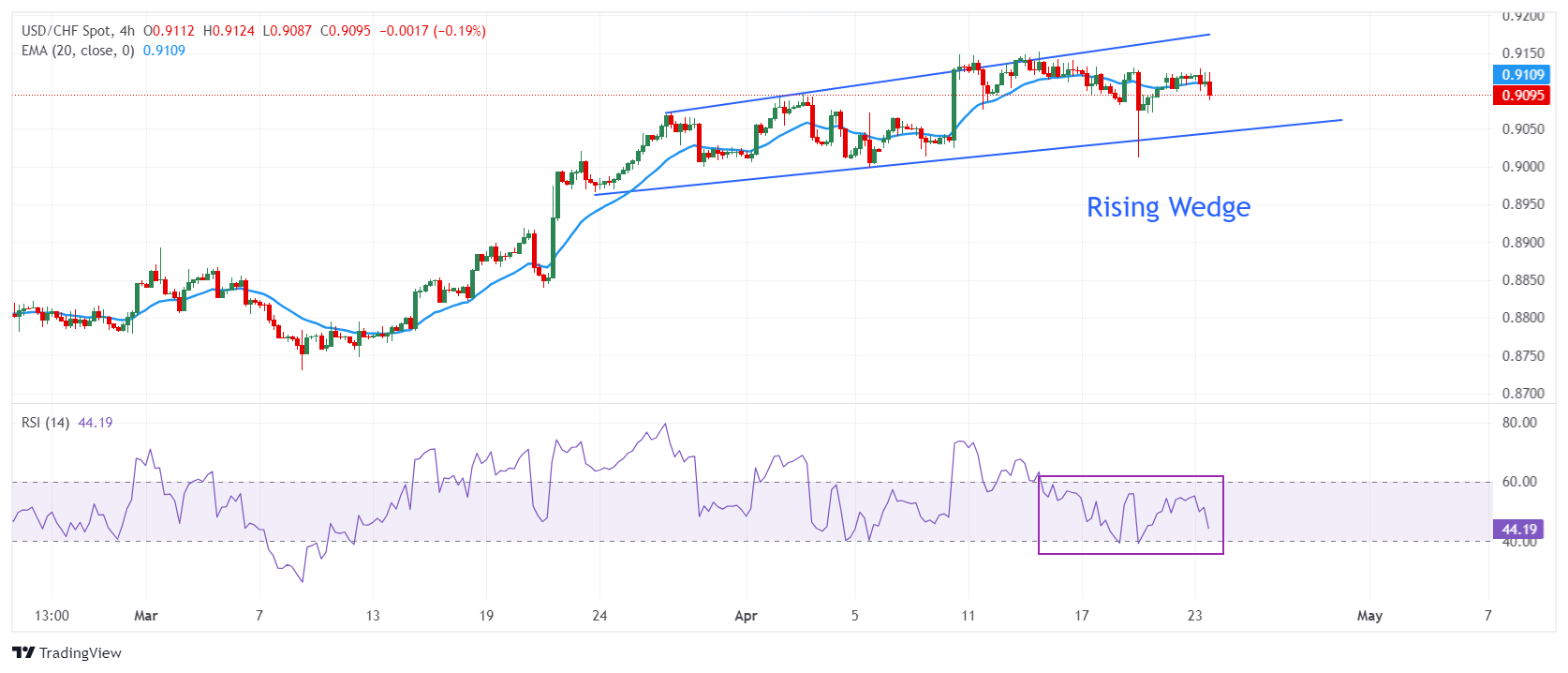
The formation of the USD/CHF pair on a four-hour timeframe appears to be a Rising Wedge chart pattern, which indicates a limited upside and is generally followed by a breakdown move. The 20-period Exponential Moving Average (EMA) at 0.9100 glued with the Swiss Franc asset, suggesting indecisiveness among market participants.

The 14-period Relative Strength Index (RSI) shifts to the 40.00-60.00 range, indicating a consolidation ahead.

Fresh downside would appear if the asset breaks below the psychological support of 0.9000, which will expose it to March 22 low at 0.8966, followed by March 1 high at 0.8893.

In an alternate scenario, an upside move above April high of 0.9150 will drive the asset towards the round-level support of 0.9200. A breach of the latter will push the asset further to 4 October 2023 high at 0.9232.

USD/CHF four-hour chart
USD/CHF

Overview
Today last price0.9094
Today Daily Change-0.0026
Today Daily Change %-0.29
Today daily open0.912
 
Trends
Daily SMA200.9073
Daily SMA500.8931
Daily SMA1000.8776
Daily SMA2000.8837
 
Levels
Previous Daily High0.9124
Previous Daily Low0.9098
Previous Weekly High0.9152
Previous Weekly Low0.9012
Previous Monthly High0.9072
Previous Monthly Low0.873
Daily Fibonacci 38.2%0.9114
Daily Fibonacci 61.8%0.9108
Daily Pivot Point S10.9104
Daily Pivot Point S20.9088
Daily Pivot Point S30.9077
Daily Pivot Point R10.913
Daily Pivot Point R20.914
Daily Pivot Point R30.9157

Author

Sagar Dua

Sagar Dua

FXStreet

Sagar Dua is associated with the financial markets from his college days. Along with pursuing post-graduation in Commerce in 2014, he started his markets training with chart analysis.


More from Sagar Dua
Share:

Editor's Picks

AUD/USD holds above 0.6900 ahead of Fed's Warsh

AUD/USD struggles to capitalize on the previous day's modest bounce from its lowest level since early July and trades above 0.6900 in the Asian session on Friday. Thursday's disappointing Australian jobs data tempered RBA rate-hike bets, capping the Aussie. The US Dollar (USD), meanwhile, is regaining positive traction as this week's hot US CPI and PPI reports keep Fed rate hike bets firmly on the table. This further limits the pair ahead of Fed Chair Kevin Warsh speech.

USD/JPY retakes 158.00, with eyes on Warsh's speech

USD/JPY retakes 158.00 in the Asian session on Friday, holding on the overnight bounce from the vicinity of 157.50, or a one-week low, amid the emergence of some US Dollar buying. This week's hot US CPI and PPI reports lifted Fed rate-hike bets, which, along with stable US bond yields and geopolitical uncertainties, help revive USD demand. Traders, however, remain on high alert amid speculation that authorities will step in to prop up the Japanese Yen, which could cap the currency pair ahead of Fed Chair Kevin Warsh's speech.

Gold eases to $4,150 as traders await Warsh's speech

Gold drifts lower to near $4,150 in the Asian session on Friday, reversing part of the previous day's move up amid reviving US Dollar demand. US inflation data released this week reaffirmed bets for at least one Fed rate hike this year, while US bond yields stabilize after Thursday's steep decline. This, along with geopolitical risks, underpins the safe-haven USD, which, in turn, is seen weighing on bullion ahead of Fed Chair Kevin Warsh's speech.

Ethereum reclaims $2,400 as PPI hits 6.3% and yields fall
Ethereum (ETH) is back above $2,400 on Thursday, rebounding from a brief decline toward $2,340, which was sparked by an upside surprise in the US wholesale inflation report. The Producer Price Index (PPI) increased 1.3% monthly and 6.3% annually in September, far above expectations of 0.5% and 5.3%, respectively.
US midterms put fiscal policy under the spotlight, treasury sell-off raises risk
The US will hold its midterm elections - a de facto referendum on the Trump administration - on 3rd November after two years shaped by rising trade protectionism, attacks on Federal Reserve independence and, since the spring, the Iran war. Republicans are expected to take a heavy electoral hit.
Everyone's dumping Gold after hot US inflation. Here's why $4,100 could be a floor, not a cliff
Gold (XAU/USD) is recovering from a sharp sell-off triggered by hotter-than-expected United States (US) inflation data released on Wednesday. The precious metal briefly plunged toward $4,073 as investors increased their bets on further Federal Reserve (Fed) interest rate hikes before recovering as US Treasury yields and the US Dollar (USD) reversed their initial gains.















