|

USD/CAD Price Analysis: Backs down to 50-day SMA after Triangle breakout

  • USD/CAD pulls back to support at the 50-day SMA.
  • It is possible it could begin a recovery from this level. 
  • At the same time a break lower could turn the tables on bulls. 

USD/CAD has continued pulling back after decisively breaking out of a Symmetrical Triangle (ST) pattern on the daily chart. The drip decline since the bullish upthrust on June 7 has taken price back down to the level of the 50-day Simple Moving Average (SMA) at 1.3696, and the upper trendline of the ST. 

USD/CAD Daily Chart
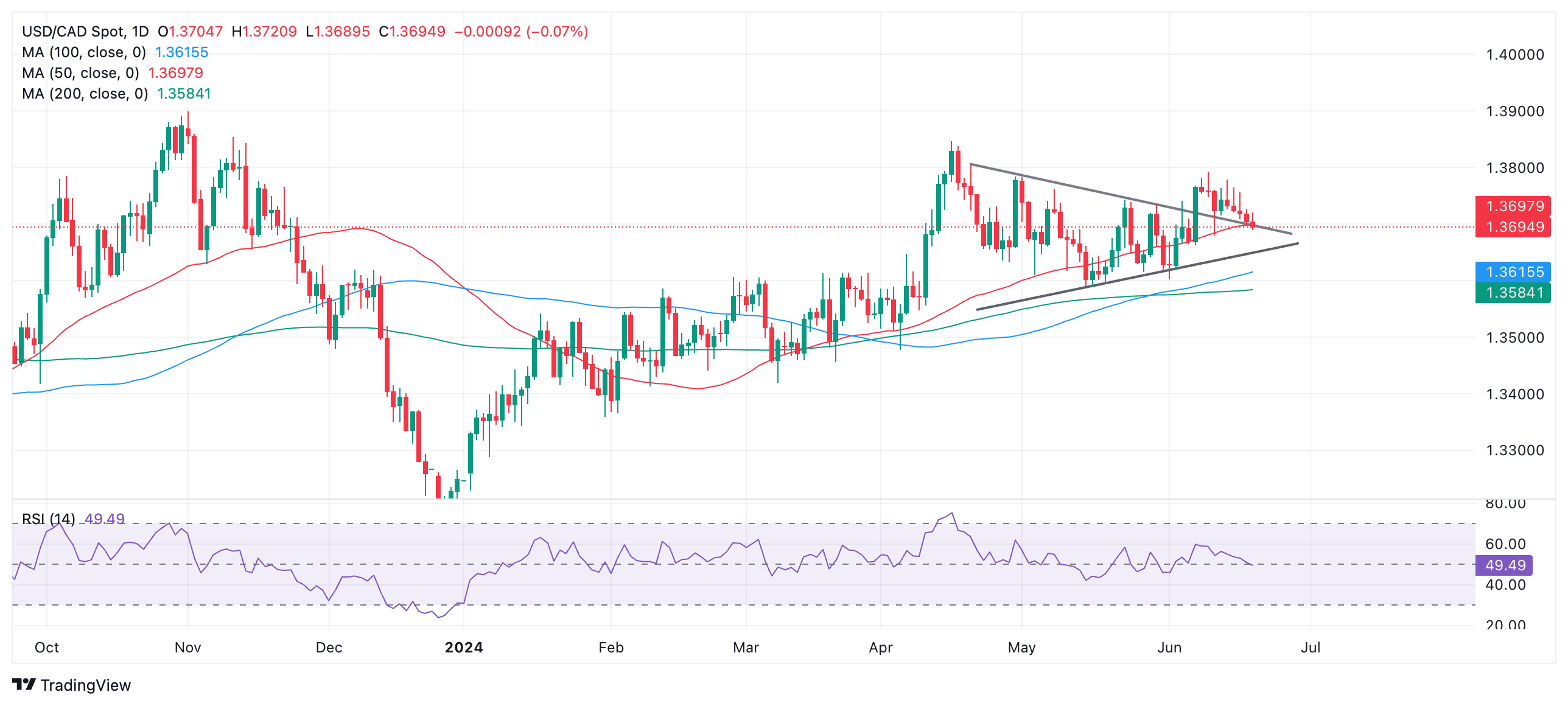
USD/CAD will probably find support at the 50-day SMA and upper borderline and, if so, it is possible this could mark the beginning of a recovery. 

The original breakout of the Symmetrical Triangle on June 7, activated some bullish upside targets for the pattern. The conservative target lies at roughly 1.3881, which is the 0.618 Fibonacci extrapolation of the height of the ST at its widest from the breakout point higher. 

A more bullish target lies at 1.3978, the 100% extrapolation of the height of the ST northwards. 

Although price action has been bearish since the June 7 breakout, with seven out of the last eight days closing lower, the odds continue to favor a resumption of the initial move higher. A break above 1.3791 (June 11 high) would provide bullish confirmation. 

However, a break below 1.3663 (June 7 low) would bring into doubt the uptrending bias. 

Furthemore, a break below the lower trendline of the ST at roughly 1.3640 would suggest a reversal lower, with such a move expected to reach a target at roughly 1.3518, the Fibonacci 0.618 ratio of the height of the Symmetrical Triangle pattern extrapolated lower.

Author

Joaquin Monfort

Joaquin Monfort is a financial writer and analyst with over 10 years experience writing about financial markets and alt data. He holds a degree in Anthropology from London University and a Diploma in Technical analysis.


More from Joaquin Monfort
Share:

Markets move fast. We move first.

Orange Juice Newsletter brings you expert driven insights - not headlines. Every day on your inbox.

By subscribing you agree to our Terms and conditions.

Editor's Picks

EUR/USD rebounds after falling toward 1.1700

EUR/USD gains traction and trades above 1.1730 in the American session, looking to end the week virtually unchanged. The bullish opening in Wall Street makes it difficult for the US Dollar to preserve its recovery momentum and helps the pair rebound heading into the weekend.

GBP/USD steadies below 1.3400 as traders assess BoE policy outlook

Following Thursday's volatile session, GBP/USD moves sideways below 1.3400 on Friday. Investors reassess the Bank of England's policy oıtlook after the MPC decided to cut the interest rate by 25 bps by a slim margin. Meanwhile, the improving risk mood helps the pair hold its ground.

Gold stays below $4,350, looks to post small weekly gains

Gold struggles to gather recovery momentum and stays below $4,350 in the second half of the day on Friday, as the benchmark 10-year US Treasury bond yield edges higher. Nevertheless, the precious metal remains on track to end the week with modest gains as markets gear up for the holiday season.

Crypto Today: Bitcoin, Ethereum, XRP rebound amid bearish market conditions

Bitcoin (BTC) is edging higher, trading above $88,000 at the time of writing on Monday. Altcoins, including Ethereum (ETH) and Ripple (XRP), are following in BTC’s footsteps, experiencing relief rebounds following a volatile week.

How much can one month of soft inflation change the Fed’s mind?

One month of softer inflation data is rarely enough to shift Federal Reserve policy on its own, but in a market highly sensitive to every data point, even a single reading can reshape expectations. November’s inflation report offered a welcome sign of cooling price pressures. 

XRP rebounds amid ETF inflows and declining retail demand demand

XRP rebounds as bulls target a short-term breakout above $2.00 on Friday. XRP ETFs record the highest inflow since December 8, signaling growing institutional appetite.