US Dollar flat after Richmond Fed confirms Manufacturing to remain in contraction for December
- The US Dollar trades sideways and remains unphased by headlines out of China about ramping up bond sales next year.
- Chinese policymakers plan to sell a record 3 trillion yuan of special treasury bonds in 2025, the highest on record.
- The US Dollar Index (DXY) resides above 108.00, very close to eke out a fresh two-year high.

The US Dollar (USD) trades with small gains on Tuesday, seeing the DXY Index trade slightly above 108.00, as markets are starting to unwind towards the Christmas holiday. The Greenback failed to significantly move despite news that China’s policymakers are floating the idea of selling nearly 3 trillion Yuan (CNH) in special treasury bonds in 2025, Reuters reported on Tuesday. The additional capital should boost the slowing and sluggish Chinese economy.
The US economic calendar is a very light one on Tuesday, with just minor indicators such as the Philadelphia Fed Non-Manufacturing Activity Index and the Richmond Fed Manufacturing Index regional surveys for December. One main takeaway for the last few data points of December is that the US manufacturing sector is sounding the alarm bell, with several indicators confirming the sector is falling further into contraction.
Daily digest market movers: Richmond Manufacturing confirms contraction
- Policymakers in China plan to sell a record 3 trillion Yuan ($411 billion) of special treasury bonds in 2025, Reuters reported Tuesday. The government seeks to support consumption subsidies, business equipment upgrades as well as investments in key technology and advanced manufacturing sectors, according to Reuters.
- French Prime Minister Francois Bayrou aims to reach an agreement with parliament on a 2025 budget that would reduce the deficit to close to 5%, near the level of his predecessor Michel Barnier, Bloomberg reports.
- Near 13:30 GMT, the Philadelphia Fed Non-Manufacturing Activity Index for December was published. The actual number came in at -6 agains the previous reading at -5.9.
- The Richmond Fed Manufacturing Index comes in at -10, below the -9 expected and coming from -14.
- Asian equities are fired up after the 3 trillion Yuan expected injection from China. Europe is rather struggling to benefit from that tailwind and remains looking sluggish. US futures are in the green.
- The CME FedWatch Tool for the first Fed meeting of 2025 on January 29 sees a 91.4% chance for a stable policy rate against a small 8.6% chance for a 25 basis points rate cut.
- The US 10-year benchmark rate trades at 4.59%, the high of last week.
US Dollar Index Technical Analysis: End of the line
The US Dollar Index (DXY) is trading in a rather narrow range this Tuesday. More and more traders will not participate in markets today, which will mean nearly no reaction in prices unless a big headline comes up. It thus looks like the DXY is set to close off Christmas eve very close to a two-year high.
On the upside, a trend line originating from December 28, 2023, is acting as a moving cap. The next firm resistance comes in at 109.29, which was the peak of July 14, 2022, and has a good track record as a pivotal level. Once that level is surpassed, the 110.00 round level comes into play.
The first downside barrier comes in at 107.35, which has now turned from resistance into support. The second level that might be able to halt any selling pressure is 106.52. From there, even 105.53 could come under consideration while the 55-day Simple Moving Average (SMA) at 105.23 is making its way up to that level.
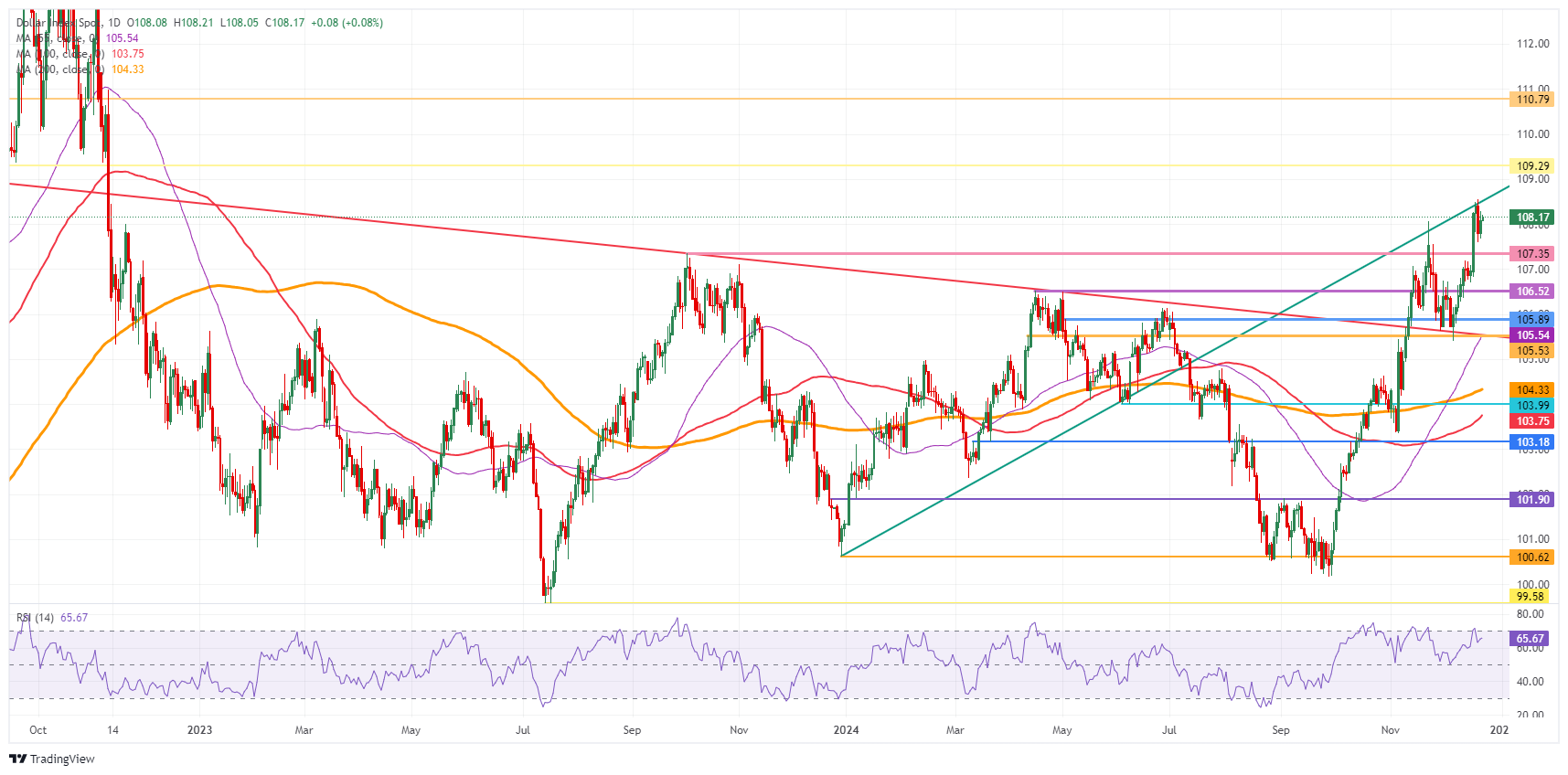
US Dollar Index: Daily Chart
Fed FAQs
Monetary policy in the US is shaped by the Federal Reserve (Fed). The Fed has two mandates: to achieve price stability and foster full employment. Its primary tool to achieve these goals is by adjusting interest rates. When prices are rising too quickly and inflation is above the Fed’s 2% target, it raises interest rates, increasing borrowing costs throughout the economy. This results in a stronger US Dollar (USD) as it makes the US a more attractive place for international investors to park their money. When inflation falls below 2% or the Unemployment Rate is too high, the Fed may lower interest rates to encourage borrowing, which weighs on the Greenback.
The Federal Reserve (Fed) holds eight policy meetings a year, where the Federal Open Market Committee (FOMC) assesses economic conditions and makes monetary policy decisions. The FOMC is attended by twelve Fed officials – the seven members of the Board of Governors, the president of the Federal Reserve Bank of New York, and four of the remaining eleven regional Reserve Bank presidents, who serve one-year terms on a rotating basis.
In extreme situations, the Federal Reserve may resort to a policy named Quantitative Easing (QE). QE is the process by which the Fed substantially increases the flow of credit in a stuck financial system. It is a non-standard policy measure used during crises or when inflation is extremely low. It was the Fed’s weapon of choice during the Great Financial Crisis in 2008. It involves the Fed printing more Dollars and using them to buy high grade bonds from financial institutions. QE usually weakens the US Dollar.
Quantitative tightening (QT) is the reverse process of QE, whereby the Federal Reserve stops buying bonds from financial institutions and does not reinvest the principal from the bonds it holds maturing, to purchase new bonds. It is usually positive for the value of the US Dollar.
Author

Filip Lagaart
FXStreet
Filip Lagaart is a former sales/trader with over 15 years of financial markets expertise under its belt.