US Dollar sees equity undergo meltdown with tension between Russia and Ukraine hit fresh highs
- The US Dollar flat at the start of the US session on Tuesday, with escalation between Russia and Ukraine reaching new highs.
- President Vladimir Putin earlier this Tuesday signed a nuclear weapons decree against Ukraine, just hours before Ukraine sent its first missiles into Russia.
- The US Dollar index trades in the mid-106 area backed by some safe haven flow.

The US Dollar (USD) is flying all over the place after Russian President Vladimir Putin has signed a decree that allows the use of nuclear weapons against a non-nuclear state if it is supported by nuclear powers earlier this Tuesday. The move is widely seen as a clear threat to Ukraine after the United States gave Kyiv permission to use long-range missiles to attack military targets inside Russia. Meanwhile Ukraine has already fired its first missiles into Russia, with confirmation from both local sources and the Russian Minister Defence Minister, according to Bloomberg.
As tensions escalate, US equities are turning red and safe havens such as the USD, the Swiss Frank (CHF) and the Japanese Yen (JPY) are seeing substantial inflows. The move is a knee-jerk reaction to the risk-on close that markets saw on Monday.
The US economic calendar is all about US Housing data on Tuesday, with the Building Permits and the Housing Starts data. Seeing the recent trend, expectations are that the numbers will point to a broad stabilization in the housing market.
Daily digest market movers: Equities drop on escalation risk
- Headlines around Russia are delivering a knee-jerk reaction in markets. Russian President Vladimir Putin has signed a decree that allows the full deployment of nuclear weapons against any non-nuclear nation that strikes positions on Russian soil, Bloomberg reportsl. This basically means that once Ukraine deploys long-distance missiles from the US or the UK, Russia will be able to retaliate with the use of nuclear weapons.
- Meanwhile Ukraine has launched its first ATACMS strike inside Russia, Bloomberg reports - citing local sources. This all is taking place on the 1000th day since Russia breached Ukrainian borders.
- At 13:30 GMT, US Housing data for October has been released:
- Building Permits came in at 1,311 million units, which is lower than the previous 1.425 million.
- Housing Starts fell as well to 1.311 million against the previous 1.353 million.
- Federal Reserve Bank of Kansas City President Jeffrey Schmid delivers a speech about the US economic and monetary policy outlook at an event organized by The Greater Omaha Chamber in La Vista, Nebraska around 18:10 GMT.
- Equities are nosediving with US equities flirting with a negative 1% performance while European equities are set to close off by near -2%.
- The CME FedWatch Tool is pricing in another 25 basis points (bps) rate cut by the Fed at the December 18 meeting by 58.4%. A 41.6% chance is for rates to remain unchanged. While the rate-cut scenario is the most probable, traders have significantly pared back some of the rate-cut bets compared with a week ago.
- The US 10-year benchmark rate trades at 4.37%, sliding further away from the high printed on Friday at 4.50%
US Dollar Index Technical Analysis: It gets cloudy up ahead
The US Dollar Index (DXY) shakes up markets with geopolitical headlines taking control of markets. While the G20 group is meeting in Brazil, Russian President Putin signs an expanding decree for the use of nuclear weapons in Ukraine. It looks like markets are starting to doubt if this is still part of the normal “flexing the muscles” or this could turn into an actual threat.
After a brief test and a firm rejection last Thursday, the 107.00 round level remains in play. A fresh yearly high has already been reached at 107.07, which is the static level to beat. Further up, a fresh two-year high could be reached if 107.35 gets taken out.
On the downside, a fresh set of support is coming live. The first level is 105.93, the closing from November 12. A touch lower, the pivotal 105.53 (April 11 high) should avoid any downturns towards 104.00.
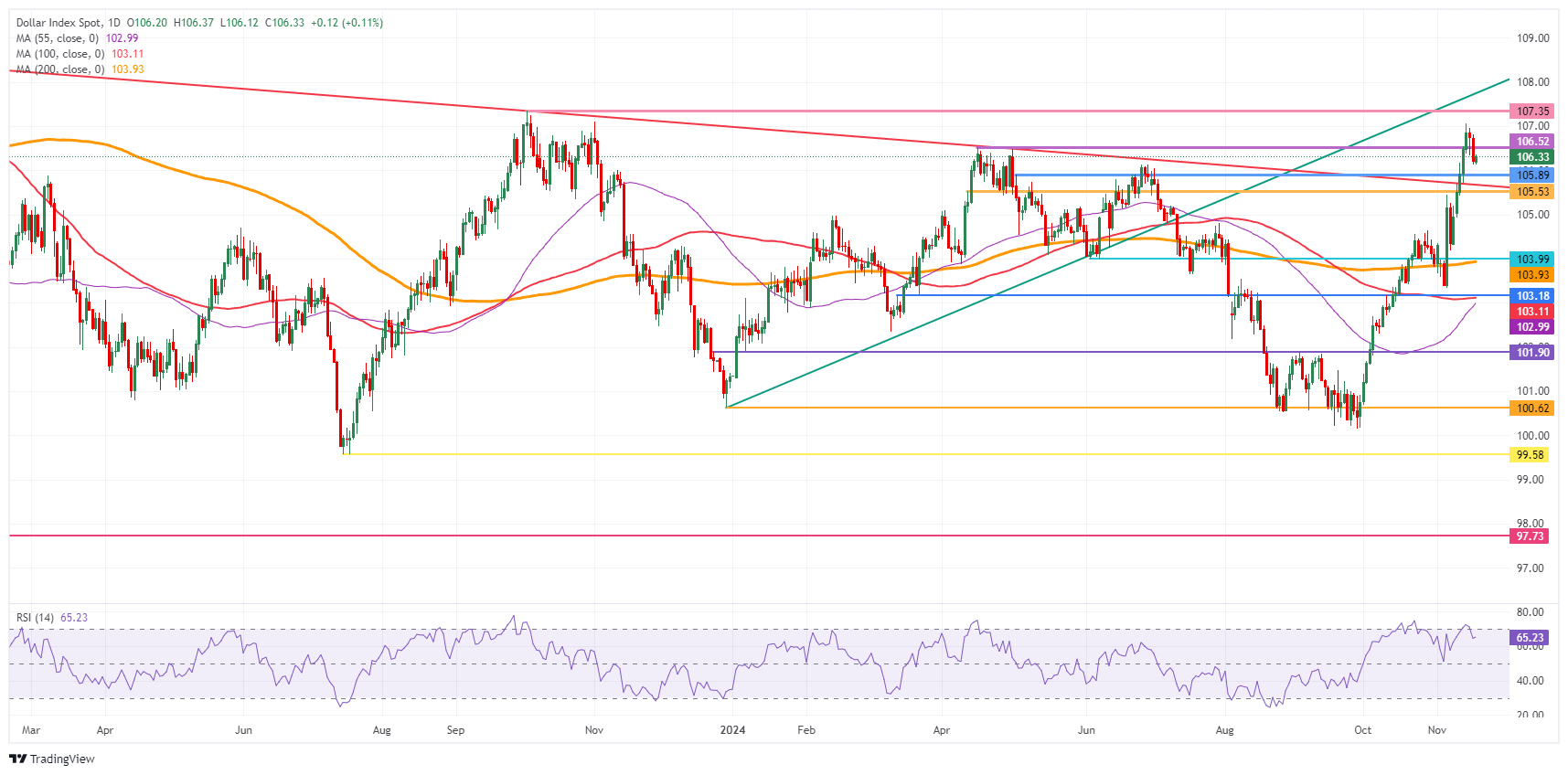
US Dollar Index: Daily Chart
Central banks FAQs
Central Banks have a key mandate which is making sure that there is price stability in a country or region. Economies are constantly facing inflation or deflation when prices for certain goods and services are fluctuating. Constant rising prices for the same goods means inflation, constant lowered prices for the same goods means deflation. It is the task of the central bank to keep the demand in line by tweaking its policy rate. For the biggest central banks like the US Federal Reserve (Fed), the European Central Bank (ECB) or the Bank of England (BoE), the mandate is to keep inflation close to 2%.
A central bank has one important tool at its disposal to get inflation higher or lower, and that is by tweaking its benchmark policy rate, commonly known as interest rate. On pre-communicated moments, the central bank will issue a statement with its policy rate and provide additional reasoning on why it is either remaining or changing (cutting or hiking) it. Local banks will adjust their savings and lending rates accordingly, which in turn will make it either harder or easier for people to earn on their savings or for companies to take out loans and make investments in their businesses. When the central bank hikes interest rates substantially, this is called monetary tightening. When it is cutting its benchmark rate, it is called monetary easing.
A central bank is often politically independent. Members of the central bank policy board are passing through a series of panels and hearings before being appointed to a policy board seat. Each member in that board often has a certain conviction on how the central bank should control inflation and the subsequent monetary policy. Members that want a very loose monetary policy, with low rates and cheap lending, to boost the economy substantially while being content to see inflation slightly above 2%, are called ‘doves’. Members that rather want to see higher rates to reward savings and want to keep a lit on inflation at all time are called ‘hawks’ and will not rest until inflation is at or just below 2%.
Normally, there is a chairman or president who leads each meeting, needs to create a consensus between the hawks or doves and has his or her final say when it would come down to a vote split to avoid a 50-50 tie on whether the current policy should be adjusted. The chairman will deliver speeches which often can be followed live, where the current monetary stance and outlook is being communicated. A central bank will try to push forward its monetary policy without triggering violent swings in rates, equities, or its currency. All members of the central bank will channel their stance toward the markets in advance of a policy meeting event. A few days before a policy meeting takes place until the new policy has been communicated, members are forbidden to talk publicly. This is called the blackout period.
Author

Filip Lagaart
FXStreet
Filip Lagaart is a former sales/trader with over 15 years of financial markets expertise under its belt.