US Dollar sets forth recovery for second day in very light US calendar
- The US Dollar recovers for a second day in a row this week.
- The BoJ dropped mixed messages on its monetary policy.
- The US Dollar index pops above 103.00 and rallies higher on Wednesday.

The US Dollar (USD) recovers as all asset classes start to head back to more normal levels. Equities are behaving quite well and are stable, volatility is easing, and safe havens such as Japanese Yen (JPY) and Swiss Franc (CHF) are easing further against the Greenback. The Japanese Yen, sinking over 1.5% against the US Dollar, is the biggest contributor to the recovery of the US Dollar Index (DXY).
On the economic front, there is a very light day ahead, which should be beneficial for markets to continue the recovery path. In the interest rate space, the 10-year Note auction from the US treasury might draw the most attention, seeing it is a substantial benchmark rate. Late on Wednesday, the United States (US) Consumer Credit Change data for June will be released.
Daily digest market movers: Empty shell
- Traders must have raised their eyebrows in Asian hours when comments from Bank of Japan (BoJ) member Shinichi Uchida said that the BoJ would not raise rates if markets were unstable. This pushed the Yen down by 1% against the US Dollar in an initial reaction.
- At 11:00 GMT, the Mortgage Bankers Association has released its weekly Mortgage Application Index. The previous number was at -3.9%, with this week's number coming in positive at 6.9%
- Dr Olli Rehn, Governor of the Bank of Finland and member of the Governing Council of the European Central Bank, said that the ECB can continue its cutting cycle if and only when inflation is further slowing down.
- At 17:00 GMT, the US Treasury will allocate a 10-year Note in the market. Previous interest was 4.276%, while the US 10-year note currently trades around 3.90%, a substantial discount.
- US Consumer Credit Change data for June is set to be released at 19:00 GMT, with expectations for a drop to $10 billion from $11.35 billion a month earlier.
- Equity markets are on a winning streak, with both the Japanese Nikkei and Topix indexes in the green. European and US equities are all up over 1% on the day ahead of the US Opening Bell.
- The CME Fedwatch Tool shows a 63.5% chance of a 50 basis points (bps) interest rate cut by the Federal Reserve (Fed) in September. Another 25 bps cut is expected in November by 55.5%, while a 17.5% chance for a 50 bps cut and 27.0% for no cut are being pencilled in for that meeting.
- The US 10-year benchmark rate trades at 3.93%, shooting higher for this week, as investors flee away from bonds and back into equities.
US Dollar Index Technical Analysis: Rate differential drives Dollar
The US Dollar Index (DXY) is continuing its recovery with some help from the Japanese Yen. TWhen looking at that specific currency cross (USD/JPY), it paints a clearly shows picture that the Yen has gained too much too quickly against the US Dollar. A full recline is not projected, though certainly more recovery could occur take place this week for the US Dollar, which would spill over into the DXY trading higher by Friday.
The three-tiered recovery is already in play, with the first resistance up at 103.18, a level held on Friday though snapped on Monday in the Asian hours, being tested on Wednesday. Once the DXY closes above that level, next up is 104.00, which was the support from June. If the DXY can make its way back above that level, the 200-day Simple Moving Average (SMA) at 104.22 is the next resistance level to look out for.
On the downside, the oversold Relative Strength Index (RSI) indicator in the daily chart should prevent the DXY from making more hefty losses. Support nearby is the March 8 low at 102.35. Once through there, pressure will start to build on 102.00 as a big psychological figure before testing 101.90, which was a pivotal level in December 2023 and January 2024.
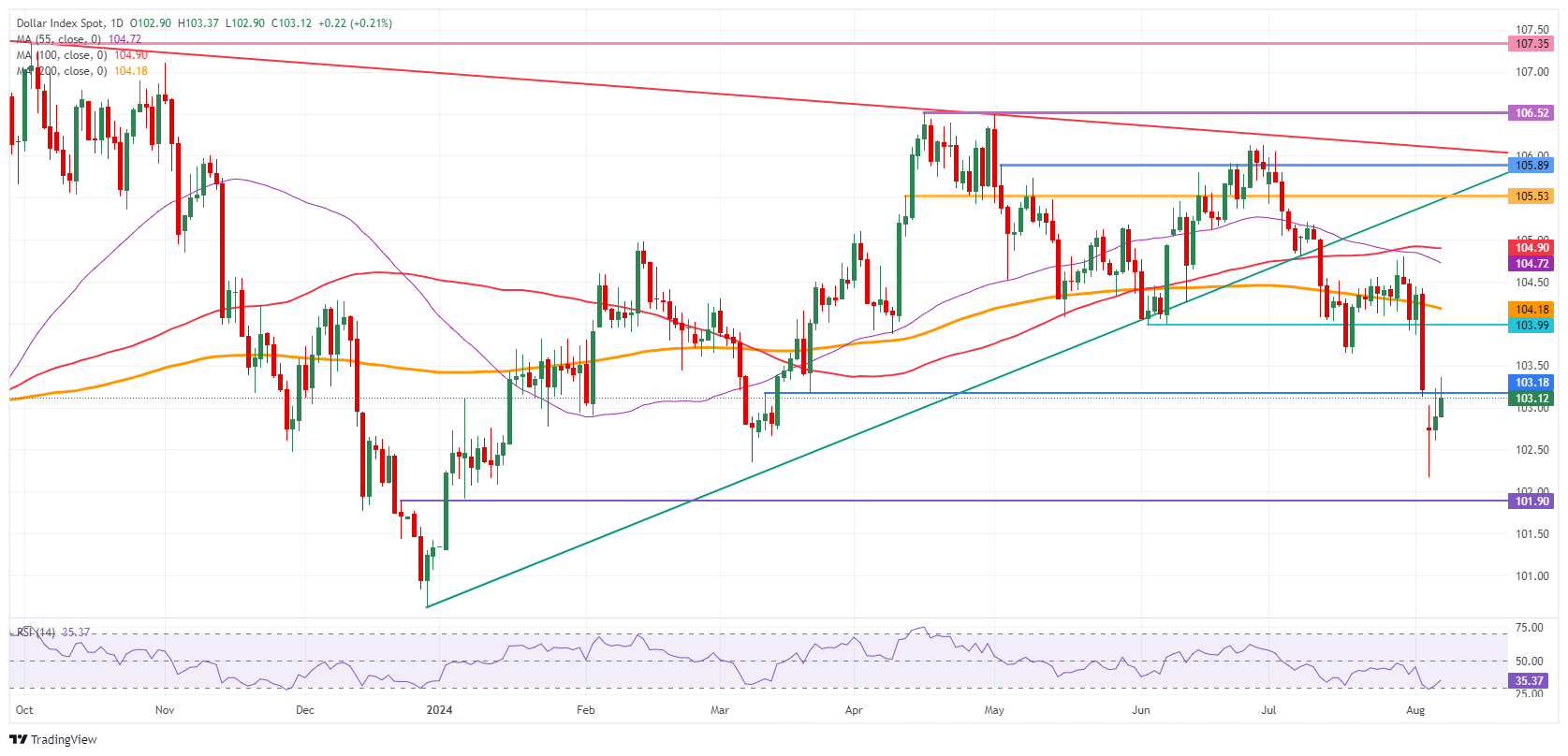
US Dollar Index: Daily Chart
Interest rates FAQs
Interest rates are charged by financial institutions on loans to borrowers and are paid as interest to savers and depositors. They are influenced by base lending rates, which are set by central banks in response to changes in the economy. Central banks normally have a mandate to ensure price stability, which in most cases means targeting a core inflation rate of around 2%. If inflation falls below target the central bank may cut base lending rates, with a view to stimulating lending and boosting the economy. If inflation rises substantially above 2% it normally results in the central bank raising base lending rates in an attempt to lower inflation.
Higher interest rates generally help strengthen a country’s currency as they make it a more attractive place for global investors to park their money.
Higher interest rates overall weigh on the price of Gold because they increase the opportunity cost of holding Gold instead of investing in an interest-bearing asset or placing cash in the bank. If interest rates are high that usually pushes up the price of the US Dollar (USD), and since Gold is priced in Dollars, this has the effect of lowering the price of Gold.
The Fed funds rate is the overnight rate at which US banks lend to each other. It is the oft-quoted headline rate set by the Federal Reserve at its FOMC meetings. It is set as a range, for example 4.75%-5.00%, though the upper limit (in that case 5.00%) is the quoted figure. Market expectations for future Fed funds rate are tracked by the CME FedWatch tool, which shapes how many financial markets behave in anticipation of future Federal Reserve monetary policy decisions.
Author

Filip Lagaart
FXStreet
Filip Lagaart is a former sales/trader with over 15 years of financial markets expertise under its belt.















