US Dollar goes in search of sixth consecutive days of wins in volatile trading Friday
- The Greenback overturns intraday losses and is set to flip in the green.
- Fed Chairman Jerome Powell surprised markets by casting doubts over December’s interest-rate cut.
- The US Dollar index surges back to the fresh one-year high from Thursday.

The US Dollar (USD) sees earlier declines soften a bit on Friday with US Retail Sales seeing strong upward revisions ahead of the important US shopping season with Thanksgiving, Black Friday and Christmas as main events for consumers and the Retail sector. The impact of the number is not to be underestimated with the US Dollar Index (DXY) erasing over 0.50% intraday losses and is set to turn green for this Friday's trading session. Meanwhile geopolitical talks sweep markets with German Chancellor Olaf Schultz having discussed the war in Ukraine with President Vladimir Putin during their first contact in over two years time.
The USD retreats even as traders are quickly paring back bets of another interest-rate cut by the US Federal Reserve (Fed) in December. The last blow came from Fed Chairman Jerome Powell, who in a speech on Thursday cast a shadow over the December rate cut odds by pointing out that the economy is doing great and the job market is looking healthy. Equities across the globe are not digesting this message too well, as this kills off the chances for a year-end Goldilocks scenario.
Daily digest market movers: US Retail and Ukraine
- Fed Chairman Jerome Powell’s speech on Thursday came as a surprise to markets. While the Fed is said to remain data-dependent, several traders and strategists are pointing out that the Fed might already be pricing in a Trump trade effect.
- Bloomberg reports that German chancellor Olaf Schultz and Russian President Vladimir Putin will hold a phone call later this Friday.
- Boston Fed President Susan Collins told the Wall Street Journal in an interview that a December rate cut is not a done deal, while she does not see signs of price pressures.
- At 13:30 GMT, US Retail Sales for October were due. Headline Sales grew by 0.4%, beating the 0.3% forecast. The positive surprise came with the revision to 0.8%, from 0.4% previously.
- Also at 13:30 GMT, the New York Empire State Manufacturing for November came in as a cherry on the cake with the number breaking out of contraction, surging to 31.2. That is a big beat of expectations agains tthe -0.7 expectation and the previous -11.9.
- Industrial Production for October fell by 0.3%, in line with expectations. The September number got revised down to -0.5%, from -0.3% earlier.
- Federal Reserve Bank of Boston President Susan Collins delivers welcome remarks at the 68th Economic Conference organized by the Boston Fed at 14:00 GMT.
- Federal Reserve Bank of New York President John Williams delivers opening remarks at the New York Fed Alumni event in New York near 18:15 GMT.
- Equities in Asia have closed off this Friday quite mixed. Japanese equities closed off on Friday on the front foot, while Chinese indices were on the back foot at the closing bell. US futures are sinking, with the Nasdaq flirting with a 1% loss early on the day.
- The CME FedWatch Tool is pricing in another 25 basis points (bps) rate cut by the Fed at the December 18 meeting by 58.7%. A 41.3% chance is for rates to remain unchanged. While the rate-cut scenario is the most probable, traders have significantly pared back some of the rate-cut bets compared with a week ago.
- The US 10-year benchmark rate reaches 4.50% and prints a fresh 6-month high.
US Dollar Index Technical Analysis: Did not take that long
The US Dollar Index (DXY) is undergoing a small fade this Friday, though warnings must be issued as comments from Powell are US Dollar positive. The Fed signals it will probably pause its cutting cycle, while for example the European Central Bank (ECB) will likely continue with still a string of rate cuts. This would widen the interest rate gap between the two nations, and will support the US Dollar as a high-yielding currency against other currencies.
From now on, the 107.00 round level remains in play going forward after the sharp rejection from Thursday. A fresh yearly high has already been printed at 107.07. A two-year high could be reached if 107.35 gets taken out.
On the downside, a fresh set of support is coming live. The first support is 105.93, the closing level on Tuesday. A touch lower, the pivotal 105.53 (April 11 high) should avoid any downturns towards 104.00.
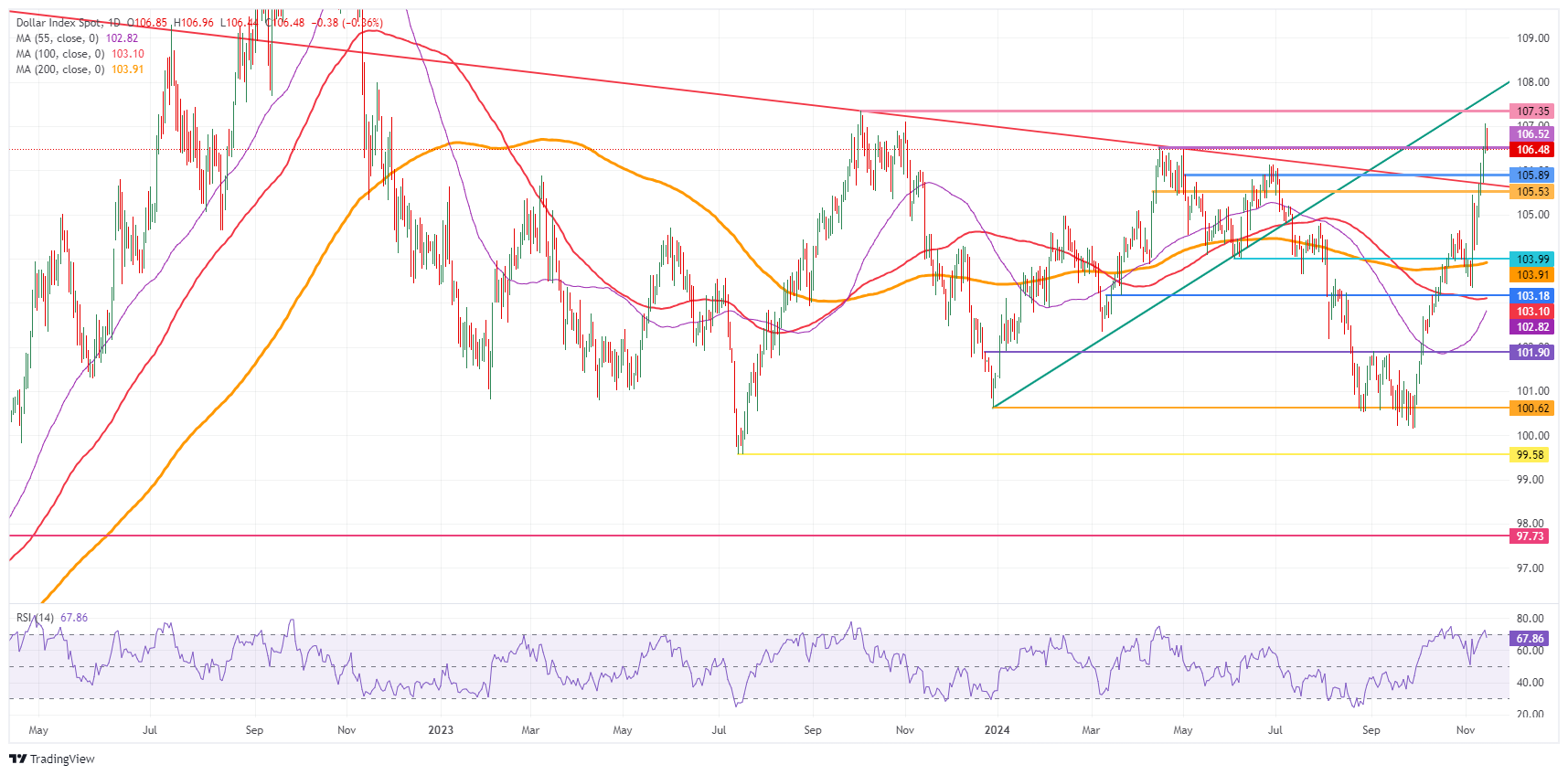
US Dollar Index: Daily Chart
Central banks FAQs
Central Banks have a key mandate which is making sure that there is price stability in a country or region. Economies are constantly facing inflation or deflation when prices for certain goods and services are fluctuating. Constant rising prices for the same goods means inflation, constant lowered prices for the same goods means deflation. It is the task of the central bank to keep the demand in line by tweaking its policy rate. For the biggest central banks like the US Federal Reserve (Fed), the European Central Bank (ECB) or the Bank of England (BoE), the mandate is to keep inflation close to 2%.
A central bank has one important tool at its disposal to get inflation higher or lower, and that is by tweaking its benchmark policy rate, commonly known as interest rate. On pre-communicated moments, the central bank will issue a statement with its policy rate and provide additional reasoning on why it is either remaining or changing (cutting or hiking) it. Local banks will adjust their savings and lending rates accordingly, which in turn will make it either harder or easier for people to earn on their savings or for companies to take out loans and make investments in their businesses. When the central bank hikes interest rates substantially, this is called monetary tightening. When it is cutting its benchmark rate, it is called monetary easing.
A central bank is often politically independent. Members of the central bank policy board are passing through a series of panels and hearings before being appointed to a policy board seat. Each member in that board often has a certain conviction on how the central bank should control inflation and the subsequent monetary policy. Members that want a very loose monetary policy, with low rates and cheap lending, to boost the economy substantially while being content to see inflation slightly above 2%, are called ‘doves’. Members that rather want to see higher rates to reward savings and want to keep a lit on inflation at all time are called ‘hawks’ and will not rest until inflation is at or just below 2%.
Normally, there is a chairman or president who leads each meeting, needs to create a consensus between the hawks or doves and has his or her final say when it would come down to a vote split to avoid a 50-50 tie on whether the current policy should be adjusted. The chairman will deliver speeches which often can be followed live, where the current monetary stance and outlook is being communicated. A central bank will try to push forward its monetary policy without triggering violent swings in rates, equities, or its currency. All members of the central bank will channel their stance toward the markets in advance of a policy meeting event. A few days before a policy meeting takes place until the new policy has been communicated, members are forbidden to talk publicly. This is called the blackout period.
Author

Filip Lagaart
FXStreet
Filip Lagaart is a former sales/trader with over 15 years of financial markets expertise under its belt.















