US Dollar turns red with the US session underway on Tuesday, bracing for JOLTS
- The US Dollar turns red again after briefly turning flat this Tuesdsay
- A new French government formation could take place as off Wednesday, seen as positive for the Euro.
- The US Dollar Index turns dips back to 106.00 with traders getting nervous ahead of JOLTS.

The US Dollar (USD) fails to bounce and hits session's low on Tuesday just ahead of the US trading session opening bell, with the US Dollar Index (DXY) trading in the lower end of 106.00 on Tuesday, as traders take profits after the steep surge seen at the beginning of the week. The move comes even as investors remain on edge about the political situation in France, with a motion of no confidence to be debated and voted on Wednesday.
If successful, it is unclear what will happen next as parliamentary elections cannot be held until next June. An option is that Macron appoints a new prime minister who could bring more stability. Still, this looks like a daunting task given the fragmentation of the current parliament.
The US economic calendar, meanwhile, is getting ready for the first key data point preceding the Nonfarm Payrolls release on Friday: the JOLTS Job Openings report for October. Markets will hear from Federal Reserve (Fed) officials as well, with three Fed speakers set to release comments after Federal Reserve Governor Christopher Waller said he is open to an interest-rate cut in December.
Daily digest market movers: Whipsaw moves
- The US JOLTS Jobs Openings report for October is due at 15:00 GMT. Expectations are for an uptick to 7.48 million job openings against the previous 7.443 million.
- At 17:15 GMT, Federal Reserve Bank of San Francisco President Mary Daly is interviewed at Fox Business.
- Federal Reserve Governor Adriana Kugler delivers a speech about the labor market and monetary policy at an event organized by the Detroit Economic Club in Detroit near 17:35 GMT.
- Closing off near 20:45 GMT, Federal Reserve Bank of Chicago President Austan Goolsbee delivers closing remarks at the Wildwest Agriculture Conference organized by the Chicago Fed.
- Equities are surging across the board. Both Asia and Europe are seeing their indices tick up firmly, some of them over 1%. The German Dax even reached an all-time high of 20,000 points. US equity futures are lagging behind, still looking for direction.
- The CME FedWatch Tool is pricing in another 25 basis points (bps) rate cut by the Fed at the December 18 meeting by 72.5%. A 27.5% chance is for rates to remain unchanged. The Fed Minutes and Waller’s recent comments have helped the rate cut odds for December to move higher.
- The US 10-year benchmark rate trades at 4.21%, rather steady for a second day in a row.
US Dollar Index Technical Analysis: Knee jerk reaction could take place
The US Dollar Index (DXY) could be in for more downside despite the increasing risk of the French government falling. An important rule of thumb in financial markets is that, when a country is facing new leadership, it is often seen as a positive in the runup towards the announcement of the new government. The reason for this is that a fresh coalition could mean more growth and a chance for relaunching plans for the economy, a scenario that would be supportive for the currency.
A stronger Euro would weigh on the DXY because the European currency is the biggest contributor to the index’s basket. Several consecutive days of Euro strength would mean more selling pressure in the DXY.
On the upside, 106.52 (April 16 high) remains as the first resistance to look at after failing to close above it on Monday and another failed attempt on early Tuesday. Should the Dollar bulls reclaim that level, 107.00 (round level) and 107.35 (October 3, 2023, high) are back on target for a retest.
Should the French government fall and a new, more stable, government formation is set to take place, the pivotal level at 105.53 (April 11 high) comes into play before heading into the 104-region. Should the DXY fall all the way towards 104.00, the big figure and the 200-day Simple Moving Average at 104.03 should catch any falling knife formation.
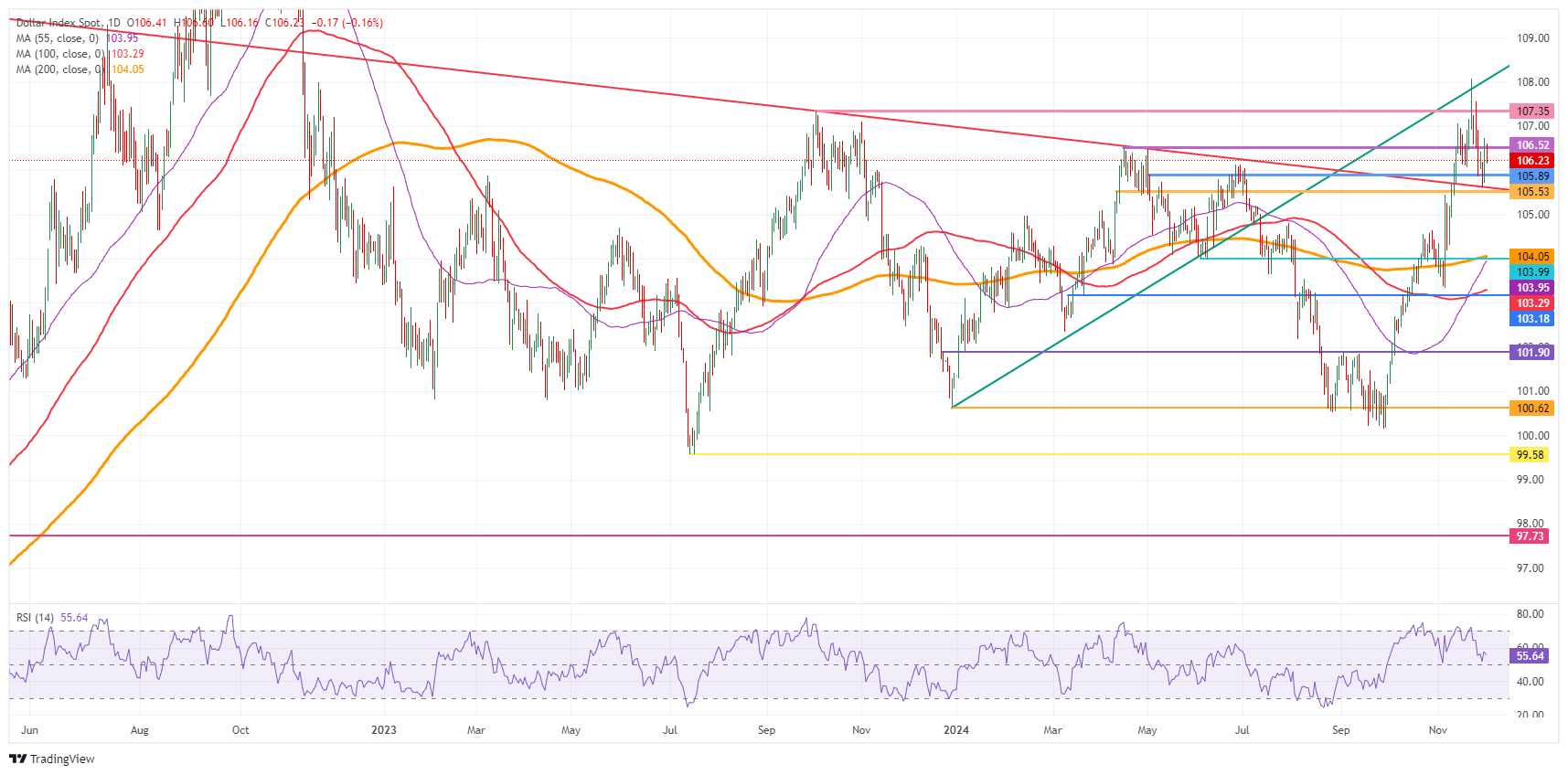
US Dollar Index: Daily Chart
Nonfarm Payrolls FAQs
Nonfarm Payrolls (NFP) are part of the US Bureau of Labor Statistics monthly jobs report. The Nonfarm Payrolls component specifically measures the change in the number of people employed in the US during the previous month, excluding the farming industry.
The Nonfarm Payrolls figure can influence the decisions of the Federal Reserve by providing a measure of how successfully the Fed is meeting its mandate of fostering full employment and 2% inflation. A relatively high NFP figure means more people are in employment, earning more money and therefore probably spending more. A relatively low Nonfarm Payrolls’ result, on the either hand, could mean people are struggling to find work. The Fed will typically raise interest rates to combat high inflation triggered by low unemployment, and lower them to stimulate a stagnant labor market.
Nonfarm Payrolls generally have a positive correlation with the US Dollar. This means when payrolls’ figures come out higher-than-expected the USD tends to rally and vice versa when they are lower. NFPs influence the US Dollar by virtue of their impact on inflation, monetary policy expectations and interest rates. A higher NFP usually means the Federal Reserve will be more tight in its monetary policy, supporting the USD.
Nonfarm Payrolls are generally negatively-correlated with the price of Gold. This means a higher-than-expected payrolls’ figure will have a depressing effect on the Gold price and vice versa. Higher NFP generally has a positive effect on the value of the USD, and like most major commodities Gold is priced in US Dollars. If the USD gains in value, therefore, it requires less Dollars to buy an ounce of Gold. Also, higher interest rates (typically helped higher NFPs) also lessen the attractiveness of Gold as an investment compared to staying in cash, where the money will at least earn interest.
Nonfarm Payrolls is only one component within a bigger jobs report and it can be overshadowed by the other components. At times, when NFP come out higher-than-forecast, but the Average Weekly Earnings is lower than expected, the market has ignored the potentially inflationary effect of the headline result and interpreted the fall in earnings as deflationary. The Participation Rate and the Average Weekly Hours components can also influence the market reaction, but only in seldom events like the “Great Resignation” or the Global Financial Crisis.
Author

Filip Lagaart
FXStreet
Filip Lagaart is a former sales/trader with over 15 years of financial markets expertise under its belt.