US Dollar pops with Fed's Logan reassuring markets on rate cuts to come
- The US Dollar is having positive returns against nearly every G10 currency on Wednesday.
- Fed's Logan is commenting that gradual rate cuts are possible in uncertain timing.
- The US Dollar Index trades above 102.50 and looks to be on its way to 103.00.

The US Dollar (USD) is recovering and is advancing higher against nearly all major G10 currencies. The Greenback is jumping higher after comments from the Federal Reserve of Dallas President Lorie Logan who said the Fed can continue to cut gradually, even in economic uncertainty. That was enough for traders to reward the Greenback with some buying activity that pushes the US Dollar Index (DXY) higher.
The economic calendar is again a very light one for this Wednesday. Besides a few light data points such as the Wholesale Inventories for August, the main event will be the release of the Federal Open Market Committee (FOMC) Minutes, curtailing the latest Federal Reserve rate decision in September. Markets will get to see the reasoning behind the 50 basis points rate cut and what it means for the November rate decision.
Daily digest market movers: Fed comments support further rate cuts
- Concerns on China are still keeping markets in a choke hold. Chinese equities are still selling off with the Hang Seng Index down near 1.5% at the closing bell. The Shanghai Composite fell over 7%.
- Germany has revised down its 2024 Gross Domestic Product (GDP) into contraction of 0.2%, Bloomberg reports.
- At 11:00 GMT, the Mortgage Bankers Association has contracted further this week, by 5.1%, a pickup from the smaller 1.3% contraction last week.
- At 14:00 GMT, August Wholesale Inventories are due. Expectations are for a steady 0.2% growth as seen in July.
- Two Fed speakers on the docket this Wednesday:
- Around 16:30 GMT Federal Reserve Vice Chair Phillip Jefferson (a neutral FOMC member according to FXStreet’s Fed Tracker) delivers a speech at an event organized by the Charlotte Economics Club in Charlotte, North Carolina.
- At 22:00 GMT, Federal Reserve Bank of San Francisco President Mary Daly (also neutral according to the Fed Tracker) participates in a moderated conversation and a Q&A session at Boise State University.
- The US Treasury is heading to markets to auction a 10-year Note at 17:00 GMT.
- European equities are on average near 0.5% in the green while US equities are brushing off negative early performance
- The CME Fedwatch Tool shows an 88.6% chance of a 25 basis point (bps) interest rate cut at the next Fed meeting on November 7, while 11.4% is pricing in no rate cut. Chances for a 50 bps rate cut have been fully priced out now.
- The US 10-year benchmark rate trades at 4.04%, the highest level since mid-August.
US Dollar Index Technical Analysis: US sprints higher
The US Dollar Index (DXY) is setting the record straight, back at the high of September and looks set to head higher. With a very chunky area of several pivotal levels just above 103.00, the question is how far this rally can go. Taking into account the Relative Strength Index (RSI), a test at 103.18 looks possible, but 104.00 looks to be out of the question.
The psychological 103.00 is the first level to tackle on the upside. Further up, the chart identifies 103.18 as the very final resistance level for this week. Once above there, a very choppy area emerges, with the 100-day Simple Moving Average (SMA) at 103.30, the 200-day SMA at 103.76, and the pivotal 103.99-104.00 levels in play.
On the downside, the 55-day SMA at 101.96 is the first line of defence, backed by the 102.00 round level and the pivotal 101.90 as support to catch any bearish pressure and trigger a bounce. If that level does not work out, 100.62 also acts as support. Further down, a test of the year-to-date low of 100.16 should take place before more downside. Finally, and that means giving up the big 100.00 level, the July 14, 2023, low at 99.58 comes into play.
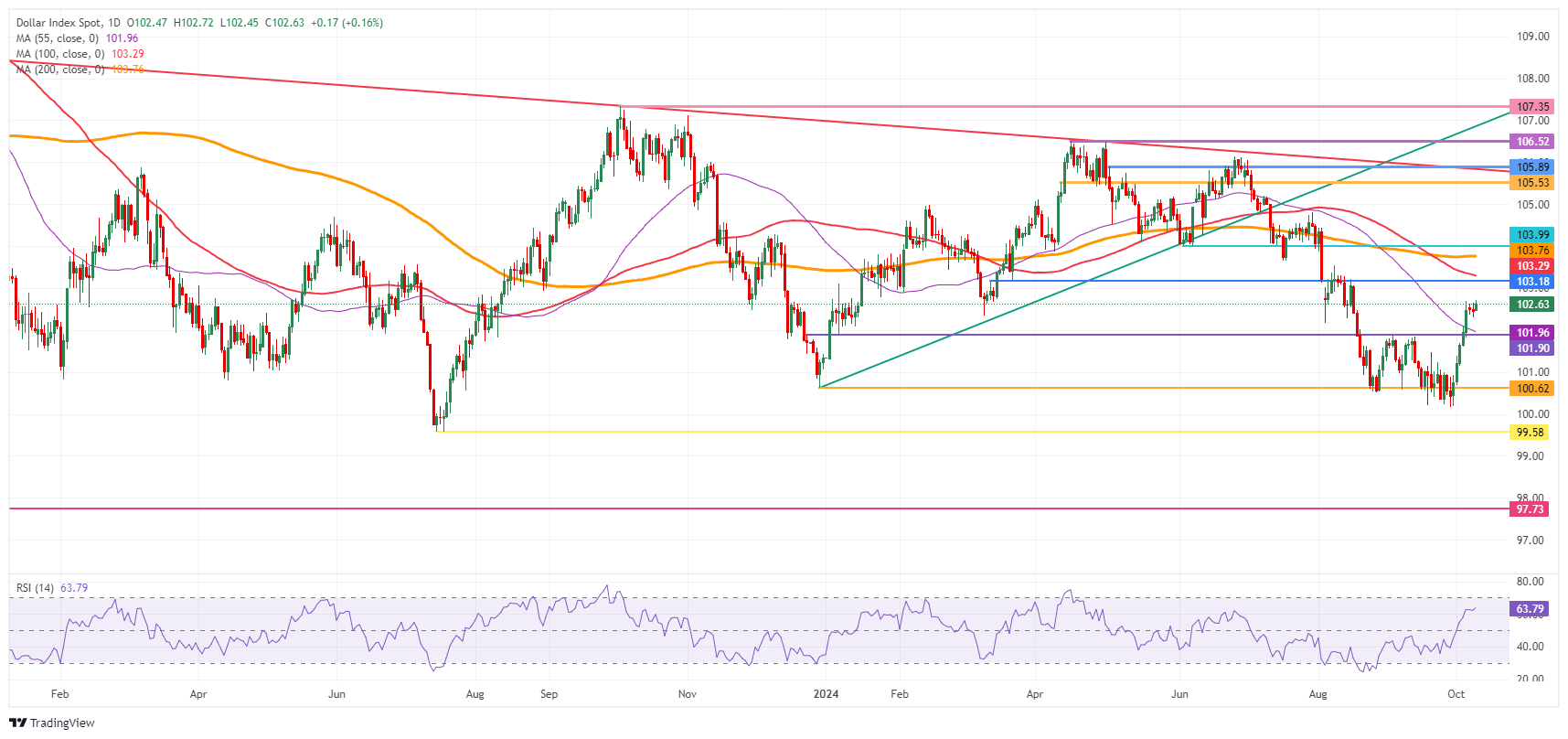
US Dollar Index: Daily Chart
Fed FAQs
Monetary policy in the US is shaped by the Federal Reserve (Fed). The Fed has two mandates: to achieve price stability and foster full employment. Its primary tool to achieve these goals is by adjusting interest rates. When prices are rising too quickly and inflation is above the Fed’s 2% target, it raises interest rates, increasing borrowing costs throughout the economy. This results in a stronger US Dollar (USD) as it makes the US a more attractive place for international investors to park their money. When inflation falls below 2% or the Unemployment Rate is too high, the Fed may lower interest rates to encourage borrowing, which weighs on the Greenback.
The Federal Reserve (Fed) holds eight policy meetings a year, where the Federal Open Market Committee (FOMC) assesses economic conditions and makes monetary policy decisions. The FOMC is attended by twelve Fed officials – the seven members of the Board of Governors, the president of the Federal Reserve Bank of New York, and four of the remaining eleven regional Reserve Bank presidents, who serve one-year terms on a rotating basis.
In extreme situations, the Federal Reserve may resort to a policy named Quantitative Easing (QE). QE is the process by which the Fed substantially increases the flow of credit in a stuck financial system. It is a non-standard policy measure used during crises or when inflation is extremely low. It was the Fed’s weapon of choice during the Great Financial Crisis in 2008. It involves the Fed printing more Dollars and using them to buy high grade bonds from financial institutions. QE usually weakens the US Dollar.
Quantitative tightening (QT) is the reverse process of QE, whereby the Federal Reserve stops buying bonds from financial institutions and does not reinvest the principal from the bonds it holds maturing, to purchase new bonds. It is usually positive for the value of the US Dollar.
Author

Filip Lagaart
FXStreet
Filip Lagaart is a former sales/trader with over 15 years of financial markets expertise under its belt.