US Dollar sees earlier gains evaporate after weekly Jobless Claims hit six-week high
- The US Dollar turns flat ahead of the US trading session on Thursday.
- US President Trump is set to speak at the World Economic Forum in Davos.
- The US Dollar Index (DXY) is back above 108.00, though faces some mild selling pressure again.

The US Dollar Index (DXY), which tracks the Greenback’s value against six major currencies, goes nowhere in the US session after some earlier gains this Thursday ahead of some US economic data. Still, there is a long road to recovery, although after a few days with an almost empty US data calendar, traders can brace for a pickup in the next releases. Positive and upbeat data could put inflation concerns back on the agenda, which would fuel higher rates and a stronger US Dollar again.
Meanwhile, the US economic calendar is starting to take shape with the weekly Jobless Claims and the Kansas Fed Manufacturing Activity Index. This all precedes the release of Friday’s S&P Global Purchase Managers Index (PMIs) numbers. Later this Thursday, US President Trump will also appear virtually at the Davos World Economic Forum where he will hold a speech.
Daily digest market movers: Bumpy road ahead
- At 13:30 GMT, the weekly Jobless Claims for the week ending on January 17 came out. The actual number came in at 223,000, coming from 217,000 in last week’s count. The Continuing Claims for the week of January 10 came in at 1.899 million, from 1.859 million previously.
- At 16:00 GMT, the Kansas Fed will release its manufacturing activity survey for January. No forecast is available, with the previous reading at -5.
- In that same timeframe, US President Donald Trump will make a virtual appearance at the World Economic Forum in Davos.
- Equities are looking sluggish this Thursday, facing some profit-taking after its broad rally throughout the week.
- The CME FedWatch tool projects a 57.1% chance that interest rates will remain unchanged at current levels in the May meeting, suggesting a rate cut in June. Expectations are that the Federal Reserve (Fed) will remain data-dependent with uncertainties that could influence inflation during US President Donald Trump’s term.
- The US 10-year yield is trading around 4.63%, off its poor performance seen earlier this week at 4.528% and still has a long way to go back to the more-than-one-year high from last week at 4.807%.
US Dollar Index Technical Analysis: Looking for direction
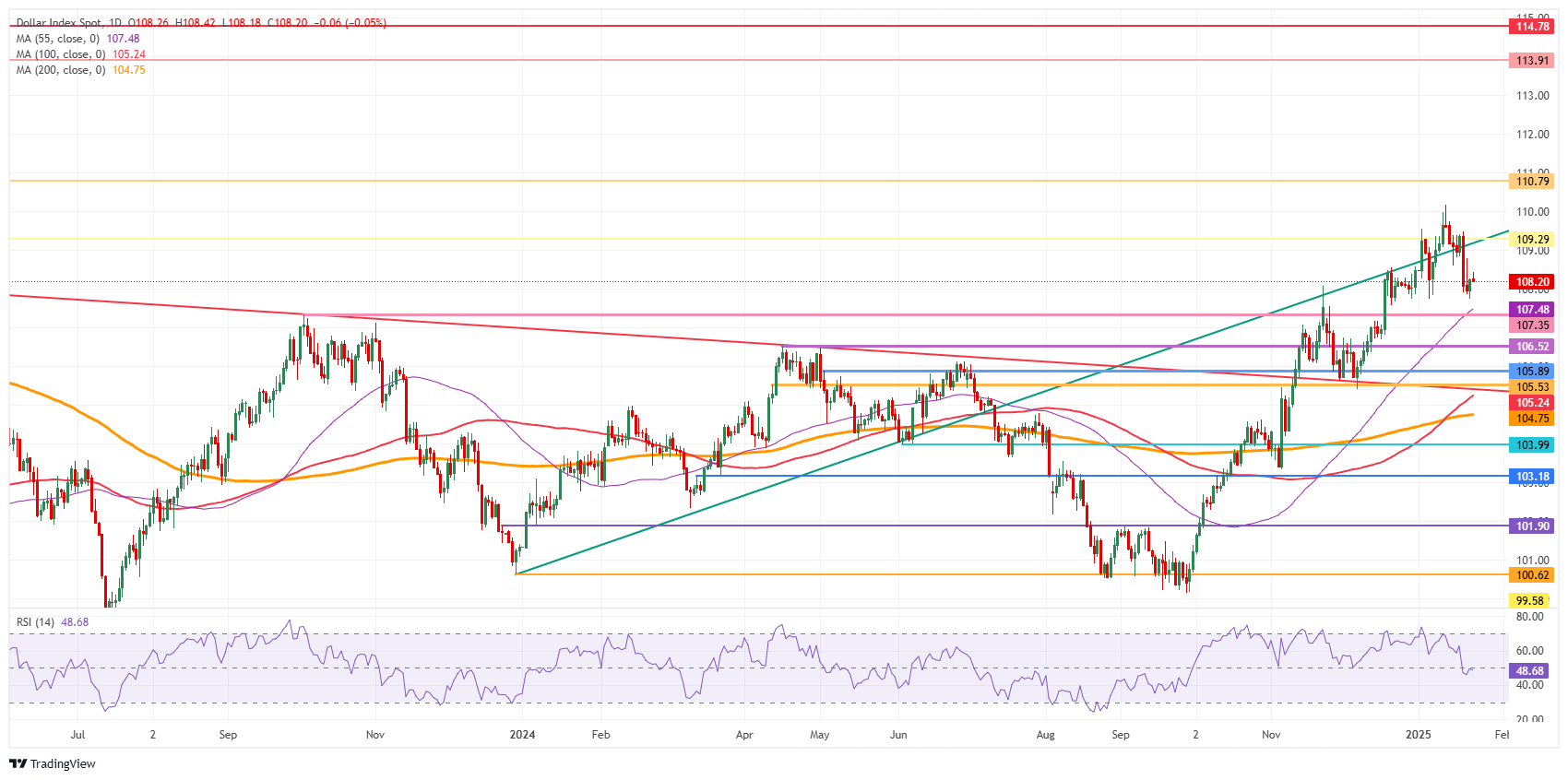
The US Dollar Index (DXY) halts its correction and consolidates around 108.00 on Thursday. Upcoming US economic data this week could fuel inflation concerns again with higher rates and a stronger US Dollar as a result.
If the recovery in the DXY wants to continue its ascent, the pivotal level to gain control of is 109.29 (July 14, 2022, high and rising trendline). Further up, the next big upside level to hit before advancing further remains at 110.79 (September 7, 2022, high). Once beyond there, it is quite a stretch to 113.91, a double top from October 2022.
On the downside, the first area to watch is 107.80-107.90, which held this week’s correction. Further down, the convergence of the high of October 3, 2023, and the 55-day Simple Moving Average (SMA) around 107.50 should act as a double safety feature to catch any falling knives.
US Dollar Index: Daily Chart
Interest rates FAQs
Interest rates are charged by financial institutions on loans to borrowers and are paid as interest to savers and depositors. They are influenced by base lending rates, which are set by central banks in response to changes in the economy. Central banks normally have a mandate to ensure price stability, which in most cases means targeting a core inflation rate of around 2%. If inflation falls below target the central bank may cut base lending rates, with a view to stimulating lending and boosting the economy. If inflation rises substantially above 2% it normally results in the central bank raising base lending rates in an attempt to lower inflation.
Higher interest rates generally help strengthen a country’s currency as they make it a more attractive place for global investors to park their money.
Higher interest rates overall weigh on the price of Gold because they increase the opportunity cost of holding Gold instead of investing in an interest-bearing asset or placing cash in the bank. If interest rates are high that usually pushes up the price of the US Dollar (USD), and since Gold is priced in Dollars, this has the effect of lowering the price of Gold.
The Fed funds rate is the overnight rate at which US banks lend to each other. It is the oft-quoted headline rate set by the Federal Reserve at its FOMC meetings. It is set as a range, for example 4.75%-5.00%, though the upper limit (in that case 5.00%) is the quoted figure. Market expectations for future Fed funds rate are tracked by the CME FedWatch tool, which shapes how many financial markets behave in anticipation of future Federal Reserve monetary policy decisions.
Author

Filip Lagaart
FXStreet
Filip Lagaart is a former sales/trader with over 15 years of financial markets expertise under its belt.