US Dollar turns red after Services from ISM and S&P falls short of expectations
- The US Dollar whipsaws on Wednesday and turns red after both S&P and ISM Services release.
- Federal Reserve Bank of St. Louis President Alberto Musalem delivers hawkish comment.
- Fed Chairman Powell is set to speak during the American session, likely adding volatility to the US Dollar Dollar Index.

The US Dollar (USD) is turning red after numbers on the US Services sector from S&P global and the Institute for Supply Management fell short of expectations, while a no-confidence vote in France is taking place. Chances that Prime Minister Michel Barnier will survive the vote are slim to nil, with President Emmanuel Macron forced to select a new prime minister to form a new government in the coming weeks. Meanwhile, in the US, traders are starting to keep their powder dry ahead of Friday's US Jobs Report.
On the economic data front, all data is now out of the way. The Services Purchasing Manager Index (PMI) for November came in as a downbeat surprise with all components falling under their estimated result. The ADP private payroll estimate held no surprise and was a very small miss on estimates, not moving the needle. Late in the US trading session, Federal Reserve (Fed) Chairman Jerome Powell will speak at the New York Times DealBook Summit in New York.
Daily digest market movers: ISM and S&P contradict Fed's Musalem
- The ADP Job Change numbers for November comes in a touch softer at 146,000, below the 150,000 estimate and down from 233,000 in October.
- S&P Global has released its final reading of its November numbers for the Purchasing Managers Index. The services index came in at 56.1, missing the 57 estimate and initial reading, while the Composite fell to 54.9, lower than the previous 55.3.
- The Institute for Supply Management has release its November survey for the Services sector. The headline PMI fell to 52.1, undershooting the 55.5 expected and far below the 56 previously.
- Three Federal Reserve members will speak this Wednesday:
- at 13:45 GMT, Federal Reserve Bank of St. Louis President Alberto Musalem has delivered a keynote speech on "Monetary Policymaking: Central Banking in a Changing World" at the College of Central Bankers Symposium in New York City, United States. Fed's Musalem commented that a rate cut in December is too big of a gamble seeing the recent geopolitical tensions and activities that could spark a fresh inflation surge, Bloomberg reported.
- Around 18:45 GMT, Federal Reserve Chairman Jerome Powell participates in a discussion at the New York Times DealBook Summit in New York.
- Closing off at 23:00 GMT, Federal Reserve Bank of San Francisco President Mary Daly is interviewed at PBS New Hour.
- Equities are heading through and are positive throughout the trading day in both Europe and the US ahead of Fed Chairman Jerome Powell.
- The CME FedWatch Tool is pricing in another 25 basis points (bps) rate cut by the Fed at the December 18 meeting by 73.8%. A 26.2% chance is for rates to remain unchanged. The Fed Minutes and recent comments from several Fed officials have helped the rate cut odds for December to move higher.
- The US 10-year benchmark rate trades at 4.23%, ticking up from the 4.21% seen on Tuesday.
US Dollar Index Technical Analysis: Nothing moving despite a lot of moving parts
The US Dollar Index (DXY) is ticking up slightly ahead of the Nonfarm Payrolls print of Friday. After the turmoil at the start of the week on the back of the French political stage, it looks that traders want to keep their powder dry going into Friday’s Jobs Report. Although Fed Chairman Jerome Powell is set to speak, not manyuch market- moving comments are expected.
On the upside, 106.52 (April 16 high) remains as the first resistance to look at after failing to close above it this week. Should the US Dollar bulls reclaim that level, 107.00 (round level) and 107.35 (October 3, 2023, high) are back on target for a retest.
Looking down,Should the French government fall and a new, more stable, government formation is set to take place, the pivotal level at 105.53 (April 11 high) comes into play before heading into the 104-region. Should the DXY fall all the way towards 104.00, the big figure and the 200-day Simple Moving Average at 104.03 should catch any falling knife formation.
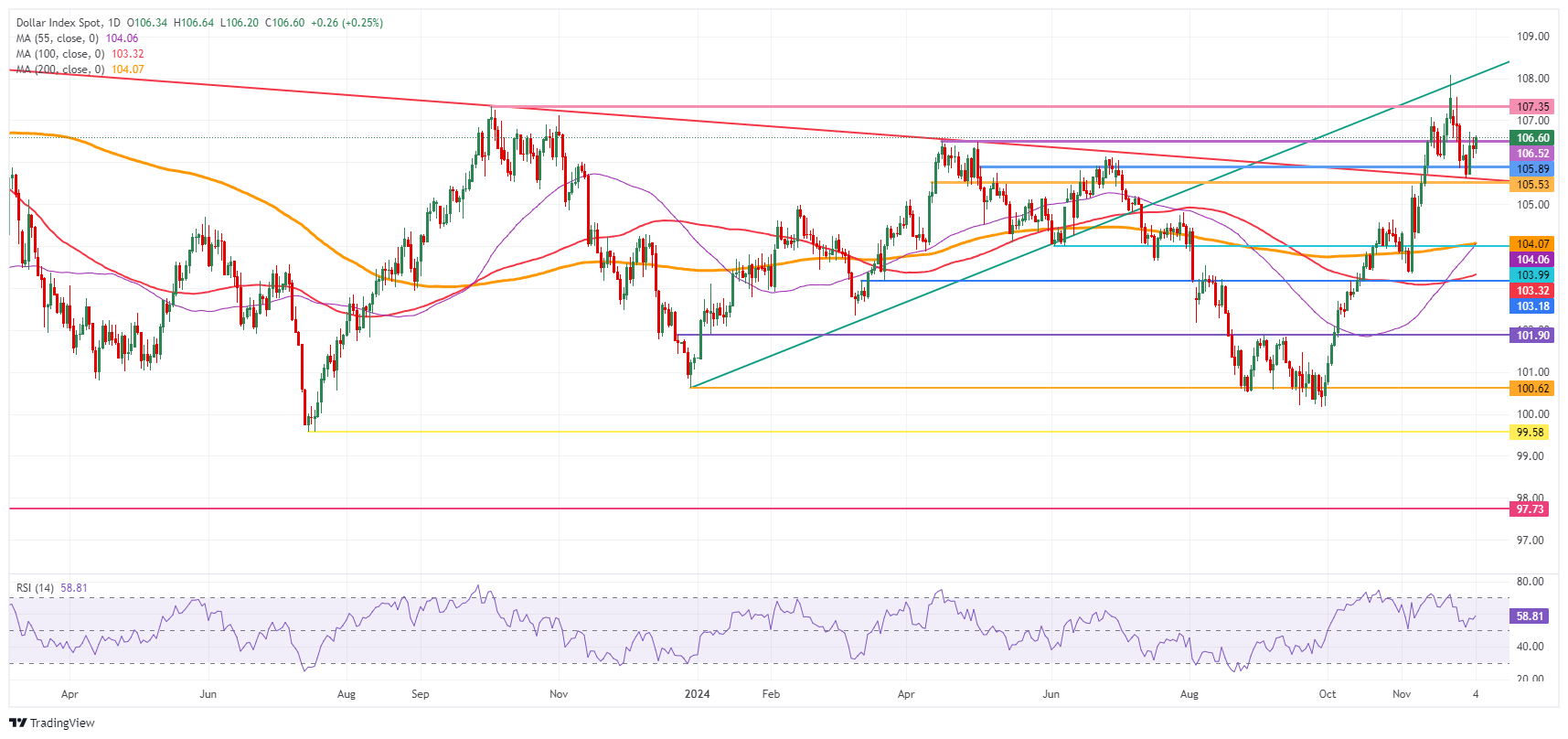
US Dollar Index: Daily Chart
(This story was corrected on December 04 at 13:58 GMT to say Closing off at 23:00 GMT, Federal Reserve Bank of San Francisco President Mary Daly is interviewed at PBS New Hour, not 13:00 GMT)
Central banks FAQs
Central Banks have a key mandate which is making sure that there is price stability in a country or region. Economies are constantly facing inflation or deflation when prices for certain goods and services are fluctuating. Constant rising prices for the same goods means inflation, constant lowered prices for the same goods means deflation. It is the task of the central bank to keep the demand in line by tweaking its policy rate. For the biggest central banks like the US Federal Reserve (Fed), the European Central Bank (ECB) or the Bank of England (BoE), the mandate is to keep inflation close to 2%.
A central bank has one important tool at its disposal to get inflation higher or lower, and that is by tweaking its benchmark policy rate, commonly known as interest rate. On pre-communicated moments, the central bank will issue a statement with its policy rate and provide additional reasoning on why it is either remaining or changing (cutting or hiking) it. Local banks will adjust their savings and lending rates accordingly, which in turn will make it either harder or easier for people to earn on their savings or for companies to take out loans and make investments in their businesses. When the central bank hikes interest rates substantially, this is called monetary tightening. When it is cutting its benchmark rate, it is called monetary easing.
A central bank is often politically independent. Members of the central bank policy board are passing through a series of panels and hearings before being appointed to a policy board seat. Each member in that board often has a certain conviction on how the central bank should control inflation and the subsequent monetary policy. Members that want a very loose monetary policy, with low rates and cheap lending, to boost the economy substantially while being content to see inflation slightly above 2%, are called ‘doves’. Members that rather want to see higher rates to reward savings and want to keep a lit on inflation at all time are called ‘hawks’ and will not rest until inflation is at or just below 2%.
Normally, there is a chairman or president who leads each meeting, needs to create a consensus between the hawks or doves and has his or her final say when it would come down to a vote split to avoid a 50-50 tie on whether the current policy should be adjusted. The chairman will deliver speeches which often can be followed live, where the current monetary stance and outlook is being communicated. A central bank will try to push forward its monetary policy without triggering violent swings in rates, equities, or its currency. All members of the central bank will channel their stance toward the markets in advance of a policy meeting event. A few days before a policy meeting takes place until the new policy has been communicated, members are forbidden to talk publicly. This is called the blackout period.
Author

Filip Lagaart
FXStreet
Filip Lagaart is a former sales/trader with over 15 years of financial markets expertise under its belt.