US Dollar flirts with pre-Fed's Jackson Hole levels after upbeat GDP data
- The US Dollar trades strong and reverses nearly all losses incured last week.
- Markets see risk on while US Dollar rolls through markets.
- The US Dollar Index rallies into the 101-region and looks good to hold gains for this Thursday.

The US Dollar (USD) trades substantially stronger and has reversed in a few pairs the incurred losses from last week. That is especially the case in the US Dollar (USD) against the Euro (EUR) where very soft European inflation data already triggered a weaker Euro. With the strong and upbeat US data, the Euro took another leg lower against the US Dollar and currently trades at levels where it started on Monday last week preceding the Jackson Hole Symposium.
On the US economic calendar front, as mentioned above, US Gross Domestic Product saw its second reading for the second quarter and saw upbeat numbers coming in. In addition to that, the US weekly jobless claims showed a still strong weekly number, while the continuing claims are starting to tick up a little bit.
Daily digest market movers: Spending up again
- Inflation data from both Germany and Spain showed an intensifying disinflation trend, with even some German provinces posting price declines on a monthly basis. This triggered a sharp move lower for the Euro (EUR) against the US Dollar (USD), erasing nearly all gains booked last week.
- At 12:30 GMT, a chunky batch of data has been released:
- Weekly Jobless Claims for the week ending August 23:
- Initial Claims came in at 231,000 against 233,000 from previous week.
- Continuing Claims jumped from 1.855 million unemployend people to 1.868 million.
- US Gross Domestic Product for the second quarter saw its second estimate:
- Headline GDP came in higher from 2.8% to 3.0%.
- The headline Personal Consumption Expenditure (PCE) Prices component softened a touch from 2.6% to 2.5%. The Core PCE came in softer as well, from 2.9% to 2.8%.
- The GDP Price Index component was at 2.3% in the first reading, and ticked up to 2.5%.
- Wholesale Inventories for July grew by 0.3% against 0.1% for June. The Goods Trade Balance,widened substantially to $102.7billion from $97.4 billion.
- Weekly Jobless Claims for the week ending August 23:
- At 14:00 GMT, Pending Home Sales for July shows and ugly truth by falling 5.5% from a positive 4.8% from previous month. Clearly the US consumer is doubting if they should still buy a home.
- Around 19:30, comments are expected from Federal Reserve Bank of Atlanta President Raphael Bostic, who delivers a presentation and participates in a Q&A about the Federal Reserve and the US economic outlook to Georgia Tech's Scheller College of Business Management of Financial Institutions class.
- Equities are jumping higher with the German Dax in Europe up near 1%. US equities are in good spirits as well, with the three major indices up by 0.5%.
- The CME Fedwatch Tool shows a 65.5% chance of a 25 basis points (bps) interest rate cut by the Fed in September against a 34.5% chance for a 50 bps cut. Another 25 bps cut (if September is a 25 bps cut) is expected in November by 44.2%, while there is a 44.6% chance that rates will be 75 bps (25 bps + 50 bps) below the current levels and an 11.2% probability of rates being 100 (25 bps + 75 bps) basis points lower.
- The US 10-year benchmark rate trades at 3.87%, testing the high of this week.
US Dollar Index Technical Analysis: Rate cuts you say?
The US Dollar Index (DXY) could enter a rough volatile patch in the coming 48 hours with a bulk load of data making its way to markets. That the DXY is set to make some whipsaw moves is due to the Fed not committing to the size of its initial rate cut and also not clarifying if this is the start of a rate cutting cycle or could still end in a one-and-done cut. Markets were euphoric last week, and clearly have tuned down that cheerful mood with the DXY becoming the barometer on how markets foresee the next steps of the Fed.
For a recovery, the DXY faces a long road ahead. First, 101.90 is the level to reclaim. A steep 2% uprising would be needed to get the index to 103.18. A very heavy resistance level near 104.00 not only holds a pivotal technical value, but it also bears the 200-day Simple Moving Average (SMA) as the second heavyweight to cap price action.
On the downside, 100.62 (the low from December 28) tries to hold support, although it looks rather feeble. Should it break, the low from July 14, 2023, at 99.58 will be the ultimate level to look out for. Once that level gives way, early levels from 2023 are coming in near 97.73.
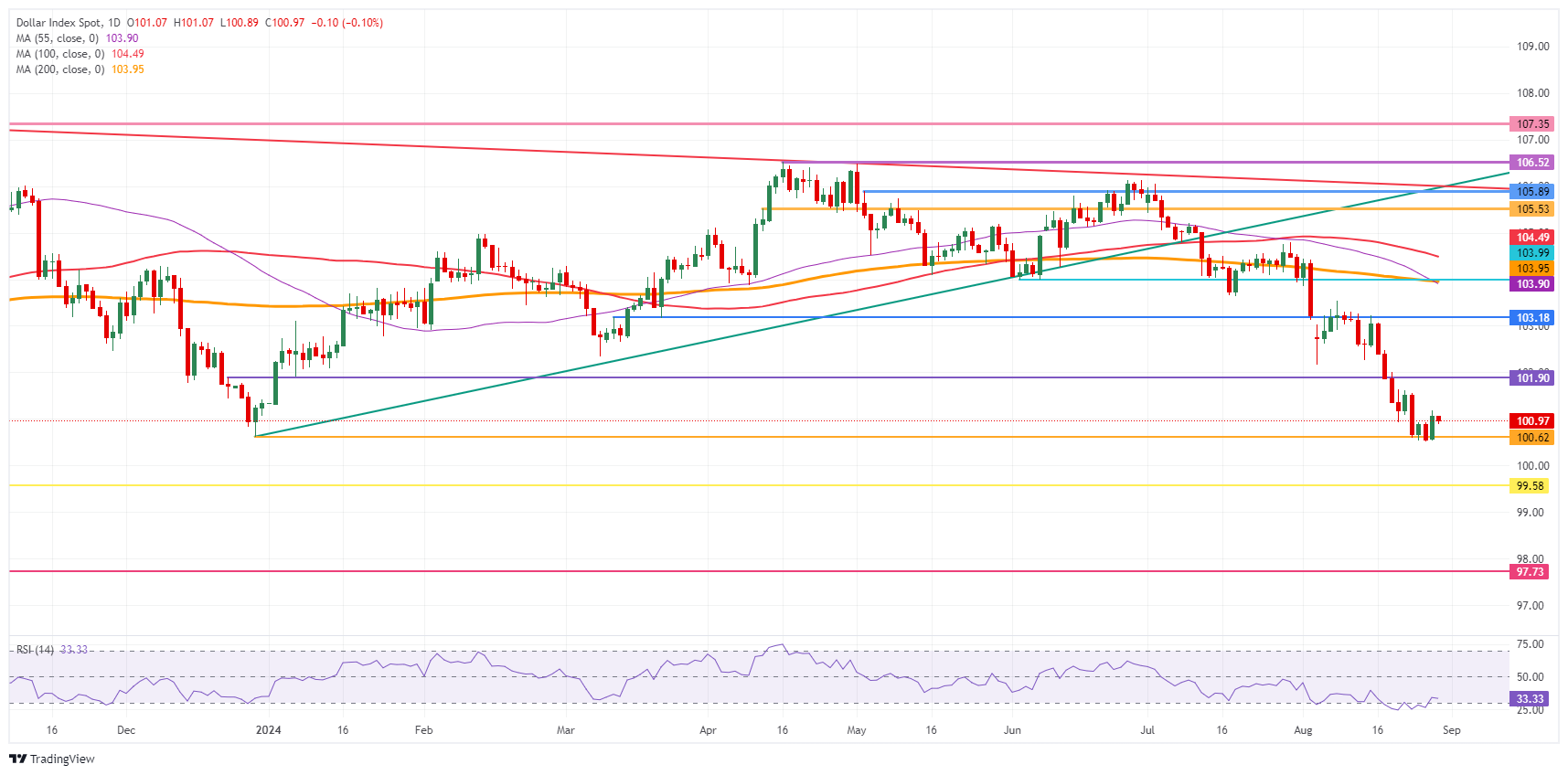
US Dollar Index: Daily Chart
Employment FAQs
Labor market conditions are a key element in assessing the health of an economy and thus a key driver for currency valuation. High employment, or low unemployment, has positive implications for consumer spending and economic growth, boosting the value of the local currency. Moreover, a very tight labor market – a situation in which there is a shortage of workers to fill open positions – can also have implications on inflation levels because low labor supply and high demand leads to higher wages.
The pace at which salaries are growing in an economy is key for policymakers. High wage growth means that households have more money to spend, usually leading to price increases in consumer goods. In contrast to more volatile sources of inflation such as energy prices, wage growth is seen as a key component of underlying and persisting inflation as salary increases are unlikely to be undone. Central banks around the world pay close attention to wage growth data when deciding on monetary policy.
The weight that each central bank assigns to labor market conditions depends on its objectives. Some central banks explicitly have mandates related to the labor market beyond controlling inflation levels. The US Federal Reserve (Fed), for example, has the dual mandate of promoting maximum employment and stable prices. Meanwhile, the European Central Bank’s (ECB) sole mandate is to keep inflation under control. Still, and despite whatever mandates they have, labor market conditions are an important factor for policymakers given their significance as a gauge of the health of the economy and their direct relationship to inflation.
Author

Filip Lagaart
FXStreet
Filip Lagaart is a former sales/trader with over 15 years of financial markets expertise under its belt.