Swiss Franc edges lower against USD on Fedspeak
- The Swiss Franc edges lower versus the US Dollar on Monday after hawkish Fedspeak.
- Earlier the Swiss Franc had made gains on the back of safe-haven demand after the EU launched a probe into big tech companies.
- USD/CHF reaches an initial upside target and pulls back.

The Swiss Franc (CHF) seesaws between tepid gains and loses on Monday with overall gains seen earlier in the day on the back of increased risk aversion pushing investors into safe-havens but some weakness coming later.
In the US session the Swiss Franc lost ground to the US Dollar after several US Federal Reserve (Fed) officials came out and suggested the Fed should delay cutting interest rates. The view that interest rates should remain at their current elevated levels for longer supported the US Dollar as higher interest rates attract more foreign capital inflows.
The earlier flight to safety that backed the Franc came on the news that the European Union (EU) had launched an investigation into big tech giants such as Apple, Google and Meta on Monday, according to ABC News.
The news that Russia has launched hypersonic missiles at Ukraine’s capital Kyiv may have further unsettled markets.
Swiss Franc benefits from safety trade
The Swiss Franc gained at the expense of competitors early on Monday as risk aversion permeated markets. The news on Monday that the EU Commission has launched an investigation into big tech companies for suspected “non-compliance” of its Digital Markets Act (DMA) has been given as a key factor rattling investors.
The DMA seeks to broadly level the playing field in digital markets by preventing online big tech platforms from acting as “gatekeepers” and thereby monopolizing digital ecosystems.
The Commission “suspects that the measures put in place by these gatekeepers fall short of effective compliance of their obligations under the DMA,” according to the EU’s press release.
In Kyiv, meanwhile, a series of hypersonic missiles escalated the conflict in Ukraine, causing damage to buildings and wounding two civilians in the central Pechersk district, as well as damaging buildings in the Solomiansky, Holosiyvsky and Dnipro districts, according to the Independent.
Fed speakers urge caution before cutting interest rates
"Go slow", was the overall message from the Fed speakers who took the stand on Monday – a stance that broadly supported the weakening US Dollar.
Atlanta Federal Reserve President Raphael Bostic said he advocated a slow approach to lowering interest rates and only expected the Fed to make one rate cut in 2024.
Federal Reserve Governor Lisa Cook was also cautious, arguing that the Fed needed to take a “careful approach” to easing over time to “ensure inflation returns sustainably to 2.0%.”
Their comments were probably responsible for the slight recovery in some USD pairs during the US Session.
Technical Analysis: Swiss Franc meets first target for breakout and pulls back
USD/CHF, the number of Swiss Francs purchasable with one US Dollar (USD), is trading in the upper 0.8900s after breaking out and rallying above a range it had been yo-yoing in since the middle of February.
The pair has met the conservative target for the breakout at 0.8984 and has pulled back. The target is calculated as the 0.618 Fibonacci extension of the height of the range extended from the breakout point higher.
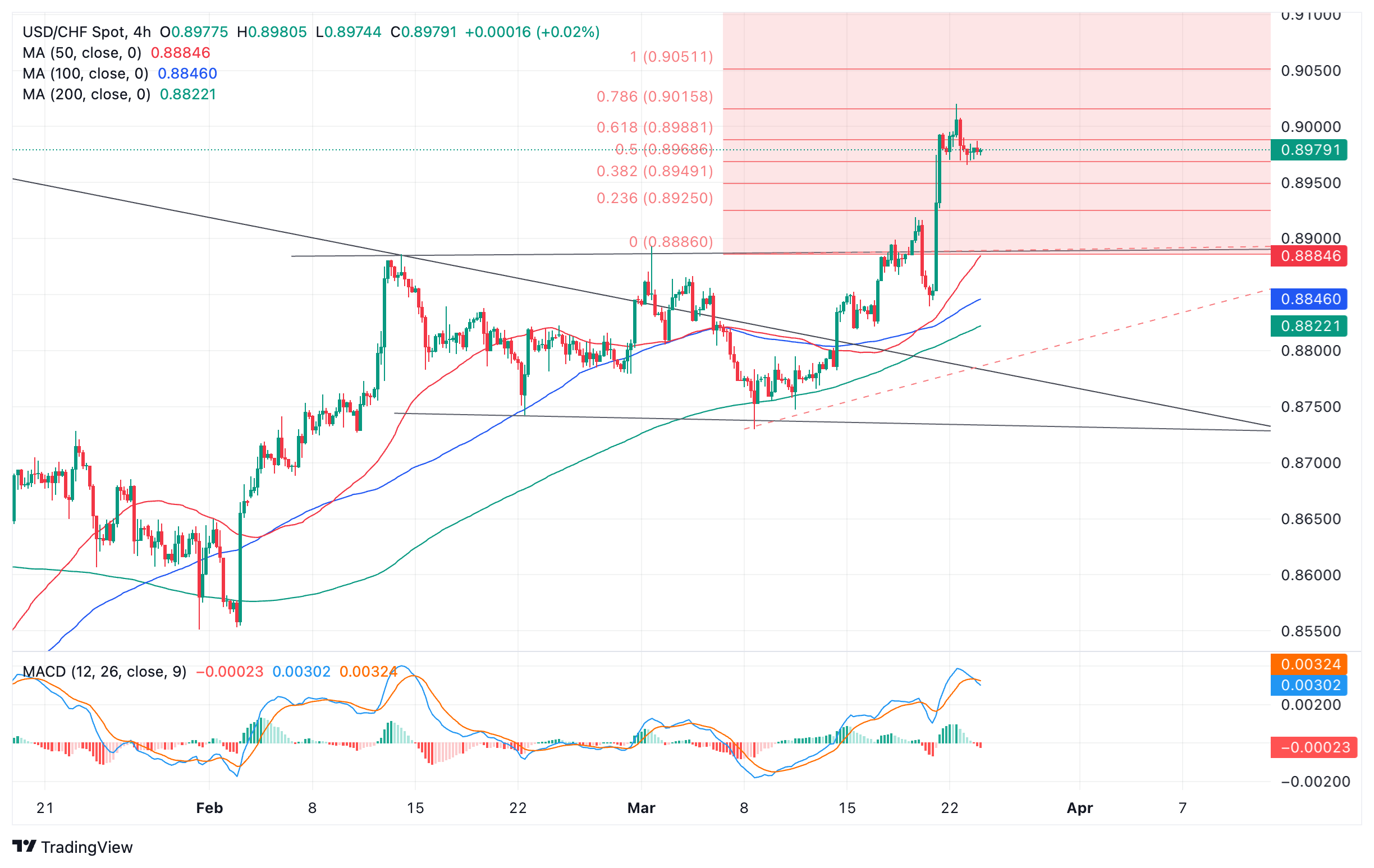
US Dollar versus Swiss Franc: 4-hour chart
The next target for the breakout is at 0.9052, the full height (1.000 ratio) of the range extrapolated higher.
There is a risk the pair could correct lower before attempting the next target. The Moving Average Convergence/ Divergence (MACD) indicator has just crossed below its signal line on the 4-hour chart, indicating the probability the pair will pull back.
If the correction continues it could target at the midpoint of the breakout rally, situated at roughly 0.8930.
Beyond that, the pair is overall seen continuing the short-term uptrend that formed prior to the range and its breakout higher.
It would take a break back below 0.8729 to suggest a short-term trend reversal and the start of a deeper slide.
The first target for such a move would be the 0.618 Fib. extrapolation of the height of the range at 0.8632, followed by the full extrapolation at 0.8577, which is also close to the 0.8551 January 31 lows, another key support level to the downside.
US Dollar FAQs
The US Dollar (USD) is the official currency of the United States of America, and the ‘de facto’ currency of a significant number of other countries where it is found in circulation alongside local notes. It is the most heavily traded currency in the world, accounting for over 88% of all global foreign exchange turnover, or an average of $6.6 trillion in transactions per day, according to data from 2022. Following the second world war, the USD took over from the British Pound as the world’s reserve currency. For most of its history, the US Dollar was backed by Gold, until the Bretton Woods Agreement in 1971 when the Gold Standard went away.
The most important single factor impacting on the value of the US Dollar is monetary policy, which is shaped by the Federal Reserve (Fed). The Fed has two mandates: to achieve price stability (control inflation) and foster full employment. Its primary tool to achieve these two goals is by adjusting interest rates. When prices are rising too quickly and inflation is above the Fed’s 2% target, the Fed will raise rates, which helps the USD value. When inflation falls below 2% or the Unemployment Rate is too high, the Fed may lower interest rates, which weighs on the Greenback.
In extreme situations, the Federal Reserve can also print more Dollars and enact quantitative easing (QE). QE is the process by which the Fed substantially increases the flow of credit in a stuck financial system. It is a non-standard policy measure used when credit has dried up because banks will not lend to each other (out of the fear of counterparty default). It is a last resort when simply lowering interest rates is unlikely to achieve the necessary result. It was the Fed’s weapon of choice to combat the credit crunch that occurred during the Great Financial Crisis in 2008. It involves the Fed printing more Dollars and using them to buy US government bonds predominantly from financial institutions. QE usually leads to a weaker US Dollar.
Quantitative tightening (QT) is the reverse process whereby the Federal Reserve stops buying bonds from financial institutions and does not reinvest the principal from the bonds it holds maturing in new purchases. It is usually positive for the US Dollar.
Author

Joaquin Monfort
FXStreet
Joaquin Monfort is a financial writer and analyst with over 10 years experience writing about financial markets and alt data. He holds a degree in Anthropology from London University and a Diploma in Technical analysis.
















