Super Micro Computer experiences heavy volatility following Nvidia earnings
- Super Micro sees greater than $100 share price movement early Thursday.
- SMCI stock has been trending lower since early March.
- Giving up SMCI's rally so quickly tells traders to expect impending sell-off.
- Super Micro should benefit from same AI demand that is leading to Nvidia's success.

Super Micro Computer (SMCI) stock rode the wave of Nvidia’s (NVDA) earnings early Thursday, which catapulted it up by 11.3% to an intraday high of $972.31, before crashing down to $866.
It appears that market euphoria over artificial intelligence is not strong enough to compete with SMCI’s nearly three-month downtrend. Though Nvidia continues trading for a gain of more than 10% at the time of writing, SMCI has given up most of its initial rally.
The wider market is starkly mixed on Thursday as it continues to digest Goldman Sachs CEO David Solomon’s opinion that the Federal Reserve (Fed) is unlikely to deliver any interest rate cuts whatsoever this year. The Dow Jones has sold off precipitously, while the NASDAQ has gained by a similar margin.
Super Micro Computer news
Following Nvidia’s barnstormer of an earnings release in Wednesday’s post-market, other AI-related stocks also rallied. Super Micro Computer builds equipment for data centers, as well as software for data centers to manage their servers.
Nvidia saw data center revenue climb to $22.6 billion in the first quarter, which was about $1.5 billion more than Wall Street had predicted.
"At this pace, NVDA could generate over $120bn in [free cash flow] in the next two years and over $200bn in FCF in the next three years,” wrote Bank of America analyst Vivek Arya.
Ruplu Bhattacharya, a separate analyst at Bank of America, extrapolated this humongous level of growth to Super Micro Computer. You see, Super Micro builds water-cooling equipment for hyperscalers. Though only 1% of data centers use liquid cooling, Bhattacharya says that about 20% will convert to this method for dealing with the insane heat created by Nvidia’s new AI GPUs.
This would mean big money for SMCI, which has an advantage building these type of systems at large scale. By the end of June, the analyst says SMCI will be delivering up to 2,000 liquid-cooled server racks per month.
"In our opinion, Supermicro stands to benefit from [...] sovereign entities who are looking for a partner who can customize their AI setup to maximize performance from the hardware, while providing attractive price/performance", writes Bhattacharya.
Semiconductor stocks FAQs
A semiconductor is a term for various types of computer chips. Officially called semiconductor devices, these computer chips rely on semiconductor materials like silicon and gallium arsenide to process the electrical current that produces the modern world of computing. They come in many shapes, sizes, enhancements and configurations such as diodes, transistors and integrated circuits to more complicated applications like DRAM memory, simple processors and even GPUs.
First, there are the pure chip designers, such as Nvidia, AMD, Broadcom and Qualcomm. These companies use sophisticated software to design and test chips. Second, there are the equipment manufacturers that provide the machines necessary to build computer chips. These include ASML and Lam Research. Then, there are foundries that manufacture the chips. These include Taiwan Semiconductor and GlobalFoundries. Last of all are the integrated device manufacturers who design their own chips and additionally manufacture themselves. These include Samsung and Intel.
It is the observation that the number of transistors in an integrated circuit doubles every two years. The “law” is named after Gordon Moore, who founded Fairchild Semiconductor and later Intel. The doubling is possible due to the shrinking size of process nodes or parts in the computer chip. In 1971 the advanced commercial manufacturing had reached 10 microns in width. In 1987 semiconductor technology had advanced to 800 nanometers in width. By 1999, this process had moved to 180 nanometers. By 2007, the size had dropped to 32 nanometers, and this fell all the way to 3 nanometers in 2022, which is close to the size of human DNA.
In 2022, the global semiconductor industry had revenues just under $600 billion. In total, the industry shipped 1.15 trillion semiconductor units in 2021. The leading nations involved in the semiconductor supply chain are Taiwan, the United States, China, the Netherlands, South Korea, Japan and Israel.
SMCI stock forecast
SMCI stock has been trending lower since March 8. We know this downtrend is likely to continue since SMCI stock registered an 11% rally early on Thursday only to see it diminish entirely. SMCI shares actually went negative at one point on Thursday.
This tells us that SMCI's market movements are dominated by short-term traders rather than long-term shareholders. The stock simply does not have robust support out there for a rally.
SMCI stock did bounce off support in the $835 to $871 range, but it's unlikely that will hold. SMCI stock is already trading beneath the 50-day Simple Moving Average (SMA), which is bearishly trading above the 20-day SMA. A better bet is the support band ranging from $686 to $709 that stems from February price dynamics.
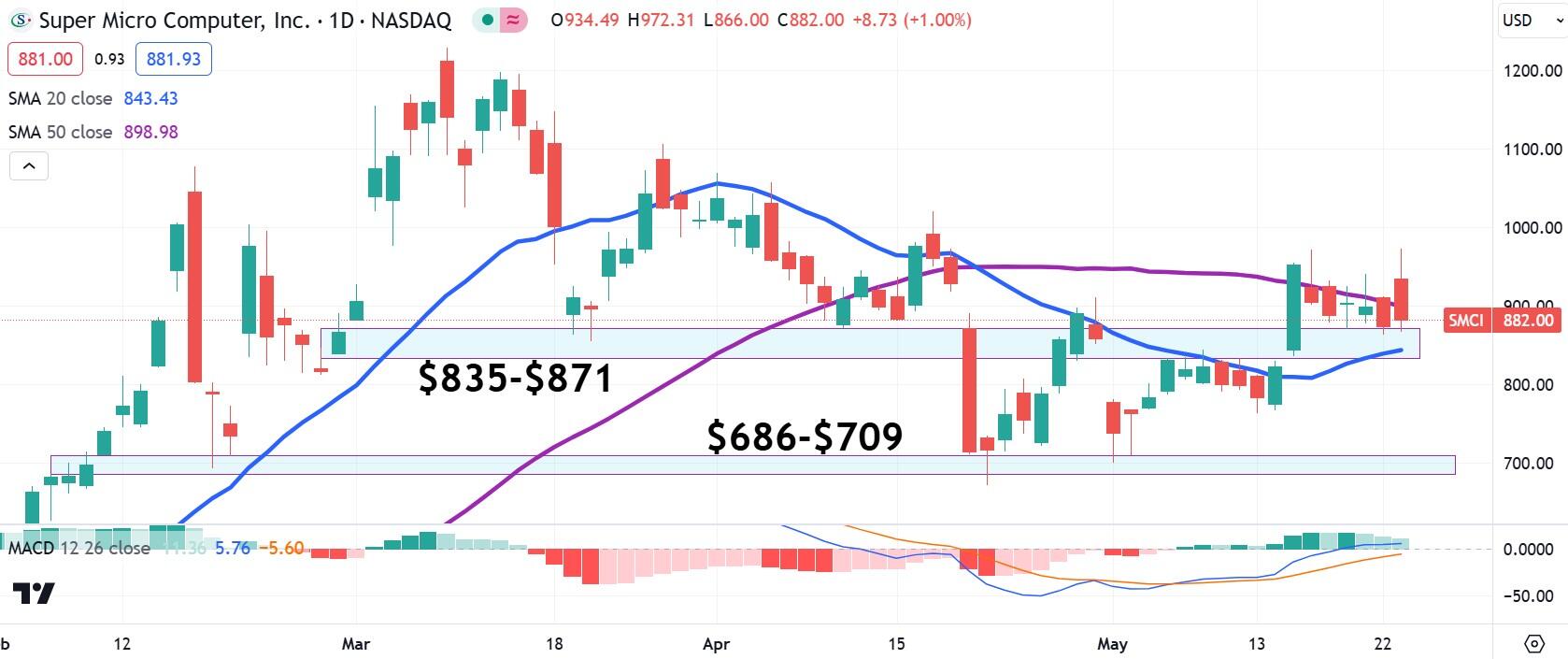
SMCI daily stock chart
Premium
You have reached your limit of 3 free articles for this month.
Start your subscription and get access to all our original articles.
Author
Clay Webster
FXStreet
Clay Webster grew up in the US outside Buffalo, New York and Lancaster, Pennsylvania. He began investing after college following the 2008 financial crisis.