SoFi’s share price barely budges despite fantastic Q2
- SoFi bests Wall Street on top and bottom lines, beats revenue figure by $30 million.
- Guidance raised for full year on profitability and revenue.
- SOFI stock can't hold onto gains despite positive quarter.
- Broad tech downtrend sucks SOFI stock lower.

SoFi Technologies’ (SOFI) second quarter was an unmitigated success. In nearly every category and line item, the neo bank looked solid with increased profitability and a healthy growth rate.
Initially, SOFI stock sailed up 8.5% on the news on Tuesday, but traders quickly took profits and shares sailed back down to a slight loss before lunchtime. Shares were down more than 2% at the time of writing.
There is some uneasiness among tech stocks as CrowdStrike (CRWD), Nvidia (NVDA) and Super Micro Computer (SMCI) continue to lose ground, and some of that general depression is seeping into the minds of SOFI traders. Microsoft (MSFT), Advanced Micro Devices (AMD) and Starbucks (SBUX) post results after the close on Tuesday.
SoFi Technologies earnings news
Wall Street had been expecting SoFi to break even in the second quarter as the personal banking solution focuses its strategy on breakneck growth. But the analysts were proved wrong when the firm run by CEO Anthony Noto reported $0.01 in GAAP earnings per share (EPS).
Revenue rose 22% YoY to $597 million, beating the analyst consensus by an impressive $30 million. Assets under management rose 58% YoY, and net interest income jumped 42% from a year prior to $412.6 million.
"Our Financial Services and Tech Platform segments now make up a record 45% of SoFi's adjusted net revenue, up from 38% a year ago and 32% two years ago," CEO Anthony Noto said in a statement. "In the second quarter, these businesses grew revenue by a combined 46% [annually].”
The company added 643K new customers in the quarter, rising to 8.77 million total customers. This is 2.5 million more customers than a year prior. Management says to expect a total of 2.3 million new customers during 2024, but that could easily be a low projection.
With users up more than 40% over the past year, total products in use rose about 36% to 12.78 million.
Besides raising the Q3 outlook, SoFi said that it now projects 2024 GAAP EPS of $0.09-$0.10, a penny higher than prior guidance. The in-house expectation for adjusted EBITDA for the full year was raised to a midpoint of $610 million from its prior midpoint guidance of $595 million.
Penny stocks FAQs
Originally, penny stocks were any stock that traded for less than $1, i.e. pennies. The Securities & Exchange Commission has since altered the definition to include any stock that trades for less than $5. Penny stocks are typically associated with small companies that have either experienced poor results, sending their share price down, or with companies who dilute their share price by issuing lots of shares over time in order to fund operations or acquisitions.
Some penny stocks trade on respected exchanges, such as the NASDAQ or the NYSE. Examples of these are Mullen Automotive (MULN) and Bark (BARK). Those exchanges have requirements though. For the NYSE, listed stocks must have 1.1 million publicly traded shares outstanding with a market value of at least $40 million. The NASDAQ requires a share price minimum of $4, a minimum of 1.25 million shares and a market cap of $45 million. Most penny stocks, however, trade on the OTC (over-the-counter) market. This may mean the OTC Bulletin Board or the privately-owned OTC Markets Group.
Quite often the sharpest movers on any normal trading day are found among penny stocks. This is because non-penny stocks tend to have more liquidity, and the market is more certain about larger companies’ long-term values. Penny stocks are illiquid, meaning there is little supply available if an announcement drives more buying demand into a particular stock. There are no market makers that hold large amounts of penny stocks just to dispense them at a slightly higher price point. Additionally, most of these penny stocks suffer from a news desert where few market players know anything relevant about them. This is why a small biopharma company can issue news about a successful drug trial and immediately rocket 500% higher, with no analysts on Wall Street covering it.
Typically, the answer is “No”. Penny stocks are more risky than higher-priced stocks on average. Penny stock investors have a higher chance of losing their capital by investing in weaker companies. There is a reason why they are penny stocks in the first place, which is that largely the mainstream market is not interested in investing in them. Two groups of investors tend to focus on penny stocks, however. The first group are day traders, who know that the lack of liquidity in penny stocks could lead to extremely large swings over a short time period. The other group is made up of investors who like the fact that these stocks are disregarded. This allows these investors to gain an advantage by benefiting from upcoming announcements, because the larger market is not paying attention.
SoFi Technologies stock forecast
SoFi stock was unable to reach the range high from July 18 but found support at the 20-day Simple Moving Average (SMA). The region between $7.90 and $8.00 appears to be stubbornly resistant to bulls once again. It has been that way since at least April.
Longer term support arrives between $6.15 and $6.50 and further resistance arises at $8.40.
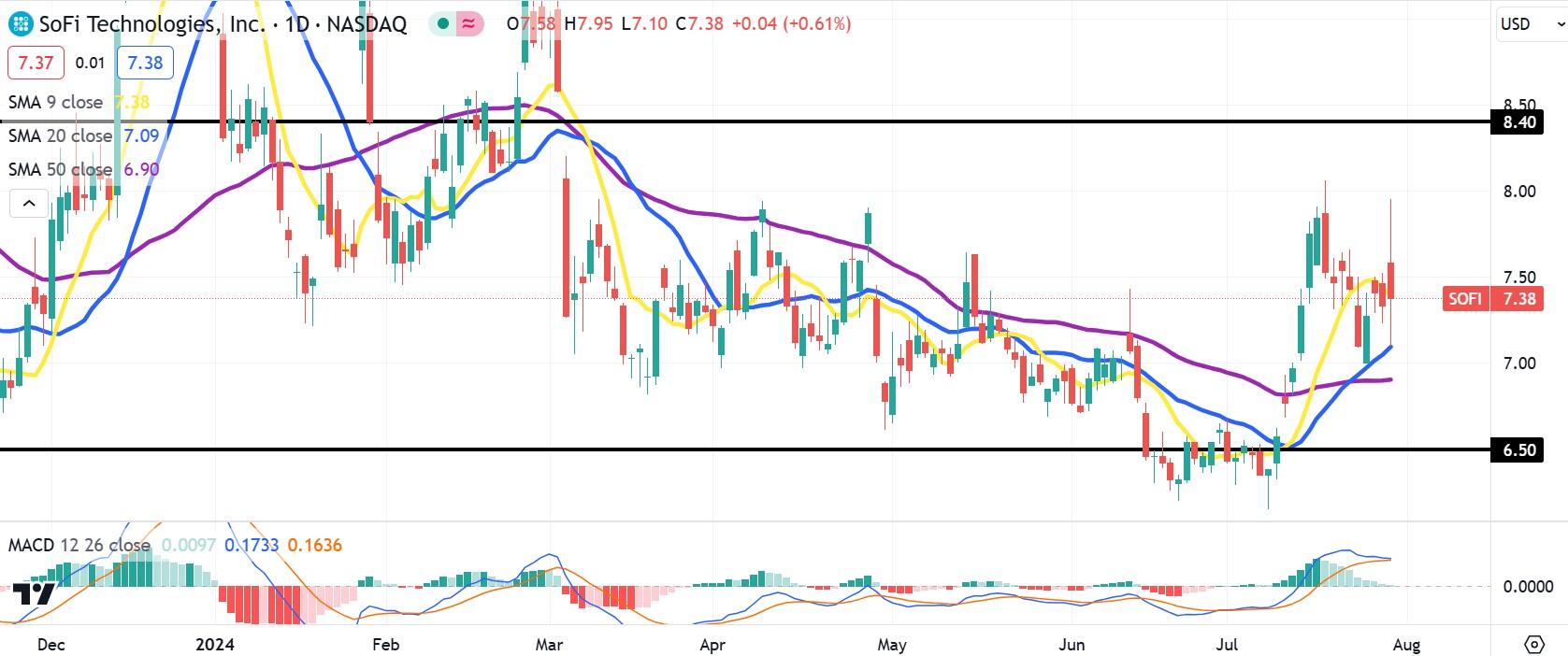
SOFI daily stock chart
Author

Clay Webster
FXStreet
Clay Webster grew up in the US outside Buffalo, New York and Lancaster, Pennsylvania. He began investing after college following the 2008 financial crisis.
















