|

Silver Price Forecast: Silver finds temporary support at Fibonacci level, RSI oversold

  • Silver is in a short-term downtrend after rolling over at the late-August high. 
  • The price has found support from a key Fibonacci retracement and is oversold, indicating the risk of a correction.

Silver (XAG/USD) has established a sequence of falling peaks and troughs on the 4-hour chart since it rolled over at the August 26 high. This suggests the precious metal is in a new short-term downtrend, and given that “the trend is your friend,” it will continue lower.

Silver 4-hour Chart 
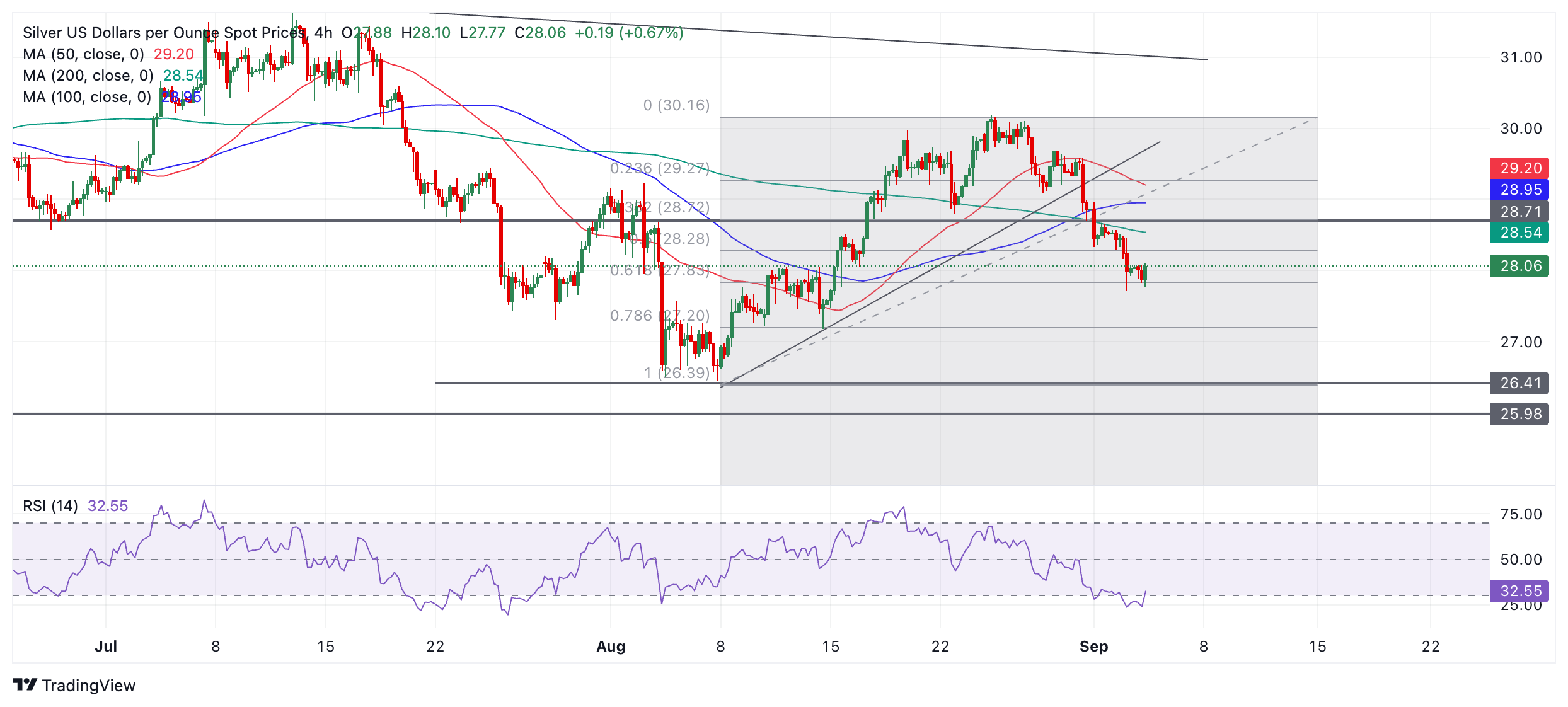
Silver is currently finding support at a key level – the 0.618 Fibonacci ratio retracement of the August rally. 

The Relative Strength Index (RSI) momentum indicator has fallen into oversold territory, and although it is shown exiting oversold on the current bar, it is not possible to tell whether it will close that way until the 4-hour period finishes. If it does rise out of oversold it will give a buy signal and, taken together with the support from the Fibonacci retracement, could indicate a temporary bottom in the downtrend. 

If a correction higher unfolds it will probably meet resistance between $28.28 (the 0.50 Fib retracement) and $28.33 (September 2 swing low). Given the trend is down it would be expected to resume its decline thereafter. 

In any case, a break below $27.71 (September 3 low) would produce a lower low and extend the downtrend. The next target is the August low at $26.41.  

The trend on the medium and longer-term charts is unclear – possibly sideways – indicating little directional bias from higher time frames.

Author

Joaquin Monfort

Joaquin Monfort is a financial writer and analyst with over 10 years experience writing about financial markets and alt data. He holds a degree in Anthropology from London University and a Diploma in Technical analysis.


More from Joaquin Monfort
Share:

Editor's Picks

GBP/USD defends 1.3300 after strong UK PMI data

Following Thursday's sharp decline, GBP/USD clings to small gains above 1.3300 in the American session on Friday, supported by the upbeat UK Retail Sales and July PMI data. Nevertheless, the pair's upside remains capped as investors cling to a cautious stance amid a further escalation of tensions in the Middle East. The US July PMI data failed to trigger relevant price action.

EUR/USD remains below 1.1400 after mixed US PMIs

EUR/USD pressures daily lows below the 1.1400 mark in the American session on Friday. Mixed S&P Global PMIs, as manufacturing output contracted while services activity expanded in July, triggered no relevant market reaction. The focus remains in Middle East developments and inflation-related concerns.

Gold holds above $4,050 but momentum still missing

Gold builds on its modest intraday bounce and climbs above the $4,050 level on Friday, hitting a fresh daily high amid a modest US Dollar pullback. The fundamental backdrop, however, warrants some caution before confirming that the pullback from an over two-week high, touched on Wednesday, has run its course and positioning for any meaningful upside.

Week ahead: Fed, BoE and BoJ face inflation test as markets reprice interest rate paths
The US dollar gained against the other major currencies this week amid the escalating tensions in the Middle East as well as US President Trump’s decision to proceed with a new round of tariffs after previously imposed levies expired.
Australian Dollar outlook: Chances of another rally won’t be decided in Canberra, but in Washington

The Australian Dollar rode a rollercoaster in the first half of the year, hitting a four-year high and then correcting. The currency enters the second half with an outlook full of uncertainty due to renewed hostilities in the Middle East, which clouds the inflation outlook and interest rates.

US Dollar mid-year outlook: Exceptional currency, exceptional risks?
The US Dollar enters the second half of 2026 in a markedly different position from a year ago. The King currency has recovered, reflecting persistent US inflation, changing expectations for Fed policy, geopolitical tensions and renewed demand for defensive assets.