Pound Sterling weakens after US Manufacturing PMI, Job Openings data
- The Pound Sterling drops sharply from 1.3400 against the US Dollar after the US data release.
- The US Manufacturing activity contracted steadily in September, while JoBb Openings came in higher-than-expected in August.
- BoE MPC member Megan Greene said inflation could rise again due to a sharp recovery in consumption.

The Pound Sterling (GBP) drops to near 1.3300 against the US Dollar (USD) in Tuesday’s North American session after facing selling pressure near the crucial resistance of 1.3400. The GBP/USD pair slumps after the release of the United States (US) JOLTS Job Openings data for August, which came in higher at 8.04 million, compared to estimates of 7.67 million and from 7.71 million in July. Meanwhile, the ISM Manufacturing PMI for September remained unchanged at 47.2, lower than estimates of 47.5.
The US Dollar was already performing strongly as investors turned cautious ahead of the United States (US) labor market data, which will provide fresh cues about how much the Federal Reserve (Fed) will reduce interest rates further this year.
The Fed started the policy-easing cycle with an interest rate cut of 50 basis points (bps) to 4.75%-5.00% on September 18. Policymakers decided to opt for a larger-than-usual cut amid growing concerns over slowing job growth and as confidence increases about inflation returning to the bank’s target of 2%.
To get cues about current labor market health, investors will pay close attention to the US ADP Employment Change and Nonfarm Payrolls (NFP) data for September, which will be published on Wednesday and Friday, respectively.
On Monday, Fed Chair Jerome Powell pushed back market expectations of an aggressive rate-cut cycle. "This is not a committee that feels like it is in a hurry to cut rates quickly,” Powell said at the National Association for Business Economics conference. "If the economy evolves as expected, that would be two more cuts by year's end, for a total reduction of half a percentage point more,” he added.
US Dollar PRICE Today
The table below shows the percentage change of US Dollar (USD) against listed major currencies today. US Dollar was the strongest against the New Zealand Dollar.
| USD | EUR | GBP | JPY | CAD | AUD | NZD | CHF | |
|---|---|---|---|---|---|---|---|---|
| USD | 0.54% | 0.61% | -0.26% | -0.19% | 0.37% | 0.80% | -0.12% | |
| EUR | -0.54% | 0.06% | -0.84% | -0.73% | -0.16% | 0.25% | -0.68% | |
| GBP | -0.61% | -0.06% | -0.89% | -0.79% | -0.23% | 0.21% | -0.71% | |
| JPY | 0.26% | 0.84% | 0.89% | 0.13% | 0.69% | 1.12% | 0.20% | |
| CAD | 0.19% | 0.73% | 0.79% | -0.13% | 0.57% | 1.00% | 0.08% | |
| AUD | -0.37% | 0.16% | 0.23% | -0.69% | -0.57% | 0.43% | -0.50% | |
| NZD | -0.80% | -0.25% | -0.21% | -1.12% | -1.00% | -0.43% | -0.90% | |
| CHF | 0.12% | 0.68% | 0.71% | -0.20% | -0.08% | 0.50% | 0.90% |
The heat map shows percentage changes of major currencies against each other. The base currency is picked from the left column, while the quote currency is picked from the top row. For example, if you pick the US Dollar from the left column and move along the horizontal line to the Japanese Yen, the percentage change displayed in the box will represent USD (base)/JPY (quote).
Daily digest market movers: Pound Sterling underperforms against its major peers
- The Pound Sterling underperforms its major peers on Tuesday. The British currency weakens even though market expectations for the Bank of England (BoE) to reduce interest rates in November have eased further after the speech from BoE external policy member Megan Greene at the National Association for Business Economics conference.
- Megan Greene, who voted for leaving interest rates unchanged in the last two policy meetings, indicated that the United Kingdom’s (UK) consumption-driven recovery could spurt price pressures again. Greene warned that the return of the headline inflation to the bank’s target of 2% was due to a temporary decline in Oil prices. Also, inflation in the service sector – which is closely tracked by BoE policymakers – at 5.6% is “worrisome,” she said. However, she remained confident that prices are “moving in the right direction,” Bloomberg reported.
- Financial market participants expect the BoE to cut interest rates one more time in the last quarter of the year, most probably in the December meeting. The BoE pivoted to policy normalization with a 25 bps interest rate cut on August 1 but left borrowing rates unchanged on September 19.
- Going forward, the next major trigger for the Pound Sterling will be the BoE Chief Economist Huw Pill’s speech, which is scheduled at 14:00 GMT. Pill’s speech could provide more guidance on the interest rate outlook for the remainder of the year.
- On the economic data front, the revised estimate of S&P Global/CIPS Manufacturing PMI data for September, came in at 51.5, unchanged from the flash estimate.
Technical Analysis: Pound Sterling slides to near 1.3300
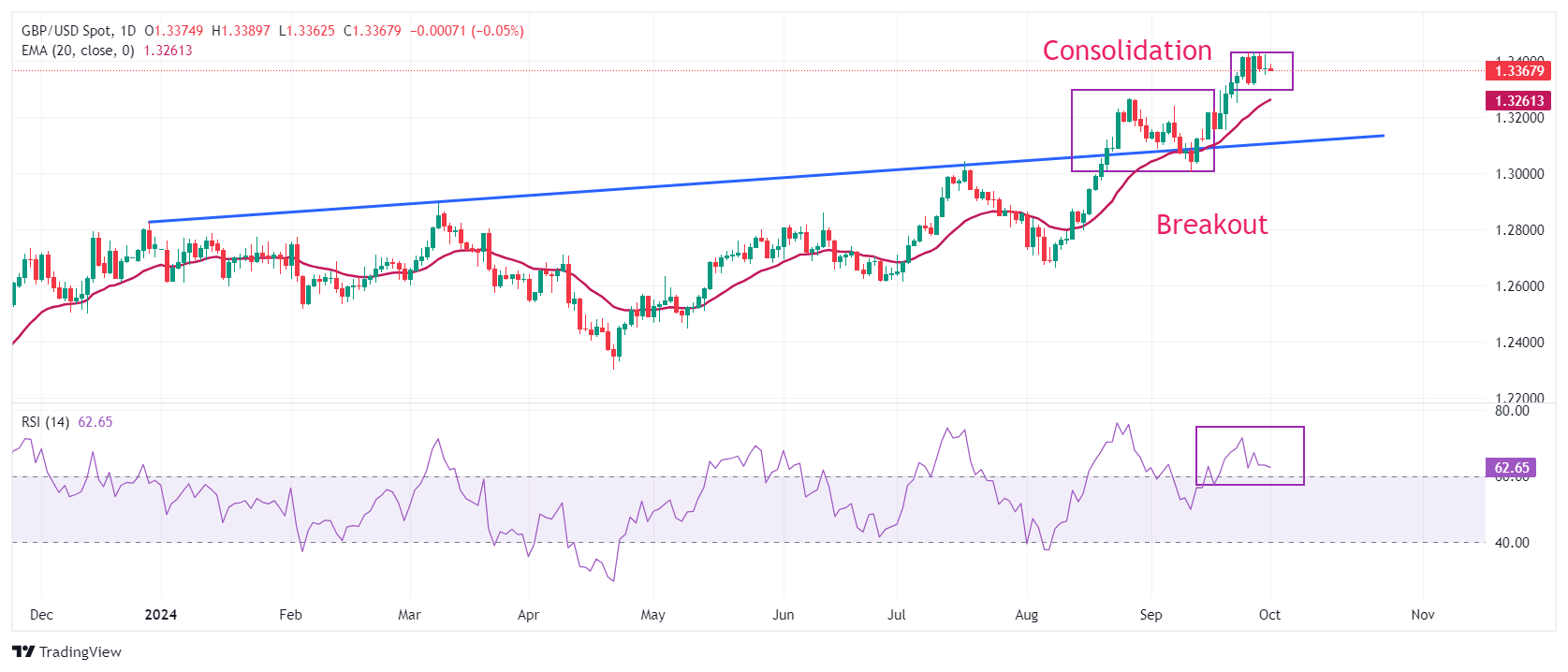
The Pound Sterling falls after facing offers near the key resistance of 1.3400 against the US Dollar in European trading hours. The near-term outlook of the GBP/USD pair remains firm as the 20-day Exponential Moving Average (EMA) near 1.3250 is sloping higher.
The Cable is expected to remain firm as it holds the breakout of the trendline plotted from the December 28, 2023, high of 1.2828, delivered on August 21.
The 14-day Relative Strength Index (RSI) tilts down but remains above 60.00, suggesting an active bullish momentum.
Looking up, the Cable will face resistance near the psychological level of 1.3500. On the downside, the 20-day EMA near 1.3235 will be the key support for Pound Sterling bulls.
Economic Indicator
Nonfarm Payrolls
The Nonfarm Payrolls release presents the number of new jobs created in the US during the previous month in all non-agricultural businesses; it is released by the US Bureau of Labor Statistics (BLS). The monthly changes in payrolls can be extremely volatile. The number is also subject to strong reviews, which can also trigger volatility in the Forex board. Generally speaking, a high reading is seen as bullish for the US Dollar (USD), while a low reading is seen as bearish, although previous months' reviews and the Unemployment Rate are as relevant as the headline figure. The market's reaction, therefore, depends on how the market assesses all the data contained in the BLS report as a whole.
Read more.Next release: Fri Oct 04, 2024 12:30
Frequency: Monthly
Consensus: 140K
Previous: 142K
Source: US Bureau of Labor Statistics
America’s monthly jobs report is considered the most important economic indicator for forex traders. Released on the first Friday following the reported month, the change in the number of positions is closely correlated with the overall performance of the economy and is monitored by policymakers. Full employment is one of the Federal Reserve’s mandates and it considers developments in the labor market when setting its policies, thus impacting currencies. Despite several leading indicators shaping estimates, Nonfarm Payrolls tend to surprise markets and trigger substantial volatility. Actual figures beating the consensus tend to be USD bullish.
Author

Sagar Dua
FXStreet
Sagar Dua is associated with the financial markets from his college days. Along with pursuing post-graduation in Commerce in 2014, he started his markets training with chart analysis.