Pound Sterling recovers after UK Autumn Forecast Statement
- The Pound Sterling recovers sharply after the UK budget announcement.
- UK Reeves has unveiled 40 billion pounds worth of tax rise to revive public spending.
- The US Dollar falls back despite upbeat US ADP Employment data for October.

The Pound Sterling (GBP) bounces back against its major peers on Wednesday after the announcement of the United Kingdom’s (UK) Autumn Forecast Statement. Higher taxes and big spending plans in the Labour’s first budget presentation in over 15 years have prompted a recovery in the British currency.
UK Chancellor of the Exchequer Rachel Reeves has unveiled a 40 billion pound tax rise to fix a hole in public spending inherited from Conservatives. The major contribution to higher tax collection next year is expected to come from higher payments to be made by employers in National Insurance (NI). The government has raised the rate of Employers' contribution to NI to 15% from 13.8%. The government has also hiked taxes on inheritance wealth and private jet flights and raised duties on various components such as air passengers, alcohol, and tobacco.
The government has announced that collections from higher taxes will be pumped into National Health Sector (NHS), funding duty freeze on fuel, affordable housing, setting up Electric Vehicles (EV) industry, and 11 green hydrogen projects.
Meanwhile, an upwardly revised inflation target by the Office for Business Responsibility (OBR) to 2.5% from 2.2%, projected earlier in March, for this year would deepen fears of price pressures remaining persistent. A scenario that will force traders to pare Bank of England (BoE) dovish bets for the remainder of the year. According to the October 22-28 Reuters poll, the BoE is widely anticipated to cut interest rates by 25 basis points (bps) in its upcoming policy meeting on November 7. This would be the BoE’s second interest-rate cut this year, pushing key borrowing rates down to 4.75%.
British Pound PRICE Today
The table below shows the percentage change of British Pound (GBP) against listed major currencies today. British Pound was the strongest against the US Dollar.
| USD | EUR | GBP | JPY | CAD | AUD | NZD | CHF | |
|---|---|---|---|---|---|---|---|---|
| USD | -0.28% | -0.09% | -0.17% | -0.01% | -0.45% | -0.27% | -0.10% | |
| EUR | 0.28% | 0.19% | 0.12% | 0.27% | -0.17% | 0.01% | 0.19% | |
| GBP | 0.09% | -0.19% | -0.08% | 0.07% | -0.36% | -0.18% | 0.01% | |
| JPY | 0.17% | -0.12% | 0.08% | 0.14% | -0.29% | -0.12% | 0.06% | |
| CAD | 0.01% | -0.27% | -0.07% | -0.14% | -0.44% | -0.25% | -0.07% | |
| AUD | 0.45% | 0.17% | 0.36% | 0.29% | 0.44% | 0.18% | 0.36% | |
| NZD | 0.27% | -0.01% | 0.18% | 0.12% | 0.25% | -0.18% | 0.19% | |
| CHF | 0.10% | -0.19% | -0.01% | -0.06% | 0.07% | -0.36% | -0.19% |
The heat map shows percentage changes of major currencies against each other. The base currency is picked from the left column, while the quote currency is picked from the top row. For example, if you pick the British Pound from the left column and move along the horizontal line to the US Dollar, the percentage change displayed in the box will represent GBP (base)/USD (quote).
Daily digest market movers: Pound Sterling gains against US Dollar
- The Pound Sterling posts a fresh intraday high near 1.3030 against the US Dollar (USD) in Wednesday’s New York session after the United States (US) macroeconomic data. The GBP/USD pair recovers sharply as the US Dollar falls back in the aftermath of the US ADP Employment Change for October, which came in surprisingly higher-than-expected and slower Q3 Gross Domestic Product (GDP) growth.
- US private employers added 233K workers, much higher than 159K in September, upwardly revised from 143K. Economists expected a slower private labor growth at 115K. Meanwhile, the US Bureau of Economic Analysis (BEA) has reported that the US economy expanded by 2.8% in the third quarter of the year, slower than estimates and the former reading of 3.0%.
- It appears that the impact of upbeat private payroll data has faded due to slower GDP growth.
- For fresh Federal Reserve (Fed) interest rate cues for the remainder of the year, investors will pay close attention to the US Nonfarm Payrolls (NFP) data for October, which will be published on Friday. According to the CME FedWatch tool, the central bank is expected to cut interest rates further by 25 bps in both policy meetings in November and December.
Technical Analysis: Pound Sterling returns above 1.3000
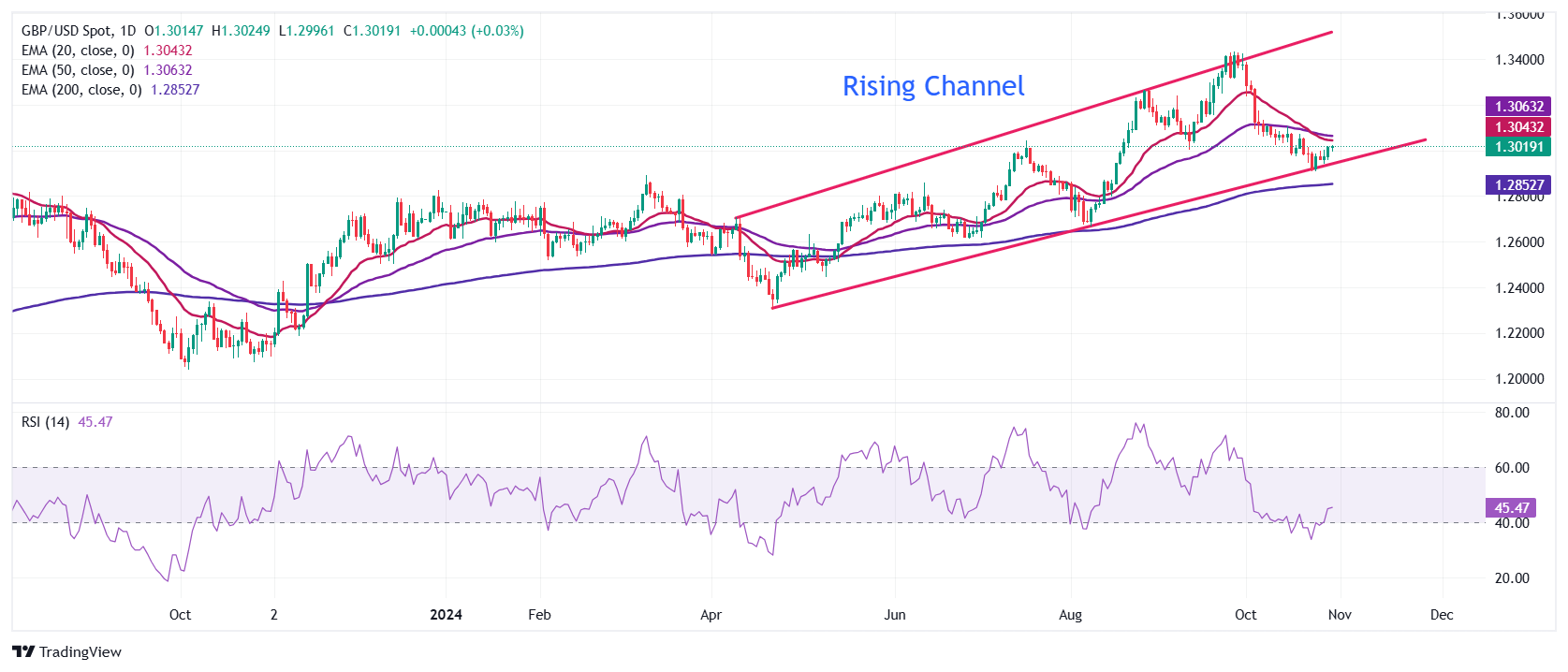
The Pound Sterling climbs back above 1.3000 against the US Dollar (USD) in North American trading hours on Wednesday. The GBP/USD pair holds the lower boundary of a Rising Channel chart formation around 1.2900 on the daily time frame.
The near-term trend of the Cable remains uncertain as it stays below the 50-day Exponential Moving Average (EMA), which trades around 1.3070.
The 14-day Relative Strength Index (RSI) stays above 40.00. A fresh bearish momentum would trigger if it fails to climb above it.
Looking down, the 200-day EMA near 1.2845 will be a major support zone for Pound Sterling bulls. On the upside, the Cable will face resistance near the 20-day EMA around 1.3060.
Economic Indicator
Autumn Forecast Statement
Autumn Forecast Statement is is one of the two statements HM Treasury makes each year to Parliament upon publication of economic forecasts. This document provides an updated economic outlook and previews the government's budget for the coming year, including expected spending and income levels, borrowing levels, and financial objectives. It also contains comments on the latest independent economic forecasts prepared by the OBR.
Read more.Author

Sagar Dua
FXStreet
Sagar Dua is associated with the financial markets from his college days. Along with pursuing post-graduation in Commerce in 2014, he started his markets training with chart analysis.

















