Pound Sterling extends upside on UK’s improved economic outlook, soft US Dollar
- The Pound Sterling capitalizes on risk-on mood and rises to 1.2660.
- UK’s upbeat Manufacturing PMI data and increasing home prices suggest that the UK recession was shallow.
- The US NFP data will guide the next move in the US Dollar.

The Pound Sterling (GBP) aims to extend its recovery above the one-week high of 1.2660 in Thursday’s early New York session. The GBP/USD pair exhibits strength as recent economic indicators in the United Kingdom have shown that the economy is on track to return to growth after falling into a technical recession in the second half of 2023. Meanwhile, a weaker US Dollar due to the poor United States Institute of Supply Management (ISM) Services PMI data for March also boosted the Cable.
The UK’s Manufacturing PMI surprisingly expanded in March after contracting for 20 straight months, driven by robust domestic demand. Strong UK factory data propelled business optimism to its highest level since April 2023, with 58% of manufacturers expecting their production level to increase over the coming 12 months. In addition, British house prices rose 1.6% in March, the highest pace since December 2022, suggesting that the real estate sector is holding up despite historically higher interest rates.
In the European session, the latest Bank of England (BoE) Decision Maker Panel (DMP) survey for February showed that most firms see selling prices and wage inflation cooling down over the next year. Selling price expectations decelerated to 4.1% from 4.3%, the lowest reading in over two years. Wage growth expectations softened to 4.9% on a three-month moving average basis from 5.2% in February.
Daily digest market movers: Pound Sterling continues winning spell
- The Pound Sterling advances to 1.2660 against the US Dollar. The asset extends the upside as the market sentiment is bullish, and a weak United States ISM Services PMI has knocked down the US Dollar. The S&P 500 opens on a positive note in Thursday's session.
- On Wednesday, the US Services PMI surprisingly fell to 51.4 in March from expectations of 52.7 and the former reading of 52.6. The Services PMI gauges business activity in the service sector, which accounts for two-thirds of the US economy. Therefore, the impact of a poor Services PMI was significantly adverse for the US Dollar, dragging the US Dollar Index (DXY) by more than 0.5% to 104.15. The ISM report also showed that new orders and prices paid subindexes fell significantly.
- This week, the major driver for the US Dollar will be the US Nonfarm Payrolls (NFP) report for March, which will be published on Friday. The economic data will significantly impact market expectations about whether the Federal Reserve will start reducing interest rates from the June meeting. The NFP report is expected to show that 200K workers were hired over the month, lower than February’s reading of 275K.
- On the UK front, the Pound Sterling will be guided by market expectations over Bank of England rate cuts. Investors expect the BoE to kick-start the rate-cut cycle in June as the United Kingdom inflation is slowing consistently. For the whole year, BoE Governor Andrew Bailey said he sees two or three rate cut expectations as “reasonable.”
- Meanwhile, S&P Global/CIPS has reported that Services PMI failed to meet expectations in Marc. The Services PMI falls to 53.1, from expectations and the prior reading of 53.4. Tim Moore, Economics Director at S&P Global Market Intelligence, said, "The recovery in service sector output lost a little bit of momentum during March, and more so than suggested by the flash PMI results, but the overall picture remains reasonably positive.
Technical Analysis: Pound Sterling prints fresh weekly high at 1.2680
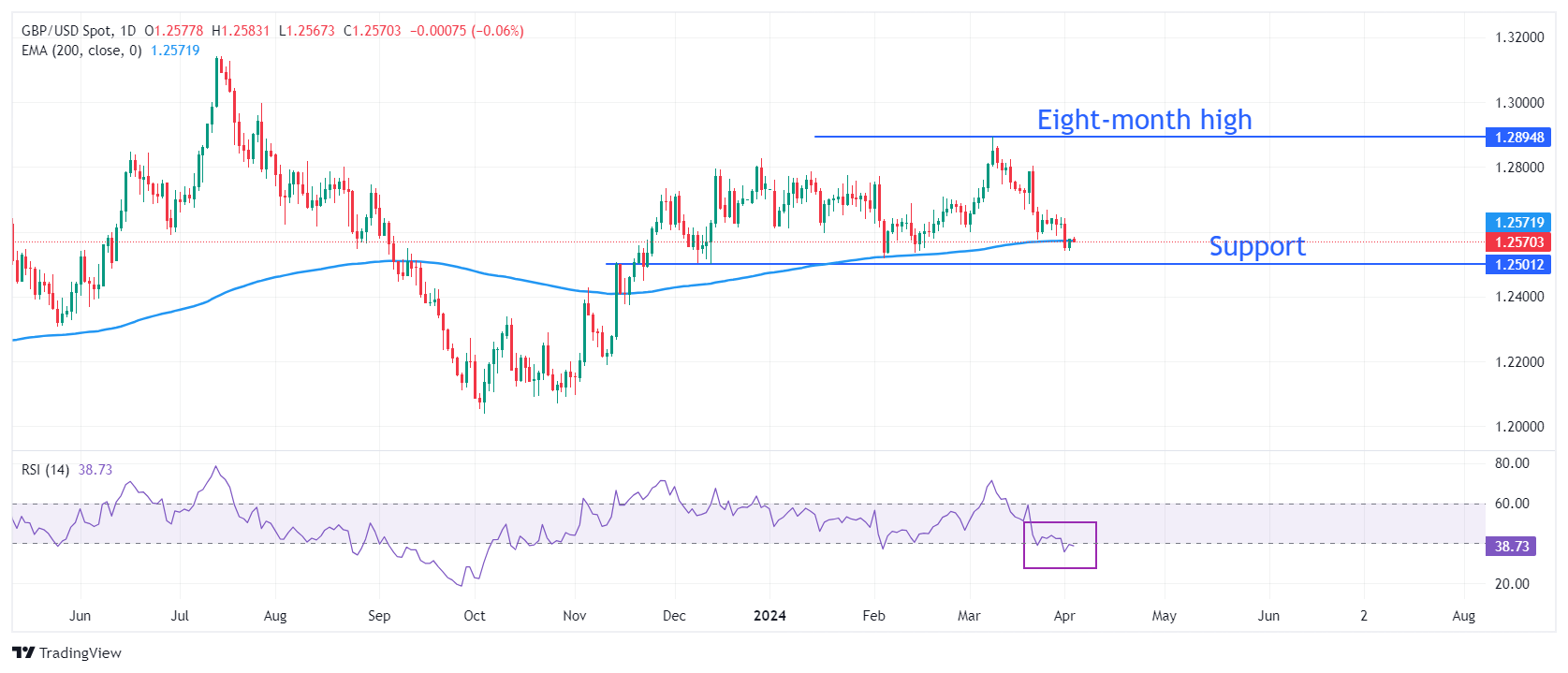
The Pound Sterling rebounds to a one-week high near 1.2660 after discovering buying interest from a six-week low of 1.2540. The GBP/USD pair continues its winning spell for the third trading session on Thursday. Cable bulls respected the 200-day Exponential Moving Average (EMA) at 1.2566. The 20-day EMA near 1.2660 could act as a strong barrier ahead.
On a broader time frame, the horizontal support from December 8 low at 1.2500 would provide further cushion to the Pound Sterling. Meanwhile, the upside is expected to remain limited near an eight-month high of around 1.2900.
The 14-period Relative Strength Index (RSI) rebounds above 40.00 after slipping below it. The event should not be considered a “bullish reversal” until it decisively breaks above 60.00.
Interest rates FAQs
Interest rates are charged by financial institutions on loans to borrowers and are paid as interest to savers and depositors. They are influenced by base lending rates, which are set by central banks in response to changes in the economy. Central banks normally have a mandate to ensure price stability, which in most cases means targeting a core inflation rate of around 2%. If inflation falls below target the central bank may cut base lending rates, with a view to stimulating lending and boosting the economy. If inflation rises substantially above 2% it normally results in the central bank raising base lending rates in an attempt to lower inflation.
Higher interest rates generally help strengthen a country’s currency as they make it a more attractive place for global investors to park their money.
Higher interest rates overall weigh on the price of Gold because they increase the opportunity cost of holding Gold instead of investing in an interest-bearing asset or placing cash in the bank. If interest rates are high that usually pushes up the price of the US Dollar (USD), and since Gold is priced in Dollars, this has the effect of lowering the price of Gold.
The Fed funds rate is the overnight rate at which US banks lend to each other. It is the oft-quoted headline rate set by the Federal Reserve at its FOMC meetings. It is set as a range, for example 4.75%-5.00%, though the upper limit (in that case 5.00%) is the quoted figure. Market expectations for future Fed funds rate are tracked by the CME FedWatch tool, which shapes how many financial markets behave in anticipation of future Federal Reserve monetary policy decisions.
Author

Sagar Dua
FXStreet
Sagar Dua is associated with the financial markets from his college days. Along with pursuing post-graduation in Commerce in 2014, he started his markets training with chart analysis.