|

Pound Sterling Price News and Forecast: GBP/USD trades in positive territory for the second consecutive day

GBP/USD Weekly Forecast: Pound Sterling to focus on Fed-BoE policy divergence

The Pound Sterling (GBP) stretched its corrective downside from yearly highs against the US Dollar (USD), sending GBP/USD back under 1.2900 – the lowest level in over a week.

GBP/USD maintained its corrective downside mode during the past week, despite a broadly rangebound US Dollar. Divergent monetary policy outlooks between the US Federal Reserve (Fed) and the Bank of England (BoE) also failed to offer the much-needed lift to the Pound Sterling, as the sentiment around the higher-yielding currency was dented by resurfacing concerns over China’s economic slowdown. Read more...
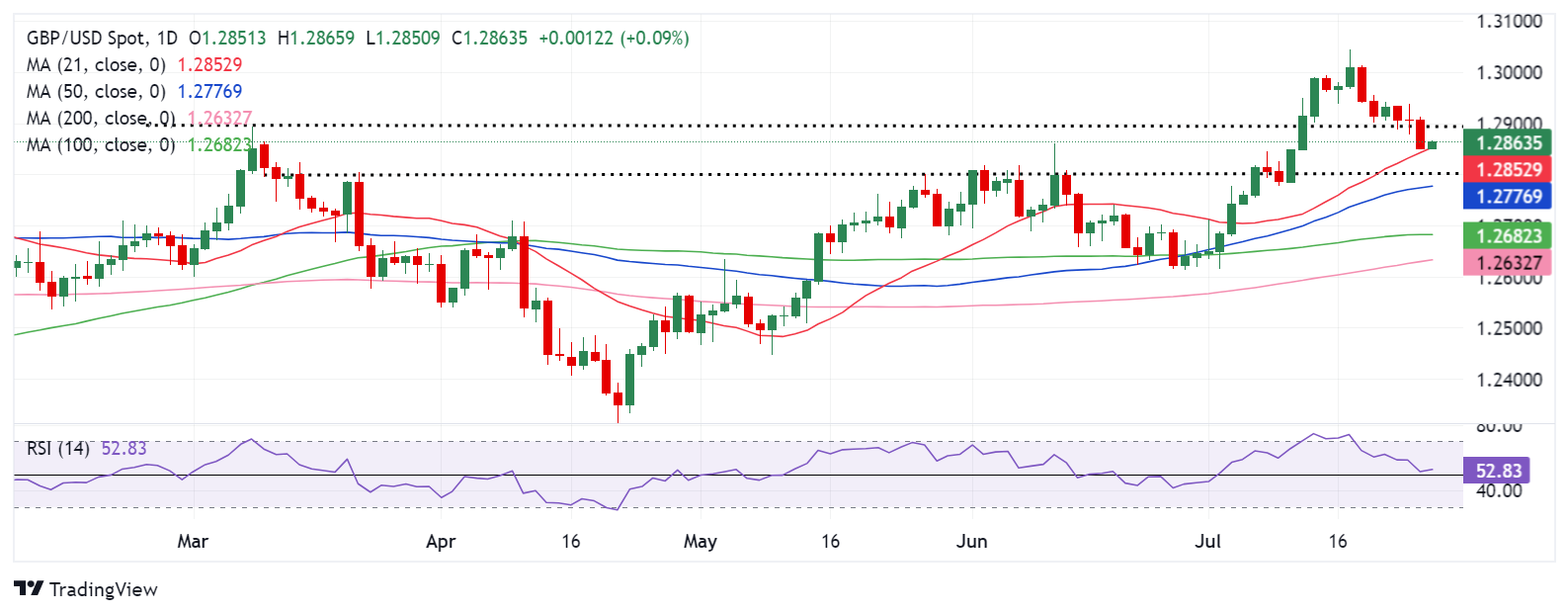
GBP/USD holds positive ground above 1.2850, focus on Fed/BoE rate decision this week

The GBP/USD pair holds positive ground around 1.2885 during the Asian trading hours on Monday. The uptick of the pair is bolstered by the softer US Dollar (USD) amid the hope of an interest rate cut by the Federal Reserve (Fed) in September. The Fed and Bank of England (BoE) monetary policy meetings on Wednesday and Thursday will be closely watched events. 

Most analysts and traders expect the Fed to leave the interest rate unchanged at its next meeting on Wednesday. The US Fed might signal this week that interest rate cuts are on the way, although it is widely anticipated to hold steady until its next rate decision in September. Investors are now seeing that the first rate cut will come by mid-September, pricing in 100% of the Fed rate cut by at least a quarter-percentage-point by then, according to data from the CME FedWatch Tool. Read more...

Author

FXStreet Team

Composed of a group of economic journalists and FX experts, the FXStreet content team produces and oversees all content published on FXStreet. It provides a purely journalistic approach to the Forex market.


More from FXStreet Team
Share:

Editor's Picks

GBP/USD defends 1.3300 after strong UK PMI data

Following Thursday's sharp decline, GBP/USD clings to small gains above 1.3300 in the American session on Friday, supported by the upbeat UK Retail Sales and July PMI data. Nevertheless, the pair's upside remains capped as investors cling to a cautious stance amid a further escalation of tensions in the Middle East. The US July PMI data failed to trigger relevant price action.

EUR/USD remains below 1.1400 after mixed US PMIs

EUR/USD pressures daily lows below the 1.1400 mark in the American session on Friday. Mixed S&P Global PMIs, as manufacturing output contracted while services activity expanded in July, triggered no relevant market reaction. The focus remains in Middle East developments and inflation-related concerns.

Gold holds above $4,050 but momentum still missing

Gold builds on its modest intraday bounce and climbs above the $4,050 level on Friday, hitting a fresh daily high amid a modest US Dollar pullback. The fundamental backdrop, however, warrants some caution before confirming that the pullback from an over two-week high, touched on Wednesday, has run its course and positioning for any meaningful upside.

Ethereum: Derivatives interest in ETH improves, but signs of caution remain

Ethereum is hovering slightly below the $1,900 level, down 3% on Thursday following a slight expansion in derivatives interest. The top altcoin's open interest has increased to 14.60 million ETH, marking a 600K ETH increase over the past two days and its highest level since June 7.

XRP retreats as ETF interest cools
Ripple (XRP) slides toward the short-term $1.10 support on Friday, as broader crypto market sentiment weighs on crypto assets. The sell-off mainly stems from fears of inflation in the United States (US) amid the ongoing war in the Middle East and rising Oil prices.
US Dollar mid-year outlook: Exceptional currency, exceptional risks?
The US Dollar enters the second half of 2026 in a markedly different position from a year ago. The King currency has recovered, reflecting persistent US inflation, changing expectations for Fed policy, geopolitical tensions and renewed demand for defensive assets.















