Pound Sterling recovers as weak US Services PMI improves market sentiment
- The Pound Sterling moves higher to 1.2600 as market sentiment improves.
- The UK Manufacturing PMI signaled expansion in March for the first time in two years.
- Investors see the BoE kick-start the rate-cut cycle in June.

The Pound Sterling (GBP) climbs to near 1.2600 against the US Dollar in Wednesday’s early American session on multiple tailwinds. A sharp decline in the US Dollar after the release of the downbeat United States ISM Services PMI and the upbeat United Kingdom (UK) Manufacturing PMI has improved the appeal of the GBP/USD pair. The US ISM reported that the Services PMI remained significantly lower at 51.4 from the consensus of 52.7 and the former reading of 52.6. The US Dollar Index (DXY) corrected to 104.40 after poor Services PMI data.
Earlier, the US ADP report for March indicated robust demand for labor by private employers. The US ADP showed that private employers hired 184K workers, higher than expectations of 148K and February's reading of 155K, which were upwardly revised from 140K.
The UK Manufacturing PMI surprisingly returned to growth in March after contracting for 20 months, driven by upbeat domestic demand for consumer goods. S&P Global/CIPS reported that business optimism rose to its highest level since April 2023, with 58% of manufacturers expecting their level of production to increase over the coming 12 months. The agency added: “Improved sentiment reflected signs of stronger demand, new product launches, a better trading environment, export opportunities and hopes the cost and supply situations would move closer to normal conditions.”
This week, the GBP/USD pair will be influenced by the US Nonfarm Payrolls (NFP) data and market expectations about when the Bank of England (BoE) will start reducing interest rates. Currently, investors’ expectations for rate cuts have been brought forward to the June policy meeting from prior anticipation for August after UK inflation softened more than expected in February.
Daily digest market movers: Pound Sterling rises while US Dollar corrects further
- The Pound Sterling jumps to 1.2600 on improved market sentiment. Weak US data improved demand for risk-sensitive assets. The S&P 500 posts significant gains in the first hour after a subdued opening.
- On Tuesday, the upbeat S&P Global/CIPS Manufacturing PMI for March supported a rebound for the Pound Sterling. The agency reported that the Manufacturing PMI returned to expansion after contracting for 20 straight months. The Manufacturing PMI rose to 50.3, above the 50.0 threshold, beating expectations and the prior reading of 49.9.
- Apart from the strong recovery in the Manufacturing PMI, British house prices rose 1.6% in March, the highest pace since December 2022. The activity in the housing sector has picked up despite the Bank of England maintaining interest rates at higher levels.
- A strong recovery in the manufacturing and real estate sectors suggests that the recession in the second half of 2023 was likely shallow and that the economy has returned to growth. In such a case, the BoE could achieve a so-called “soft landing” – a situation when an economy gets inflation under control without triggering a recession.
- Going forward, investors will focus on the S&P Global/CIPS Services PMI final data for March, which will be published on Thursday. The Services PMI is forecasted to have remained unchanged from its preliminary reading of 53.4.
- But before that, the speech from Fed Chair Jerome Powell, expected at 16:10 GMT, will be keenly watched. Powell could provide more cues about when the central bank will start reducing interest rates. Currently, investors expect that the Fed will start reducing borrowing costs from the June meeting.
Technical Analysis: Pound Sterling extends recovery to 1.2600
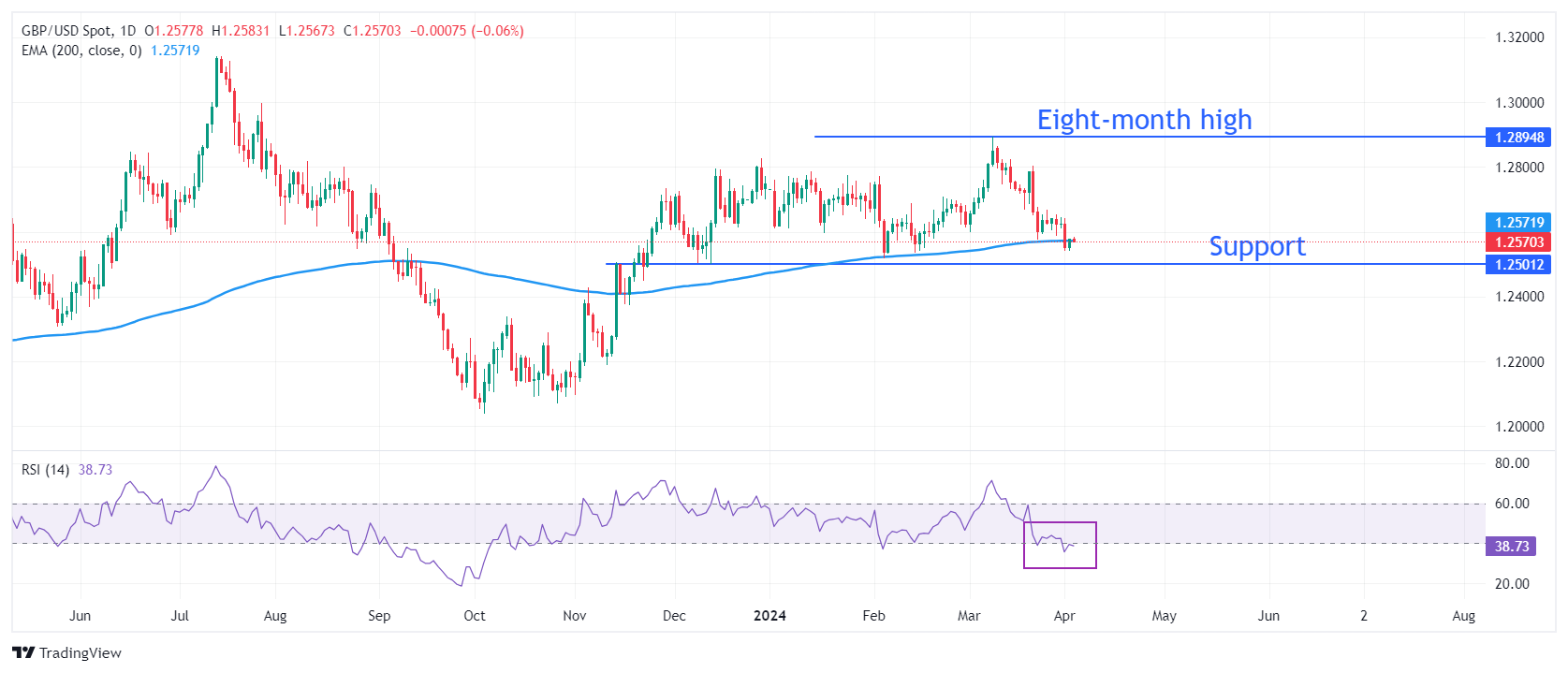
The Pound Sterling rebounds to 1.2600 f while testing the breakout of last week’s consolidation formed in a range between 1.2575 and 1.2668. The Cable aims to sustain above the 200-day Exponential Moving Average (EMA), which trades around 1.2570.
On a broader time frame, the horizontal support from December 8 low at 1.2500 would provide further cushion to the Pound Sterling. Meanwhile, the upside is expected to remain limited near an eight-month high of around 1.2900.
The 14-period Relative Strength Index (RSI) dips below 40.00. If it sustains below this level, bearish momentum will trigger.
Pound Sterling FAQs
The Pound Sterling (GBP) is the oldest currency in the world (886 AD) and the official currency of the United Kingdom. It is the fourth most traded unit for foreign exchange (FX) in the world, accounting for 12% of all transactions, averaging $630 billion a day, according to 2022 data. Its key trading pairs are GBP/USD, aka ‘Cable’, which accounts for 11% of FX, GBP/JPY, or the ‘Dragon’ as it is known by traders (3%), and EUR/GBP (2%). The Pound Sterling is issued by the Bank of England (BoE).
The single most important factor influencing the value of the Pound Sterling is monetary policy decided by the Bank of England. The BoE bases its decisions on whether it has achieved its primary goal of “price stability” – a steady inflation rate of around 2%. Its primary tool for achieving this is the adjustment of interest rates. When inflation is too high, the BoE will try to rein it in by raising interest rates, making it more expensive for people and businesses to access credit. This is generally positive for GBP, as higher interest rates make the UK a more attractive place for global investors to park their money. When inflation falls too low it is a sign economic growth is slowing. In this scenario, the BoE will consider lowering interest rates to cheapen credit so businesses will borrow more to invest in growth-generating projects.
Data releases gauge the health of the economy and can impact the value of the Pound Sterling. Indicators such as GDP, Manufacturing and Services PMIs, and employment can all influence the direction of the GBP. A strong economy is good for Sterling. Not only does it attract more foreign investment but it may encourage the BoE to put up interest rates, which will directly strengthen GBP. Otherwise, if economic data is weak, the Pound Sterling is likely to fall.
Another significant data release for the Pound Sterling is the Trade Balance. This indicator measures the difference between what a country earns from its exports and what it spends on imports over a given period. If a country produces highly sought-after exports, its currency will benefit purely from the extra demand created from foreign buyers seeking to purchase these goods. Therefore, a positive net Trade Balance strengthens a currency and vice versa for a negative balance.
Author

Sagar Dua
FXStreet
Sagar Dua is associated with the financial markets from his college days. Along with pursuing post-graduation in Commerce in 2014, he started his markets training with chart analysis.

















