Pound Sterling soars to 1.3200 on Powell's dovish interest rate guidance
- The Pound Sterling rallies against the US Dollar after Fed Powell communicated a dovish guidance on interest rates.
- Jerome Powell vows to support labor market strength.
- Investors await BoE Bailey's speech at the Jackson Hole Symposium.

The Pound Sterling (GBP) extends its winning streak for a seventh trading session against the US Dollar (USD) on Friday. The GBP/USD pair posts a fresh two-year high at 1.3200 as the US Dollar (USD) slides toward a year-to-date low after a dovish guidance on interest rates by Federal Reserve (Fed) Chair Jerome Powell in the Jackson Hole (JH) Symposium.
The US Dollar Index (DXY), which tracks the Greenback’s value against six major currencies, dips below the crucial support of 101.00 and is declining towards the annual low of 101.60. At the JH event, Fed Powell admitted the need to reduce interest rates as the balance of risks has now leaned to employment, given that he is confident that inflation remains on track to return to the bank's target of 2%. Jerome Powell didn't commit to a preset easing path but confirmed sooner rate cuts by saying, "The time has come for policy to adjust."
Meanwhile, other policymakers at the JH event also cited a dovish interest rate guidance. Philadelphia Fed Bank President Patrick Harker said in an interview on Thursday that the central bank should focus more on a steady course of easing, which should be started from September, rather than the size of policy action, reported Reuters.
Separately, Boston Fed Bank President Susan Collins also showed support for interest rate cuts in September. Collins remained confident about the Fed achieving its goals without triggering a recession.
Daily digest market movers: Pound Sterling gains ahead of BoE Bailey's speech at Jackson Hole
- The Pound Sterling performs strongly against its major peers, except Asia-Pacific currencies, on Friday. The British currency gains on firm speculation that the Bank of England’s (BoE) policy-easing cycle will be slower than that of other major central banks. Robust expectations for a slower BoE policy-normalization process are backed by a strong United Kingdom (UK) economic outlook and still high wage growth.
- Flash UK S&P Global/CIPS PMI data for August, released Thursday, showed that the overall business activity rose at a faster pace to a four-month high at 53.4, driven by a strong expansion in manufacturing as well as the services sector. The report also signaled a sharp reduction in the backlog of work and positive sentiment towards the business outlook that points to strong job creation.
- These strong economic prospects, however, are unlikely to ease market speculation of one more interest rate cut by the BoE this year as input prices in the service sector eased to their lowest level in just over three-and-a-half years in August. This is a relief for BoE policymakers as they appeared uncomfortable in cutting interest rates while inflation in the service sector remains elevated.
- Meanwhile, investors await BoE Governor Andrew Bailey’s speech at the Jackson Hole (JH) Symposium, which is scheduled at 19:00 GMT. Andrew Bailey is expected to provide fresh cues about whether the BoE will cut interest rates in September.
British Pound PRICE Today
The table below shows the percentage change of British Pound (GBP) against listed major currencies today. British Pound was the strongest against the US Dollar.
| USD | EUR | GBP | JPY | CAD | AUD | NZD | CHF | |
|---|---|---|---|---|---|---|---|---|
| USD | -0.54% | -0.83% | -0.67% | -0.72% | -1.07% | -1.31% | -0.06% | |
| EUR | 0.54% | -0.29% | -0.13% | -0.18% | -0.54% | -0.54% | 0.47% | |
| GBP | 0.83% | 0.29% | 0.15% | 0.10% | -0.26% | -0.24% | 0.51% | |
| JPY | 0.67% | 0.13% | -0.15% | -0.05% | -0.41% | -0.43% | 0.36% | |
| CAD | 0.72% | 0.18% | -0.10% | 0.05% | -0.36% | -0.36% | 0.41% | |
| AUD | 1.07% | 0.54% | 0.26% | 0.41% | 0.36% | 0.00% | 0.75% | |
| NZD | 1.31% | 0.54% | 0.24% | 0.43% | 0.36% | -0.01% | 0.75% | |
| CHF | 0.06% | -0.47% | -0.51% | -0.36% | -0.41% | -0.75% | -0.75% |
The heat map shows percentage changes of major currencies against each other. The base currency is picked from the left column, while the quote currency is picked from the top row. For example, if you pick the British Pound from the left column and move along the horizontal line to the US Dollar, the percentage change displayed in the box will represent GBP (base)/USD (quote).
Technical Analysis: Pound Sterling delivers Rising Channel breakout
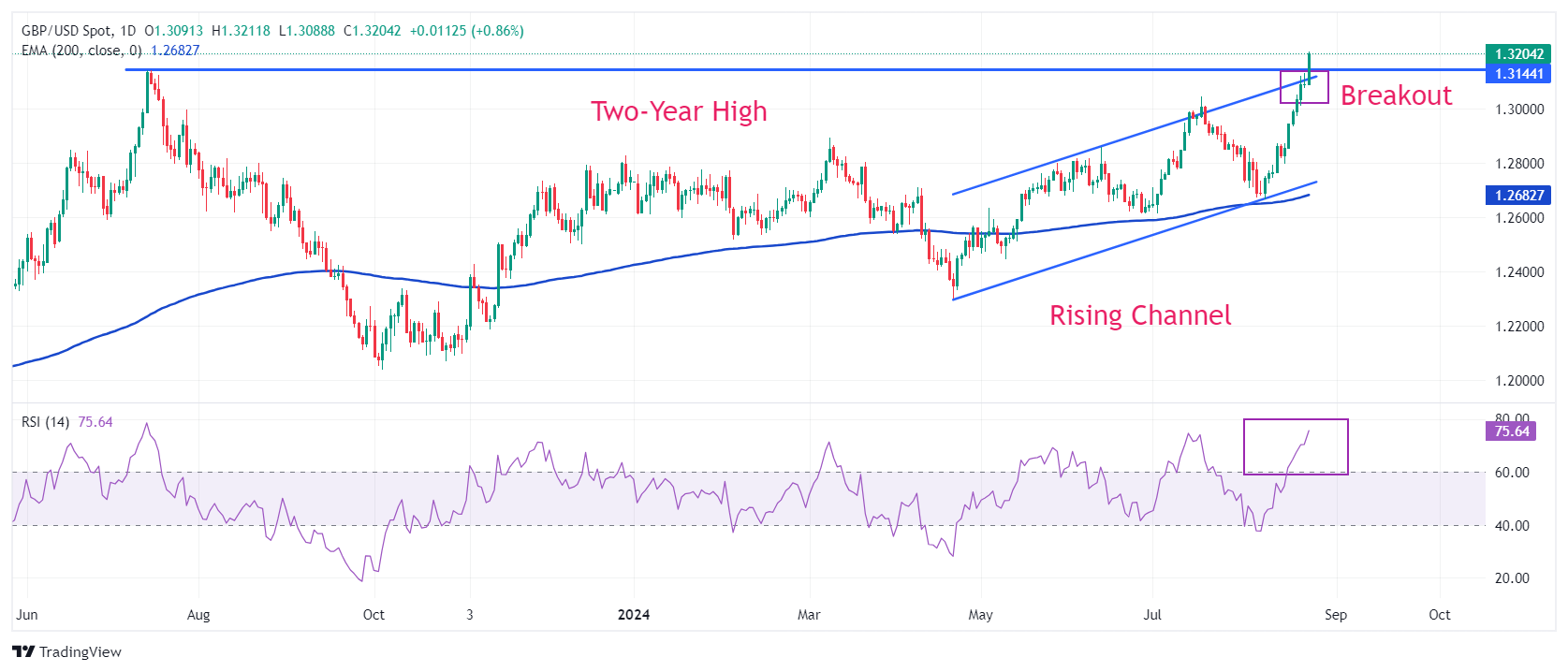
The Pound Sterling refreshes more-than-two-year high near 1.3200. The GBP/USD pair strengthens after delivering a breakout of the Rising Channel chart pattern, on a daily timeframe, in which each pullback is considered a buying opportunity by market participants. All short-to-long Exponential Moving Average (EMA) are sloping higher, suggesting that the overall trend is bullish.
The 14-period Relative Strength Index (RSI) oscillates in the bullish range of 60.00-80.00, suggesting a strong upside momentum. Still, it has reached overbought levels at around 70.00, increasing the chances of a corrective pullback. On the downside, the psychological level of 1.3000 will be the crucial support for the Pound Sterling bulls.
Economic Indicator
Jackson Hole Symposium
The Jackson Hole Economic Policy Symposium is an annual symposium sponsored by the Federal Reserve Bank of Kansas City since 1978, and held in Jackson Hole, Wyoming, since 1981. It is a forum for central bankers, policy experts and academics to come together to focus on a topic.
Read more.Last release: Fri Aug 23, 2024 00:00
Frequency: Irregular
Actual: -
Consensus: -
Previous: -
Author

Sagar Dua
FXStreet
Sagar Dua is associated with the financial markets from his college days. Along with pursuing post-graduation in Commerce in 2014, he started his markets training with chart analysis.