Pound Sterling faces pressure after upbeat US Retail Sales, lower jobless claims
- The Pound Sterling trades near 1.3000 against the US Dollar as slowing UK inflation fuels BoE’s dovish bets.
- UK service inflation slowed to 4.9%, the lowest level since May 2022.
- Growing speculation of a Trump victory in the US presidential elections has strengthened the US Dollar.

The Pound Sterling (GBP) struggles to return above the psychological figure of 1.3000 against the US Dollar in Thursday’s New York session. The GBP/USD pair surrenders some of its intraday gains as the US Dollar rises after the release of the upbeat monthly Retail Sales for September and upbeat Initial Jobless Claims data for the week ending October 11.
The US Retail Sales data, a key measure of consumer spending, rose by 0.4%, faster than estimates of 0.3% and the August reading of 0.1%. The report showed that sales receipts at Retail and Food stores and demand for clothing were robust. However, footfall at furniture stores was quite low. Meanwhile, individuals claiming jobless benefits for the first time were 241K, lower than estimates and the prior release of 260K.
The US Dollar Index (DXY), which tracks the Greenback’s value against six major currencies, posts a fresh over 10-week high near 103.70. The outlook of the US Dollar was already upbeat as traders have priced out Federal Reserve’s (Fed) large rate cut bets in November. Market participants don’t expect the Fed to continue with hefty rate cuts as the recent United States (US) labor market data for September showed that the labor market remains quite resilient.
According to the CME FedWatch tool, 30-day Federal Funds futures pricing data shows that markets broadly expect the central bank will cut interest rates by 25 basis points (bps) in both policy meetings in November and December.
Meanwhile, rising expectations for former US President Donald Trump winning the US presidential elections, scheduled for November 5, has strengthened the US Dollar. Investors expect a Trump administration to provide looser financial conditions, higher import tariffs, and tax cuts.
Daily digest market movers: Pound Sterling strives for firm-footing
- The Pound Sterling strives to gain ground against its major peers on Thursday after facing an intense sell-off on Wednesday. The British currency slumped after the release of the United Kingdom (UK) Consumer Price Index (CPI) data for September, which showed that inflation grew at a slower-than-expected pace.
- Annual headline inflation decelerated to 1.7%, below the Bank of England’s (BoE) target of 2%. The core CPI – which excludes a few of the more volatile items – rose by 3.2%, also lower than expected. UK’s service inflation, a closely watched indicator by BoE officials for decision-making on interest rates, decelerated to 4.9%.
- Plunging inflationary pressures have bolstered BoE dovish bets. Traders are pricing in a 25 basis points (bps) interest rate cut in each of the two policy meetings that remain for the year. Before the inflation data release, market participants were anticipating the BoE to cut its key borrowing rates only once, either in November or December.
- British Finance Minister Rachel Reeves welcomed the sharp drop in inflation ahead of her first budget, which she will present on October 30. A sharp decline in price pressures should allow Reeves to spend more money on development.
- On the economic front, the next important data point in the UK is Retail Sales data for September, which will be published on Friday. The Retail Sales data, a key measure of consumer spending, is estimated to have declined 0.3% after gaining 1.1% in August on month-on-month. On an annual basis, the consumer spending measure is expected to have grown by 3.2%, higher than 2.5% in August.
Technical Analysis: Pound Sterling struggles to reclaim 1.3000
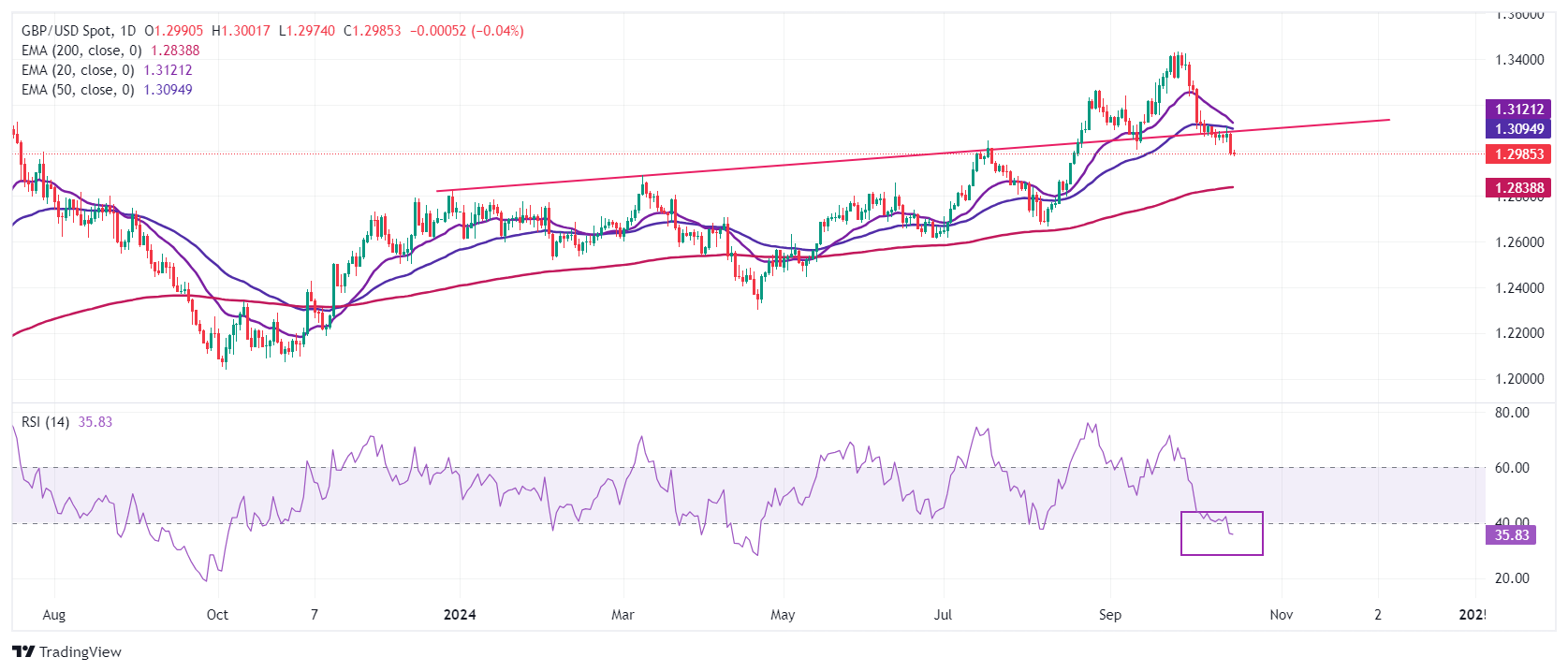
The Pound Sterling struggles to hold the psychological figure of 1.3000 against the US Dollar in North American trading hours. The GBP/USD pair weakened after breaking below the four-day trading range, extending between 1.3020 and 1.3100. The Cable was already under pressure after slipping below the upward-sloping trendline plotted from the 28 December 2023 high of 1.2827 earlier in October.
The near-term trend of the major looks vulnerable as the 20- and 50-day Exponential Moving Averages (EMAs) near 1.3135 and 1.3100, respectively, are sloping downwards.
The recent downside move in the Relative Strength Index (RSI) below 40.00 also suggests a bearish momentum is picking up.
Looking down, the 200-day EMA near 1.2840 will be a major support zone for Pound Sterling bulls. On the upside, the Cable will face resistance near the round-level figure of 1.3100.
Fed FAQs
Monetary policy in the US is shaped by the Federal Reserve (Fed). The Fed has two mandates: to achieve price stability and foster full employment. Its primary tool to achieve these goals is by adjusting interest rates. When prices are rising too quickly and inflation is above the Fed’s 2% target, it raises interest rates, increasing borrowing costs throughout the economy. This results in a stronger US Dollar (USD) as it makes the US a more attractive place for international investors to park their money. When inflation falls below 2% or the Unemployment Rate is too high, the Fed may lower interest rates to encourage borrowing, which weighs on the Greenback.
The Federal Reserve (Fed) holds eight policy meetings a year, where the Federal Open Market Committee (FOMC) assesses economic conditions and makes monetary policy decisions. The FOMC is attended by twelve Fed officials – the seven members of the Board of Governors, the president of the Federal Reserve Bank of New York, and four of the remaining eleven regional Reserve Bank presidents, who serve one-year terms on a rotating basis.
In extreme situations, the Federal Reserve may resort to a policy named Quantitative Easing (QE). QE is the process by which the Fed substantially increases the flow of credit in a stuck financial system. It is a non-standard policy measure used during crises or when inflation is extremely low. It was the Fed’s weapon of choice during the Great Financial Crisis in 2008. It involves the Fed printing more Dollars and using them to buy high grade bonds from financial institutions. QE usually weakens the US Dollar.
Quantitative tightening (QT) is the reverse process of QE, whereby the Federal Reserve stops buying bonds from financial institutions and does not reinvest the principal from the bonds it holds maturing, to purchase new bonds. It is usually positive for the value of the US Dollar.
Author

Sagar Dua
FXStreet
Sagar Dua is associated with the financial markets from his college days. Along with pursuing post-graduation in Commerce in 2014, he started his markets training with chart analysis.

















