Pound Sterling confines in a tight range as focus shifts to US economic data
- Pound Sterling awaits a fresh trigger for guidance on interest rates.
- BoE policymakers are worried about high wage growth momentum.
- Easing geopolitical tensions has trimmed safe-haven bets.

The Pound Sterling (GBP) is stuck in a narrow range in Tuesday’s session as investors seek fresh economic triggers that could provide insights into the timing of rate cuts by the Bank of England (BoE). The GBP/USD pair consolidates as the upside seems restricted as rate cuts by the BoE are inevitable, while more correction in the US Dollar has capped the downside.
The US Dollar Index, which gauges the value of the Greenback against six major currencies, has dropped to 103.70.
Improving hopes of a ceasefire between Israel and Palestine have strengthened the outlook of risk-sensitive assets (GBP), while safe-haven assets have come under pressure (USD).
This week, the US Dollar will be guided by the United States Durable Goods Orders and the core Personal Consumption Expenditure price index (PCE) data for January. A sharp decline in the US core PCE price index would increase hopes of early rate cuts by the Federal Reserve (Fed).
Daily Digest Market Movers: Pound Sterling consolidates ahead of US data
- Pound Sterling struggles to extend recovery above the round-level resistance of 1.2700 as market participants seek fresh guidance on interest rates.
- Investors remain uncertain about the timing for rate cuts by the Bank of England as policymakers need more evidence to confirm that inflation will come down sustainably to the 2% target.
- BoE policymakers see momentum in wage growth is currently twice that required to tame sticky price pressures, allowing them to remain leaned towards holding interest rates elevated.
- Meanwhile, speculators have trimmed their bullish positions in the Pound Sterling for the first time in eight weeks, suggesting that they may be searching for a new catalyst to give the currency a fresh pep, Reuters reported.
- While the BoE is widely anticipated to begin reducing interest rates after the Federal Reserve, prospects for the economic outlook of the United Kingdom economy will influence the timing for rate cuts.
- The Services PMI for the last two months has indicated that the technical recession in the second half of 2023 was shallow.
- Robust order book and higher business optimism indicate that the economy aims for a sharp recovery.
- UK business optimism has improved amid imminent hopes of the BoE pivoting to rate cuts and easing the cost of living crisis.
- On the consumer spending front, the Confederation of British Industry (CBI) reports that the momentum at which Retail Sales have been declining slowed sharply in February.
- The CBI has reported the monthly retail sales balance, a gauge of sales versus a year ago, rose to -7 from -50 in January, the slowest fall in 10 months, Reuters reported.
- This indicates an improvement in consumers’ appetite for spending, which would allow businesses to return to their average operating capacity.
- Meanwhile, the US Dollar gauges a temporary cushion despite a sharp decline in US Durable Goods Orders data for January. Orders placed for Durable Goods fell by 6.1%, while investors projected a decline of 4.8%. In December, Durable Goods Orders dropped by 0.3%, revised from stagnant growth.
Technical Analysis: Pound Sterling struggles to climb above 1.2700
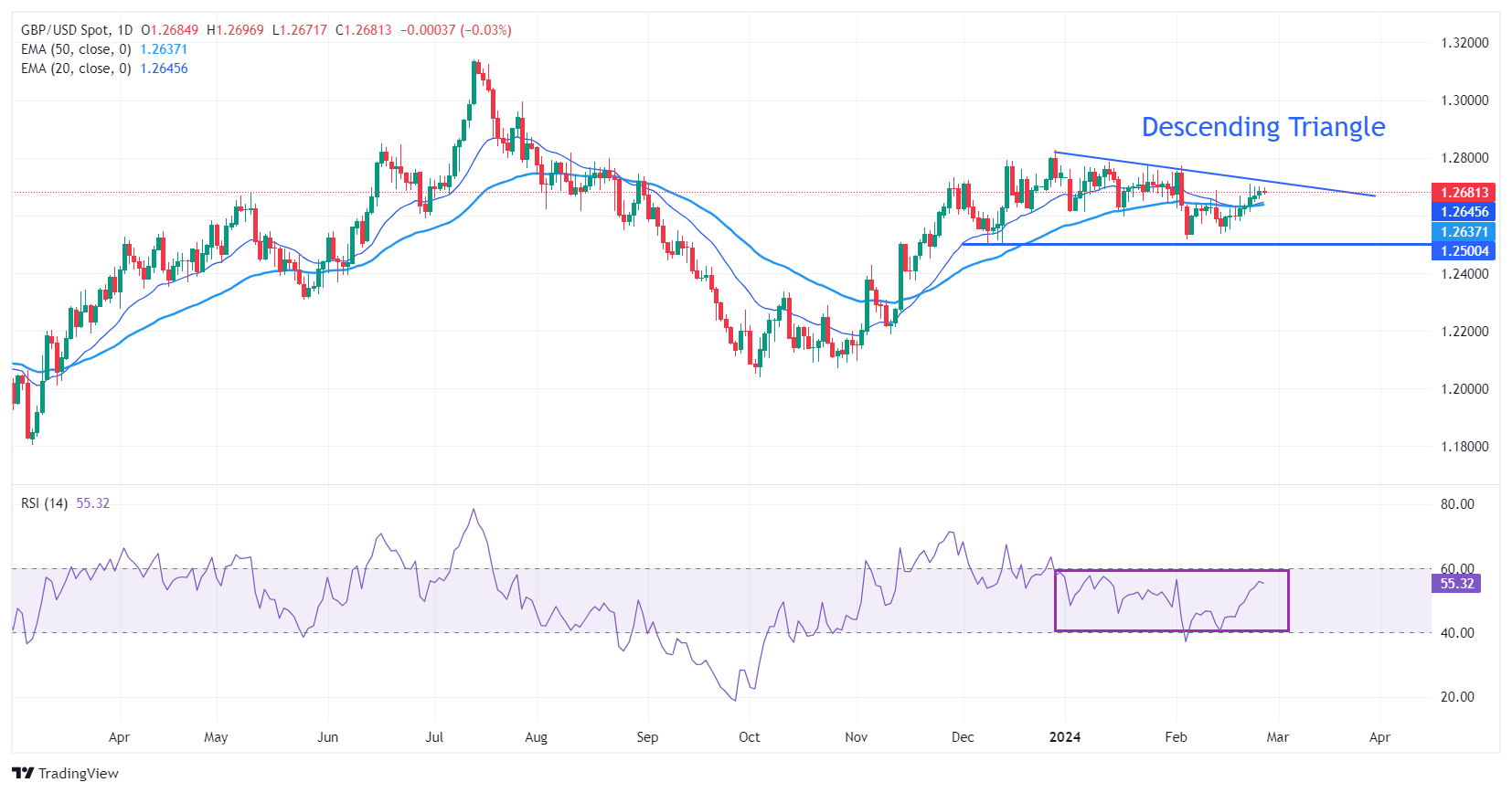
Pound Sterling trades inside Monday’s trading range due to the light UK economic calendar this week. The pair approaches the downward-sloping border of the Descending Triangle pattern which has formed on a daily time frame, traced from the December 28 high at 1.2827. While, the horizontal support is plotted from December 13 low near 1.2500.
The pair holds above the 20 and 50-day Exponential Moving Averages (EMAs), which trade around 1.2630. Meanwhile, the 14-period Relative Strength Index (RSI) marches toward 60.00. A bullish momentum will trigger if the RSI (14) manages to climb above 60.00.
BoE FAQs
What does the Bank of England do and how does it impact the Pound?
The Bank of England (BoE) decides monetary policy for the United Kingdom. Its primary goal is to achieve ‘price stability’, or a steady inflation rate of 2%. Its tool for achieving this is via the adjustment of base lending rates. The BoE sets the rate at which it lends to commercial banks and banks lend to each other, determining the level of interest rates in the economy overall. This also impacts the value of the Pound Sterling (GBP).
How does the Bank of England’s monetary policy influence Sterling?
When inflation is above the Bank of England’s target it responds by raising interest rates, making it more expensive for people and businesses to access credit. This is positive for the Pound Sterling because higher interest rates make the UK a more attractive place for global investors to park their money. When inflation falls below target, it is a sign economic growth is slowing, and the BoE will consider lowering interest rates to cheapen credit in the hope businesses will borrow to invest in growth-generating projects – a negative for the Pound Sterling.
What is Quantitative Easing (QE) and how does it affect the Pound?
In extreme situations, the Bank of England can enact a policy called Quantitative Easing (QE). QE is the process by which the BoE substantially increases the flow of credit in a stuck financial system. QE is a last resort policy when lowering interest rates will not achieve the necessary result. The process of QE involves the BoE printing money to buy assets – usually government or AAA-rated corporate bonds – from banks and other financial institutions. QE usually results in a weaker Pound Sterling.
What is Quantitative tightening (QT) and how does it affect the Pound Sterling?
Quantitative tightening (QT) is the reverse of QE, enacted when the economy is strengthening and inflation starts rising. Whilst in QE the Bank of England (BoE) purchases government and corporate bonds from financial institutions to encourage them to lend; in QT, the BoE stops buying more bonds, and stops reinvesting the principal maturing on the bonds it already holds. It is usually positive for the Pound Sterling.
Author

Sagar Dua
FXStreet
Sagar Dua is associated with the financial markets from his college days. Along with pursuing post-graduation in Commerce in 2014, he started his markets training with chart analysis.