Pound Sterling surges to 1.3300 as BoE keeps interest rates steady at 5%
- The Pound Sterling surges to near 1.3300 against the US Dollar following the Fed’s large rate cut and expectations of further policy easing.
- The BoE leaves interest rates unchanged at 5%, as expected.
- UK services inflation accelerated to 5.6% in August.

The Pound Sterling (GBP) strengthens against its major peers on Thursday after the Bank of England's (BoE) monetary policy announcement. The BoE left interest rates unchanged at 5%, as expected, as the United Kingdom (UK) core Consumer Price Index (CPI) data for August came in higher than expected.
Out of the nine Monetary Policy Committee (MPC) members, BoE external member Swati Dhingra seldom voted for cutting interest rates for the second consecutive time. The rest of the MPC supported keeping rates at their current levels. Investors were expecting that two MPC members would support a dovish policy decision.
Meanwhile, members unanimously voted to trim the holding of government bonds by 100 billion pounds over the coming 12 months.
The UK core inflation – which excludes volatile items – accelerated to 3.6%, higher than what markets expected. Services inflation, a closely watched indicator by BoE officials, rose sharply to 5.6% from 5.2% in July.
Currently, financial market participants expect that the BoE will cut interest rates one more time in any of its remaining monetary policy meetings.
British Pound PRICE Today
The table below shows the percentage change of British Pound (GBP) against listed major currencies today. British Pound was the strongest against the Japanese Yen.
| USD | EUR | GBP | JPY | CAD | AUD | NZD | CHF | |
|---|---|---|---|---|---|---|---|---|
| USD | -0.08% | -0.22% | 1.02% | -0.27% | -0.64% | -0.34% | 0.52% | |
| EUR | 0.08% | -0.15% | 1.10% | -0.18% | -0.54% | -0.26% | 0.60% | |
| GBP | 0.22% | 0.15% | 1.26% | -0.04% | -0.41% | -0.11% | 0.74% | |
| JPY | -1.02% | -1.10% | -1.26% | -1.26% | -1.64% | -1.37% | -0.51% | |
| CAD | 0.27% | 0.18% | 0.04% | 1.26% | -0.37% | -0.07% | 0.78% | |
| AUD | 0.64% | 0.54% | 0.41% | 1.64% | 0.37% | 0.30% | 1.14% | |
| NZD | 0.34% | 0.26% | 0.11% | 1.37% | 0.07% | -0.30% | 0.86% | |
| CHF | -0.52% | -0.60% | -0.74% | 0.51% | -0.78% | -1.14% | -0.86% |
The heat map shows percentage changes of major currencies against each other. The base currency is picked from the left column, while the quote currency is picked from the top row. For example, if you pick the British Pound from the left column and move along the horizontal line to the US Dollar, the percentage change displayed in the box will represent GBP (base)/USD (quote).
Daily digest market movers: Pound Sterling gives up majority of its gains against US Dollar
- The Pound Sterling surrenders the majority of its gains against the US Dollar in Thursday's North American session. The GBP/USD pair drops after posting a fresh two-year high of 1.3300 as the US Dollar rebounds after the release of the United States (US) Initial Jobless Claims data for the week ending September 13. The US Dollar Index (DXY), which tracks the Greenback’s value against six major currencies, bounces back above 101.00.
- The number of individuals claiming jobless benefits for the first time was 219K, lower than estimates of 230K, and the former release of 231K, upwardly revised from 230K. The impact of the better-than-expected jobless claims data is expected to be short-lived as market speculation for the Federal Reserve (Fed) interest rate cut path will pay a major role in its next move.
- On Wednesday, the Fed delivered a 50-basis points (bp) interest rate cut , which signaled that the central bank is confident that inflation is declining to the bank’s target of 2% and is increasingly concerned over deteriorating labor market conditions. Fed Chair Jerome Powell ruled out fears of the United States (US) economy entering a recession: "I don't see anything in the economy right now that suggests that the likelihood of a recession," he said, adding that "you see growth at a solid rate, you see inflation coming down, and you see a labor market that's still at very solid levels."
- Fed officials anticipate the federal funds rate heading to 4.4% by the end of the year, suggesting that the Fed will cut interest rates by 50 bps more. According to the CME FedWatch tool, the probability for the Fed reducing interest rates by 25 bps to 4.50%-4.75% in November is at 65.6%, while the rest favors a 50-bps rate cut.
- Analysts at Citi see the Fed reducing interest rates by 50 bps again in November. “Powell noted a number of times that today’s 50bp cut is a ‘commitment’ to not get behind the curve, which suggests the bar for further large rate reductions is very low. We continue to see risks as balanced toward a more rapid softening of labor market data and a more aggressive pace of rate cuts.”
Technical Analysis: Pound Sterling struggles to reclaim 1.3300
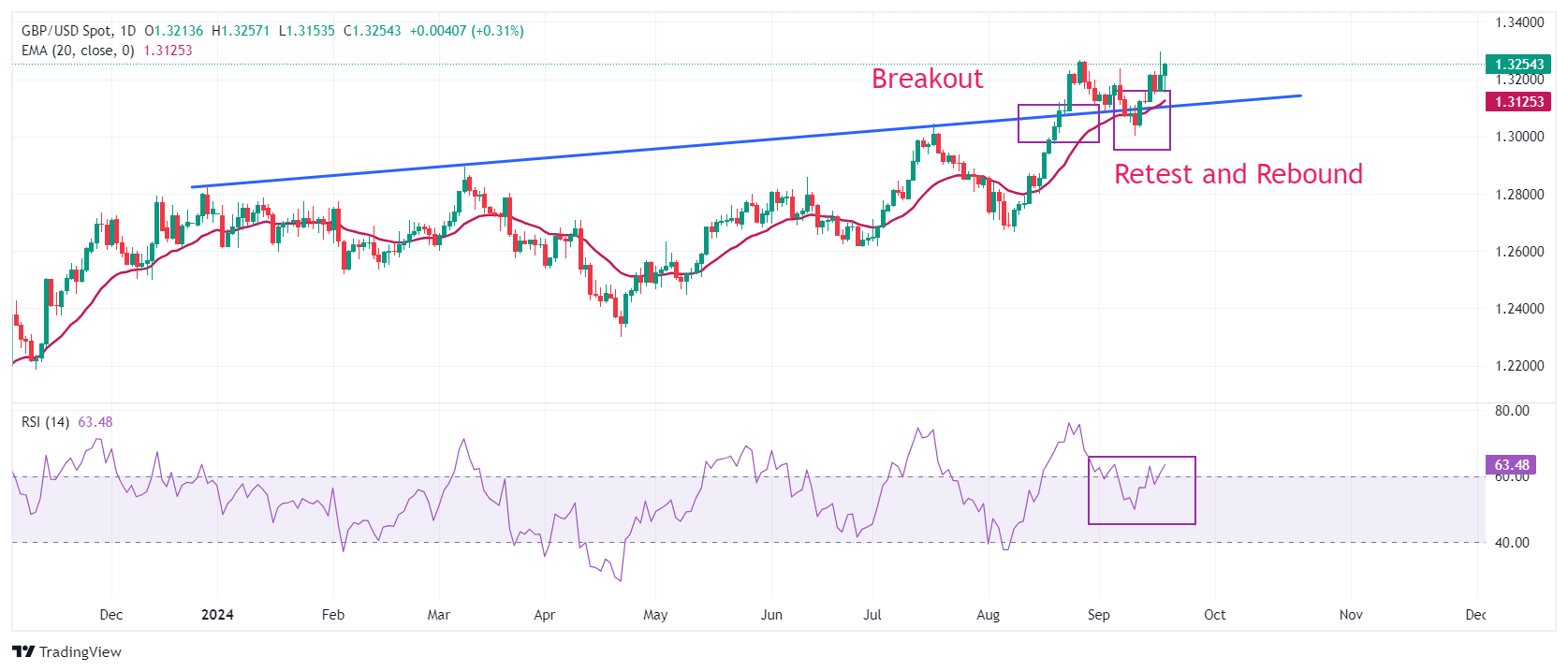
The Pound Sterling aims to capture 1.3300 against the US Dollar in European trading hours. The near-term outlook of the GBP/USD pair remains firm as it holds above the 20-day Exponential Moving Average (EMA) near 1.3100. Earlier, the Cable strengthened after recovering from a corrective move to near the trendline plotted from the December 28, 2023, high of 1.2828, from where it delivered a sharp increase after a breakout on August 21.
The 14-day Relative Strength Index (RSI) stands above 60.00. A fresh round of bullish momentum could occur if the oscillator sustains around this level.
Looking up, the Cable will face resistance near the August 27 high of 1.3266 and the psychological level of 1.3500. On the downside, the psychological level of 1.3000 emerges as crucial support.
Economic Indicator
BoE Interest Rate Decision
The Bank of England (BoE) announces its interest rate decision at the end of its eight scheduled meetings per year. If the BoE is hawkish about the inflationary outlook of the economy and raises interest rates it is usually bullish for the Pound Sterling (GBP). Likewise, if the BoE adopts a dovish view on the UK economy and keeps interest rates unchanged, or cuts them, it is seen as bearish for GBP.
Read more.Last release: Thu Sep 19, 2024 11:00
Frequency: Irregular
Actual: 5%
Consensus: 5%
Previous: 5%
Source: Bank of England
Author

Sagar Dua
FXStreet
Sagar Dua is associated with the financial markets from his college days. Along with pursuing post-graduation in Commerce in 2014, he started his markets training with chart analysis.