Pound Sterling gains as UK Reeves prioritizes growth and liberalization
- The Pound Sterling rises as UK Rachel Reeves presents a strong economic agenda.
- Investors focus on the Fed’s monetary policy meeting in which the central bank will interest rates steady.
- The White House reported that US President Trump was still considering tariffs on Canada and Mexico on February 1.

The Pound Sterling (GBP) gains against its major peers, except safe-haven currencies such as US Dollar and Japanese Yen (JPY) on Wednesday as United Kingdom (UK) Chancellor of the Exchequer Rachel Reeves reiterated Prime Minister Keir Starmer's positive outlook on the economy, saying that the economy is on the brisk of a “turnaround” in a speech in Oxfordshire. Reeves vowed to remove "stifling and unpredictable" regulations to boost productivity.
On trade relations with the US, Reeves said that she looks forward to working with the new Treasury secretary "to deepen their economic relationship". Reeves added, "PM Keir Starmer discussed the importance of growth with US President Donald Trump last weekend."
On Tuesday, Keir Starmer also said in an interview with Bloomberg that we've already got a “huge amount of trade” between our two countries, and the base is there for even “better trading relations”.
On the monetary policy front, traders are confident that the Bank of England (BoE) will reduce interest rates by 25 bps to 4.5% in its first policy meeting of the year on February 6. Traders have priced in a 25 bps interest rate reduction as the UK inflation grew at a slower-than-projected pace and Retail Sales surprisingly declined in December. Also, the labor demand has slowed due to Rachel Reeves’ decision to hike employers’ contributions to National Insurance (NI).
British Pound PRICE Today
The table below shows the percentage change of the British Pound (GBP) against listed major currencies today. The British Pound was the strongest against the Australian Dollar.
| USD | EUR | GBP | JPY | CAD | AUD | NZD | CHF | |
|---|---|---|---|---|---|---|---|---|
| USD | 0.25% | 0.11% | -0.11% | 0.25% | 0.47% | 0.38% | 0.25% | |
| EUR | -0.25% | -0.15% | -0.36% | -0.01% | 0.22% | 0.14% | -0.00% | |
| GBP | -0.11% | 0.15% | -0.23% | 0.14% | 0.36% | 0.27% | 0.14% | |
| JPY | 0.11% | 0.36% | 0.23% | 0.36% | 0.58% | 0.48% | 0.37% | |
| CAD | -0.25% | 0.00% | -0.14% | -0.36% | 0.22% | 0.13% | 0.00% | |
| AUD | -0.47% | -0.22% | -0.36% | -0.58% | -0.22% | -0.09% | -0.21% | |
| NZD | -0.38% | -0.14% | -0.27% | -0.48% | -0.13% | 0.09% | -0.13% | |
| CHF | -0.25% | 0.00% | -0.14% | -0.37% | -0.01% | 0.21% | 0.13% |
The heat map shows percentage changes of major currencies against each other. The base currency is picked from the left column, while the quote currency is picked from the top row. For example, if you pick the British Pound from the left column and move along the horizontal line to the US Dollar, the percentage change displayed in the box will represent GBP (base)/USD (quote).
Daily digest market movers: Pound Sterling underperforms USD ahead of Fed’s policy decision
- The Pound Sterling falls to near 1.2400 against the US Dollar (USD) in Wednesday’s North American session. The GBP/USD pair drops as the US Dollar recovers ahead of the Federal Reserve’s (Fed) monetary policy decision, which will be announced at 19:00 GMT. The US Dollar Index (DXY), which tracks the Greenback’s value against six major currencies, bounces back to near 108.00.
- Traders are confident that the Fed will announce a pause in the current policy easing spell and keep interest rates unchanged in the range of 4.25%-4.50%, according to the CME FedWatch tool. In the last three policy meetings, the Fed has reduced its key borrowing rates by 100 basis points (bps).
- Therefore, the Fed’s guidance on how long it will keep borrowing costs at their current levels will significantly influence the US Dollar. Apart from that, investors will also pay attention to the Fed’s views on United States (US) President Donald Trump’s tariffs plans and their impact on the monetary policy outlook and inflation.
- White House Press Secretary Karoline Leavitt stated on Tuesday that 25% tariffs on Canada and Mexico from February 1 are “still on the books”. Leavitt added that the President is “very much still considering 10% tariffs on China” from Saturday.
- This week, Trump also said that he planned to impose tariffs on the import of pharmaceuticals, advanced chips, and steel in an attempt to encourage domestic manufacturing.
Technical Analysis: Pound Sterling remains on tenterhooks around 1.2400
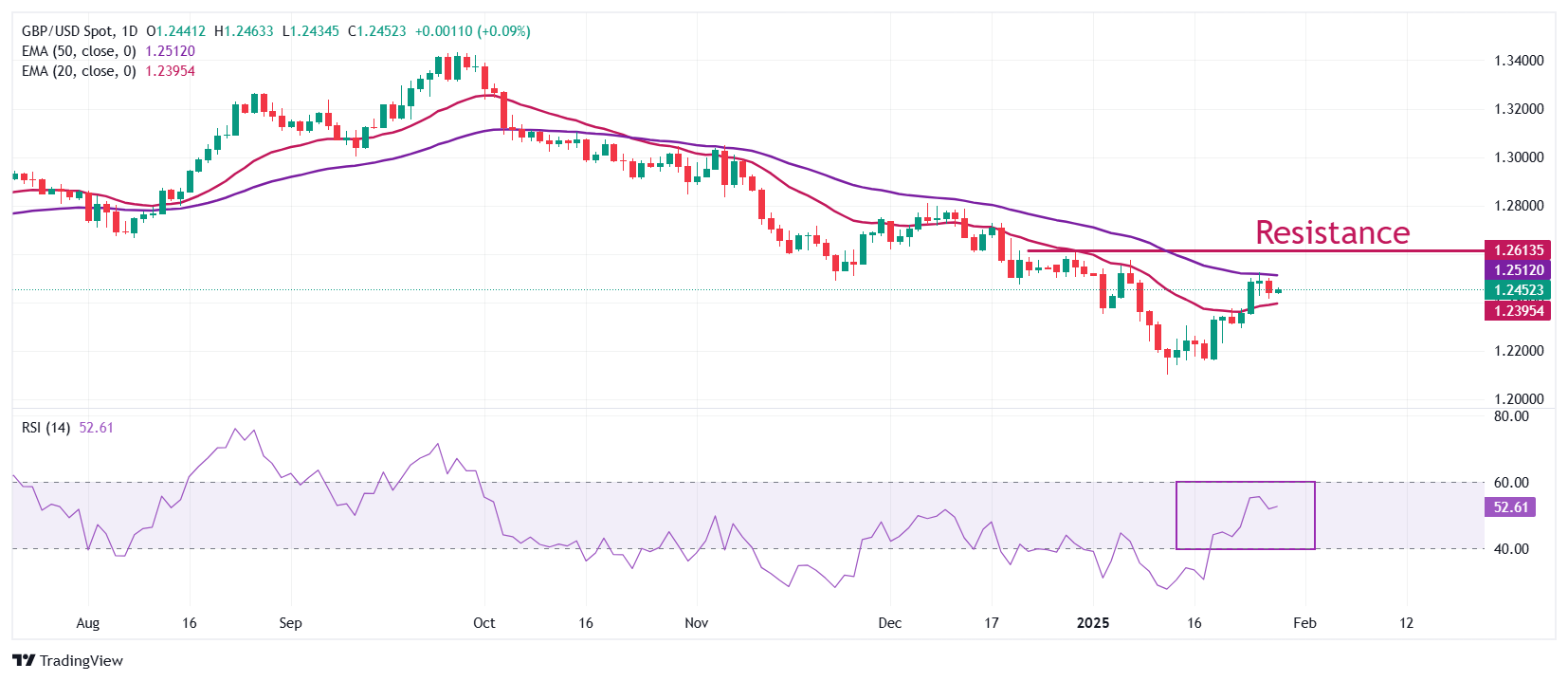
The Pound Sterling struggles to regain ground on Wednesday after correcting to near 1.2400 against the US Dollar the previous day. The near-term outlook of the GBP/USD pair remains firm as it holds the 20-day Exponential Moving Average (EMA), which trades around 1.2400. However, the 50-day EMA near 1.2510 continues to be a major barrier for the Sterling bulls.
The 14-day Relative Strength Index (RSI) moves higher above 50.00 from the 20.00-40.00 range, suggesting that the bearish momentum has ended, at least for now.
Looking down, the January 13 low of 1.2100 and the October 2023 low of 1.2050 will act as key support zones for the pair. On the upside, the December 30 high of 1.2607 will act as key resistance.
Tariffs FAQs
Tariffs are customs duties levied on certain merchandise imports or a category of products. Tariffs are designed to help local producers and manufacturers be more competitive in the market by providing a price advantage over similar goods that can be imported. Tariffs are widely used as tools of protectionism, along with trade barriers and import quotas.
Although tariffs and taxes both generate government revenue to fund public goods and services, they have several distinctions. Tariffs are prepaid at the port of entry, while taxes are paid at the time of purchase. Taxes are imposed on individual taxpayers and businesses, while tariffs are paid by importers.
There are two schools of thought among economists regarding the usage of tariffs. While some argue that tariffs are necessary to protect domestic industries and address trade imbalances, others see them as a harmful tool that could potentially drive prices higher over the long term and lead to a damaging trade war by encouraging tit-for-tat tariffs.
During the run-up to the presidential election in November 2024, Donald Trump made it clear that he intends to use tariffs to support the US economy and American producers. In 2024, Mexico, China and Canada accounted for 42% of total US imports. In this period, Mexico stood out as the top exporter with $466.6 billion, according to the US Census Bureau. Hence, Trump wants to focus on these three nations when imposing tariffs. He also plans to use the revenue generated through tariffs to lower personal income taxes.
Author

Sagar Dua
FXStreet
Sagar Dua is associated with the financial markets from his college days. Along with pursuing post-graduation in Commerce in 2014, he started his markets training with chart analysis.















