Pound Sterling declines as UK jobless rate accelerates
- The Pound Sterling slumps below 1.2800 against the US Dollar after the release of the weak UK employment data.
- UK Unemployment Rate jumped to 4.3%, while Average Earnings grew faster than expected in the three months ending September.
- Investors await the US inflation data for fresh interest-rate guidance.

The Pound Sterling (GBP) weakens against its major peers on Tuesday after the employment data from the United Kingdom (UK) showed loosening labor market conditions in three months ending September. The Office for National Statistics (ONS) reported that the ILO Unemployment Rate rose to 4.3% from 4.0% in the three months ending August, higher than estimates of 4.1%. In the same period, UK employers added 219K new workers, fewer than the former release of 373K.
Signs of slowing labor demand have weighed on the British currency even as not all components of the release were GBP-negative. Average Earnings data, a measure of wage growth, grew at a faster-than-expected pace in the three months ending September. Earnings excluding bonuses rose by 4.8%, higher than estimates of 4.7% but slower than the former release of 4.9%. Average Earnings Including bonuses accelerated to 4.3% against expectations and the prior reading of 3.9%.
Bank of England (BoE) officials have been closely tracking wage growth when deciding on interest rates as it is a major driving force to inflationary pressures in the service sector. The policy-easing cycle by the BoE has been more gradual compared with other G-7 nations, and higher service inflation is the key reason behind this approach.
It will be interesting to see whether traders increase BoE rate cut bets due to the slowing job market or pare them amid faster-than-projected wage growth. Currently, traders are slightly bent towards another interest rate reduction by 25 basis points (bps) in the December monetary policy meeting. The BoE also reduced its key borrowing rates by 25 bps last week, but favored a more gradual policy-easing approach.
On wage growth, BoE Chief Economist Huw Pill said that pay growth remains quite sticky at elevated levels that are hard to reconcile with the bank's inflation target of 2%," at the conference organized by Swiss bank UBS. Pill emphasized the need to consider a higher interest rate scenario for stabilizing the economy, which has not been the base case in Britain.
Daily digest market movers: Pound Sterling extends its downside against US Dollar
- The Pound Sterling slides below 1.2800 against the US Dollar (USD) in Tuesday’s North American session, the lowest level seen in almost three months. The GBP/USD pair weakens due to a slower UK job market and the strength in the US Dollar across the board.
- The US Dollar Index (DXY), which gauges the Greenback’s value against six major currencies, refreshes a four-month high above 105.70. The Greenback extends its upside trend generated by Donald Trump’s victory in the United States (US) presidential election as it looks increasingly likely that Republicans will control both the Senate and the House of Representatives when Trump takes office in January, according to projections from Decision Desk HQ.
- Trump’s protectionist trade practices and his promise to lower corporate taxes are expected to boost inflationary pressures, which would force the Federal Reserve (Fed) to follow a more gradual policy-easing approach. In the December policy meeting, the Fed is expected to cut interest rates again by 25 basis points (bps) to 4.25%-4.50%, according to the CME FedWatch tool. Still, investors have recently pared back bets of such an outcome.
- Meanwhile, investors await the US Consumer Price Index (CPI) data for October, which will be released on Wednesday, and commentary from a slew of Fed policymakers for fresh interest rate guidance. Economists expect the headline inflation to have grown by 2.6%, faster than 2.4% in September on year-on-year. In the same period, the core CPI – which excludes volatile food and energy prices – is expected to have risen steadily by 3.3%.
- The impact of inflation is expected to be weak on the Fed monetary policy action in December unless there is a significant deviation from the consensus, as policymakers seem to be confident about inflation remaining on track to the bank’s target of 2%.
Technical Analysis: Pound Sterling establishes below 200-day EMA
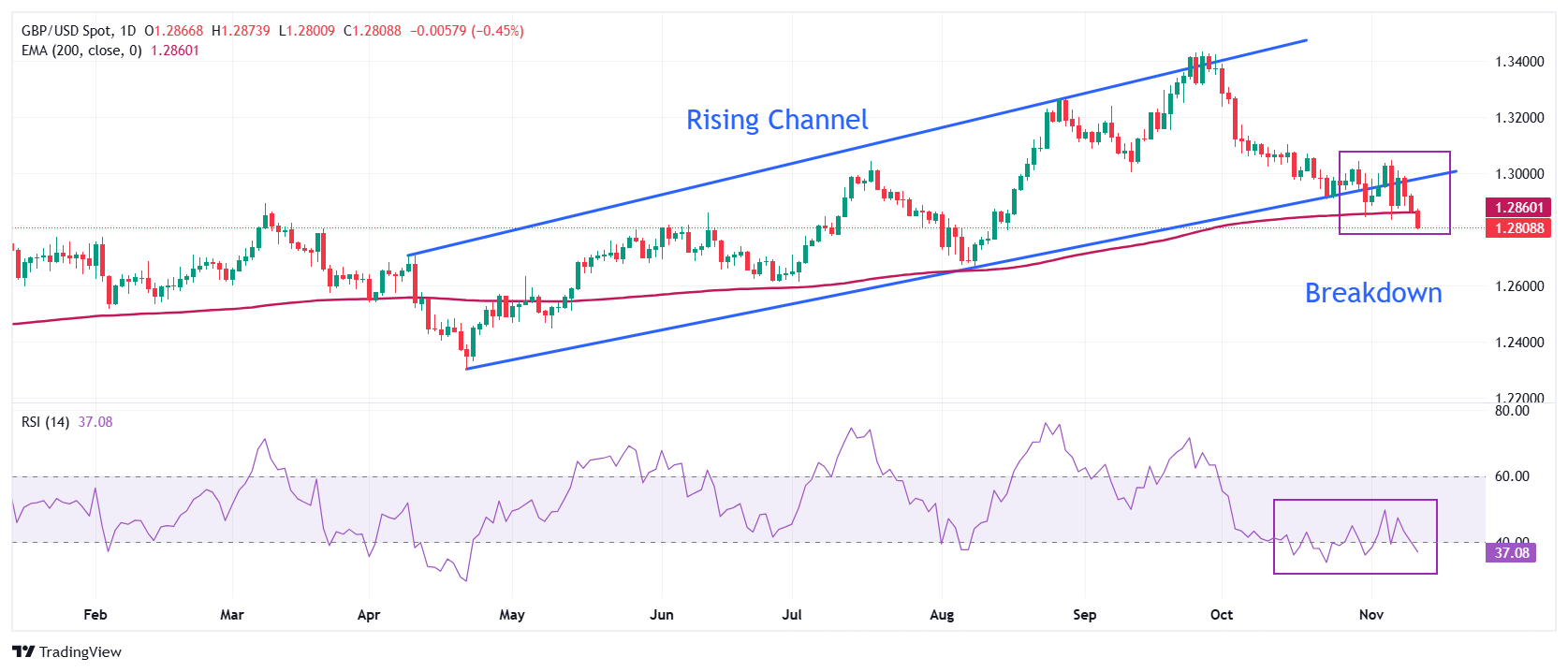
The Pound Sterling posts a fresh almost three-month low near 1.2800 against the US Dollar. The GBP/USD extends its downside after failing to hold the 200-day Exponential Moving Average (EMA), which trades around 1.2860. The overall trend of the Cable turned negative after a breakdown from the lower boundary of the rising channel, which set a bearish reversal.
A bearish momentum has kicked in with the 14-day Relative Strength Index (RSI) falling below 40.00.
Looking down, the August low at 1.2665 will be a major cushion for Pound Sterling bulls. On the upside, the Cable will face resistance near the psychological figure of 1.3000.
Author

Sagar Dua
FXStreet
Sagar Dua is associated with the financial markets from his college days. Along with pursuing post-graduation in Commerce in 2014, he started his markets training with chart analysis.

















