Pound Sterling capitalizes on weak US ISM Manufacturing PMI
- The Pound Sterling rises to 1.2770 as US ISM Manufacturing PMI for May misses estimates.
- UK’s stubborn service inflation keeps the uncertainty about the timing of BoE rate cuts.
- The US Dollar weakens amid improvement in Fed rate-cut prospects.


The Pound Sterling (GBP) climbs to near 1.2780 against the US Dollar (USD) in Monday’s American session. The GBP/USD pair strengthens at the beginning of a data-packed week in the United States (US) as the Institute for Supply Management (ISM) Manufacturing Purchasing Managers Index (PMI) data for May missed estimates.
The Manufacturing PMI, which gauges factory activity, declines to 48.7 from the consensus of 49.8 and the prior reading of 49.2. A figure below the 50.0 threshold is itself considered a contraction. However, the preliminary S&P Global PMI report for May – another survey that also gauges activity in the US manufacturing sector – showed that the PMI rose to a two-month high at 50.9 from April’s reading of 50.0.
In the PMI report, other subcomponents, such as the New Orders and Price Paid indexes, also remain downbeat. The New Orders Index, which gives insights into the demand outlook, falls to 45.4 from the former release of 49.1. The Prices Paid Index, which reflects a change in input prices of the manufacturing sector, drops at a faster pace to 57.0 from the estimates of 60.0 and the prior release of 60.9. Analysts take both indexes as good leading indicators of upcoming inflation pressures.
Later this week, investors will keenly watch the US ISM Services PMI and the official Employment data, which will be published on Wednesday and Friday, respectively. Meanwhile, there aren’t any top-tier events in the United Kingdom (UK) economic calendar.
Daily digest market movers: Pound Sterling strengthens after weak US ISM Manufacturing PMI
- The Pound Sterling exhibits strength against the US Dollar. The US Dollar Index (DXY), which tracks the Greenback’s value against six major currencies, tumbles to 104.25 after weak US ISM factory activity data.
- The US Dollar was already under pressure after the US Personal Consumption Expenditure Price Index (PCE) report showed on Friday that Personal Spending grew at a slower pace. However, price pressures remained elevated in April.
- Annual core PCE inflation, the Fed’s preferred inflation measure, grew expectedly by 2.8%. On a month-on-month basis, the underlying data grew by 0.2%, missing estimates and less than the prior reading of 0.3%.
- Personal Spending rose at a slower pace of 0.2% in April, less than estimates of 0.3% and the former release of 0.7%. A significant deceleration in consumer spending, which accounts for more than two-thirds of US economic activity, raised concerns over a deepening household crisis due to the Fed maintaining interest rates higher for a longer period.
- After weak consumer spending data, investors have become slightly more confident that the Fed will cut interest rates at least once this year. The CME FedWatch tool shows that the probability of a rate cut in the September meeting has increased to 52% from 49% a week ago.
- In the UK, investors remain uncertain about the Bank of England’s (BoE) rate-cut time frame. Financial markets expect that the BoE could start reducing interest rates from the August meeting. UK annual headline inflation has come down significantly to 2.3% in April but BoE policymakers remain worried about slower progress in the service disinflation process. UK service inflation is at 5.9%, broadly driven by wage growth, is much higher than what is needed to ensure that inflation will return to the desired rate of 2%.
- Meanwhile, UK inflation expectations for the next 12 months have dropped significantly. A monthly Citi/YouGov survey showed that public expectations for next year decelerated to 3.1% in May, which is the lowest level since July 2021.
Technical Analysis: Pound Sterling attempts descending triangle breakout
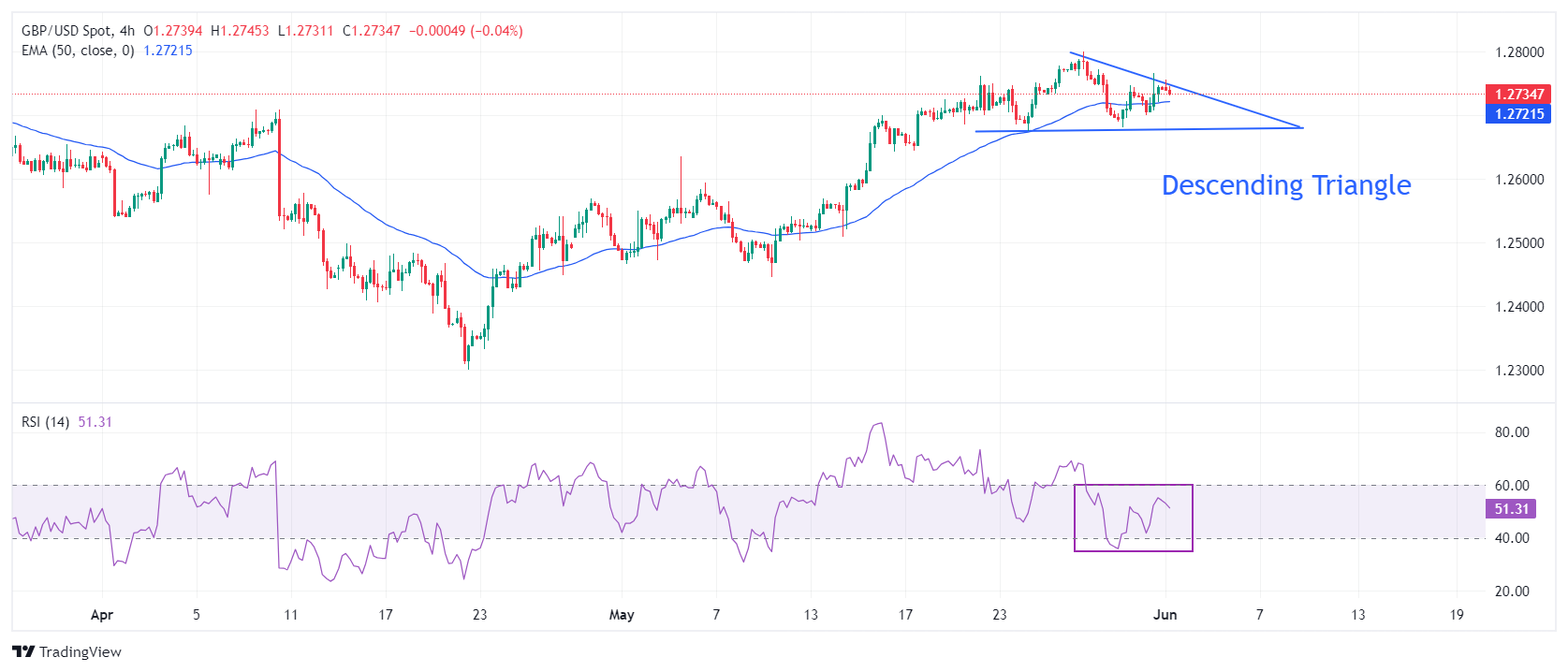
The Pound Sterling advances to 1.2760. The GBP/USD pair attempts a breakout of the Descending Triangle formation in the 4-hour time frame. The downward-sloping border of the above-mentioned chart pattern is plotted from May 28 high near 1.2800, while the horizontal support is marked from May 24 low at 1.2676.
The 50-day Exponential Moving Average (EMA) near 1.2720 continues to support the Pound Sterling bulls.
Meanwhile, the 14-period Relative Strength Index (RSI) has climbed above 60.00. A sustainable move above 60.00 will push the momentum towards the upside.
Economic Indicator
ISM Manufacturing PMI
The Institute for Supply Management (ISM) Manufacturing Purchasing Managers Index (PMI), released on a monthly basis, is a leading indicator gauging business activity in the US manufacturing sector. The indicator is obtained from a survey of manufacturing supply executives based on information they have collected within their respective organizations. Survey responses reflect the change, if any, in the current month compared to the previous month. A reading above 50 indicates that the manufacturing economy is generally expanding, a bullish sign for the US Dollar (USD). A reading below 50 signals that factory activity is generally declining, which is seen as bearish for USD.
Read more.Last release: Mon Jun 03, 2024 14:00
Frequency: Monthly
Actual: 48.7
Consensus: 49.6
Previous: 49.2
Source: Institute for Supply Management
The Institute for Supply Management’s (ISM) Manufacturing Purchasing Managers Index (PMI) provides a reliable outlook on the state of the US manufacturing sector. A reading above 50 suggests that the business activity expanded during the survey period and vice versa. PMIs are considered to be leading indicators and could signal a shift in the economic cycle. Stronger-than-expected prints usually have a positive impact on the USD. In addition to the headline PMI, the Employment Index and the Prices Paid Index numbers are watched closely as they shine a light on the labour market and inflation.
Author
Sagar Dua
FXStreet
Sagar Dua is associated with the financial markets from his college days. Along with pursuing post-graduation in Commerce in 2014, he started his markets training with chart analysis.