Pound Sterling gains as investors ignore mild uptick in BoE dovish bets
- The Pound Sterling tmoves higher in a light trading volume session amid holidays in global markets on account of Christmas Day.
- Fed policymakers see the fund rates heading to 3.9% by the end of 2025.
- Trades have fully priced in two interest rate cuts by the BoE next year.

The Pound Sterling (GBP) advances against its major peers on Tuesday. The British currency gains as investors largely ignore a mild increase in Bank of England’s (BoE) dovish bets for the next year. Traders see a 53-basis points (bps) interest rate reduction in 2025, slightly up from 46 bps after the BoE policy announcement on Thursday.
BoE dovish bets accelerated after three out of nine Monetary Policy Committee (MPC) members proposed reducing interest rates by 25 bps, more than the one projected by market participants. Investors considered the 6-3 vote split as a dovish buildup for the next year, which weighed heavily on the Pound Sterling.
BoE Governor Andrew Bailey refrained from committing a pre-defined rate cut path after leaving rates unchanged in December. “Due to heightened uncertainty in the economy, we can't commit to when or by how much we will cut rates in 2025,” he said.
Contrary to market expectations, analysts at Deutsche Bank expect the BoE to announce four interest-rate cuts next year, one coming in the first half and the rest in the second half.
British Pound PRICE Today
The table below shows the percentage change of British Pound (GBP) against listed major currencies today. British Pound was the strongest against the Australian Dollar.
| USD | EUR | GBP | JPY | CAD | AUD | NZD | CHF | |
|---|---|---|---|---|---|---|---|---|
| USD | 0.06% | -0.24% | 0.06% | 0.02% | 0.22% | 0.09% | 0.18% | |
| EUR | -0.06% | -0.30% | -0.02% | -0.04% | 0.16% | 0.03% | 0.12% | |
| GBP | 0.24% | 0.30% | 0.30% | 0.26% | 0.46% | 0.31% | 0.42% | |
| JPY | -0.06% | 0.02% | -0.30% | -0.04% | 0.19% | 0.03% | 0.16% | |
| CAD | -0.02% | 0.04% | -0.26% | 0.04% | 0.19% | 0.07% | 0.16% | |
| AUD | -0.22% | -0.16% | -0.46% | -0.19% | -0.19% | -0.13% | -0.03% | |
| NZD | -0.09% | -0.03% | -0.31% | -0.03% | -0.07% | 0.13% | 0.09% | |
| CHF | -0.18% | -0.12% | -0.42% | -0.16% | -0.16% | 0.03% | -0.09% |
The heat map shows percentage changes of major currencies against each other. The base currency is picked from the left column, while the quote currency is picked from the top row. For example, if you pick the British Pound from the left column and move along the horizontal line to the US Dollar, the percentage change displayed in the box will represent GBP (base)/USD (quote).
Daily digest market movers: Pound Sterling outperforms US Dollar
- The Pound Sterling gains to near 1.2570 against the US Dollar (USD) in Tuesday’s North American session. The GBP/USD pair broadly consolidates as trading volume is low amid a holiday-shortened week due to Christmas Eve and Boxing Day on Wednesday and Thursday, respectively.
- The US Dollar Index (DXY), which gauges the Greenback’s value against six major currencies, also trades sideways around 108.15.
- More broadly, the Greenback remains on the front foot amid firm expectations that the Federal Reserve (Fed) will follow a more gradual interest rate cut approach for the next year. Fed policymakers see the central bank delivering fewer interest rate cuts than previously expected amid a slowdown in the disinflation process and uncertainty over the impact on the economy of incoming immigration, trade, and tax policies by President-elect Donald Trump.
- The recent Fed dot plot showed that officials see the federal funds rate heading to 3.9% by the end of 2025, suggesting that there will be more than one interest rate cut next year. According to the CME FedWatch tool, traders are pricing in that the central bank will leave interest rates unchanged in the current range between 4.25% and 4.50% for January's policy meeting.
- Looking at the US economic calendar for the rest of the week, Initial Jobless Claims for the week ending December 20, to be released on Thursday, is the only major economic indicator that could impact the US Dollar. The number of individuals claiming jobless benefits for the first time is estimated to come in at 218K, slightly lower than the former release of 220K.
Technical Analysis: Pound Sterling remains vulnerable on death cross formation
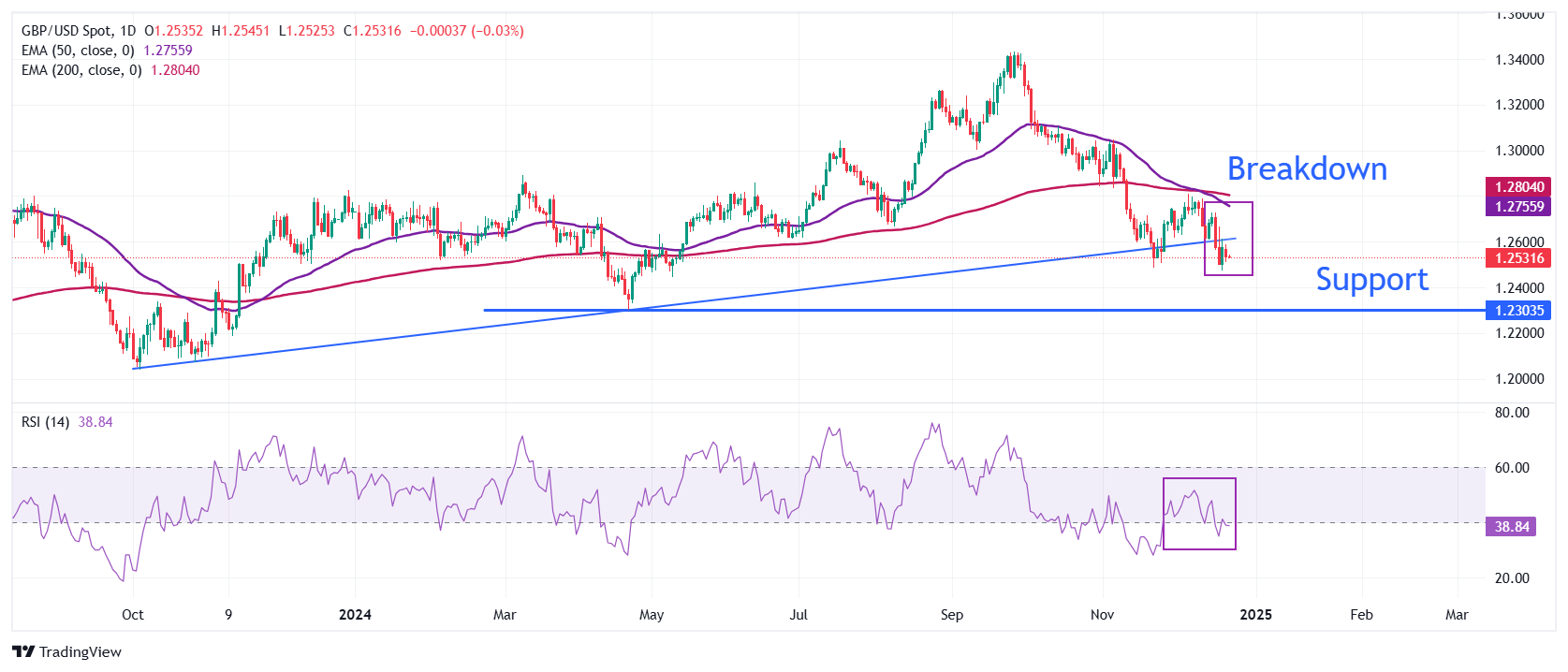
The Pound Sterling remains vulnerable against the US Dollar as it has decisively fallen below the upward-sloping trendline around 1.2600, which is plotted from the October 2023 low of 1.2035.
A death cross, represented by the 50-day and 200-day Exponential Moving Averages (EMAs) near 1.2790, also suggests a strong bearish trend in the long run.
The 14-day Relative Strength Index (RSI) falls below 40.00. A fresh downside momentum could trigger if the oscillator sustains below that level.
Looking down, the pair is expected to find a cushion near the April 22 low around 1.2300. On the upside, the December 17 high at 1.2730 will act as key resistance.
BoE FAQs
The Bank of England (BoE) decides monetary policy for the United Kingdom. Its primary goal is to achieve ‘price stability’, or a steady inflation rate of 2%. Its tool for achieving this is via the adjustment of base lending rates. The BoE sets the rate at which it lends to commercial banks and banks lend to each other, determining the level of interest rates in the economy overall. This also impacts the value of the Pound Sterling (GBP).
When inflation is above the Bank of England’s target it responds by raising interest rates, making it more expensive for people and businesses to access credit. This is positive for the Pound Sterling because higher interest rates make the UK a more attractive place for global investors to park their money. When inflation falls below target, it is a sign economic growth is slowing, and the BoE will consider lowering interest rates to cheapen credit in the hope businesses will borrow to invest in growth-generating projects – a negative for the Pound Sterling.
In extreme situations, the Bank of England can enact a policy called Quantitative Easing (QE). QE is the process by which the BoE substantially increases the flow of credit in a stuck financial system. QE is a last resort policy when lowering interest rates will not achieve the necessary result. The process of QE involves the BoE printing money to buy assets – usually government or AAA-rated corporate bonds – from banks and other financial institutions. QE usually results in a weaker Pound Sterling.
Quantitative tightening (QT) is the reverse of QE, enacted when the economy is strengthening and inflation starts rising. Whilst in QE the Bank of England (BoE) purchases government and corporate bonds from financial institutions to encourage them to lend; in QT, the BoE stops buying more bonds, and stops reinvesting the principal maturing on the bonds it already holds. It is usually positive for the Pound Sterling.
Author

Sagar Dua
FXStreet
Sagar Dua is associated with the financial markets from his college days. Along with pursuing post-graduation in Commerce in 2014, he started his markets training with chart analysis.

















