Pound Sterling recovers against US Dollar as PCE inflation data comes below expectations
- The Pound Sterling rebounds against the US Dollar on slower than projected US PCE inflation growth in November.
- A higher number of BoE officials voted for an interest rate cut on Thursday, boosting dovish bets for 2025.
- The UK Retail Sales rose by 0.2%, slower than expectations of 0.5% in November on month.

The Pound Sterling (GBP) recovers sharply in North American trading hours after posting a fresh seven-month low near 1.2470 against the US Dollar (USD) on Friday. The GBP/USD pair bounces back as the US Dollar declines after the release of the United States (US) Personal Consumption Expenditure Price Index (PCE) report for November, which showed that price pressures rose moderately.
The US Dollar Index (DXY), which tracks the Greenback's value against six major currencies, retreats below 108.00 after refreshing a two-year high around 108.50 earlier in the day. The PCE inflation report showed that the core inflation, the Federal Reserve's (Fed) preferred inflation gauge, rose by 2.8% in the year to November, at a slower pace than the 2.9% expected. Month-on-month core PCE inflation rose at a slower pace of 0.1%, against estimates of 0.2% and the former release of 0.3%. Headline
Though the US Dollar has faced selling pressure after the US inflation data, its outlook remains firm as the Fed signaled fewer interest rate cuts for 2025 in the monetary policy meeting on Wednesday. The Fed cut key borrowing rates by 25 basis points (bps) to the 4.25%-4.50% range as expected but guided a slower rate-cut trajectory for 2025. The Fed’s dot plot showed that officials collectively see federal fund rates heading to 3.9% by 2025, up from the 3.4% projected in September.
The Fed signaled fewer rate cuts for the next year as officials are confident in strong economic growth. This forced them to be cautious about further policy easing. Meanwhile, the third estimate for Q3 Gross Domestic Product (GDP) came in higher at 3.1% compared to the second estimate of 2.8%.
Daily digest market movers: Pound Sterling bounces back as investors digest BoE's dovish buildup for policy outlook
- The Pound Sterling rebounds against its major peers in Friday's North American session as investors digest the Bank of England's (BoE) dovish buildup for the monetary policy outlook. To recap, the BoE left its key borrowing rates unchanged at 4.75%, as expected, on Thursday as UK inflation accelerated in the last three months. Still, three policymakers proposed cutting interest rates against one as anticipated by market participants, which weighed on the British currency.
- BoE Governor Andrew Bailey refrained from committing a pre-defined rate cut path. “Due to heightened uncertainty in the economy, we can't commit to when or by how much we will cut rates in 2025,” he said.
- Meanwhile, traders price in a 53 basis points (bps) interest rate reduction by the BoE in 2025 after the policy announcement.
- On the economic front, the United Kingdom (UK) Retail Sales data rose less than anticipated in November. The Retail Sales data, a key measure of consumer spending, rose by 0.2% in the month, slower than estimates of 0.5% but recovering from a 0.7% decline in October.
- Retail Sales grew at a moderate pace of 0.5% year over year, against expectations of 0.8% and the former release of 2%, which was downwardly revised from 2.4%. The report showed that clothing demand remained weak, while sales were higher at other non-food stores.
- The UK Office for National Statistics (ONS) reported that the impact of the Black Friday sale was not taken into account in the November data as it commenced on November 29. The agency covered data for four weeks, from October 27 to November 23.
British Pound PRICE Today
The table below shows the percentage change of British Pound (GBP) against listed major currencies today. British Pound was the strongest against the Australian Dollar.
| USD | EUR | GBP | JPY | CAD | AUD | NZD | CHF | |
|---|---|---|---|---|---|---|---|---|
| USD | -0.38% | -0.42% | -0.52% | -0.01% | 0.08% | -0.07% | -0.47% | |
| EUR | 0.38% | -0.04% | -0.10% | 0.42% | 0.45% | 0.33% | -0.08% | |
| GBP | 0.42% | 0.04% | -0.08% | 0.43% | 0.47% | 0.35% | -0.03% | |
| JPY | 0.52% | 0.10% | 0.08% | 0.50% | 0.58% | 0.42% | 0.05% | |
| CAD | 0.01% | -0.42% | -0.43% | -0.50% | 0.08% | -0.06% | -0.44% | |
| AUD | -0.08% | -0.45% | -0.47% | -0.58% | -0.08% | -0.15% | -0.53% | |
| NZD | 0.07% | -0.33% | -0.35% | -0.42% | 0.06% | 0.15% | -0.37% | |
| CHF | 0.47% | 0.08% | 0.03% | -0.05% | 0.44% | 0.53% | 0.37% |
The heat map shows percentage changes of major currencies against each other. The base currency is picked from the left column, while the quote currency is picked from the top row. For example, if you pick the British Pound from the left column and move along the horizontal line to the US Dollar, the percentage change displayed in the box will represent GBP (base)/USD (quote).
Technical Analysis: Pound Sterling hols key support of 1.2470
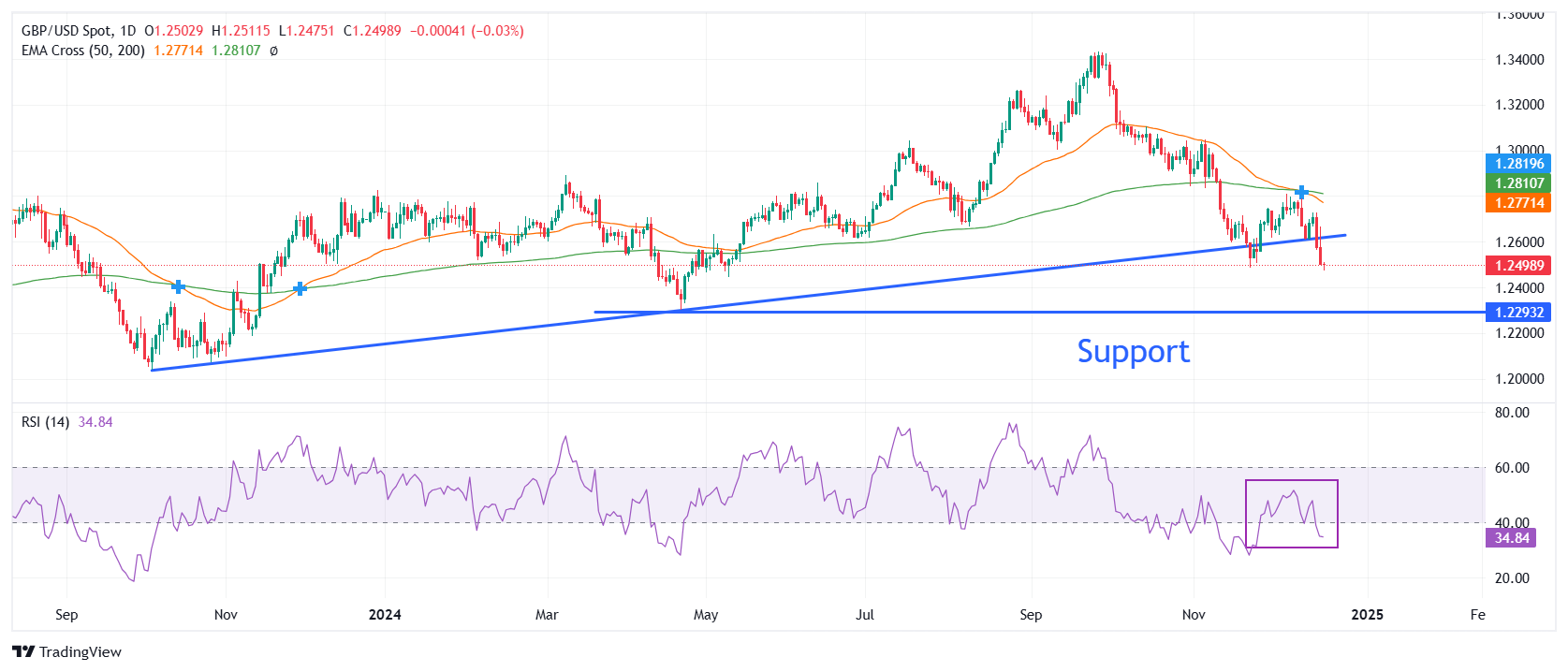
The Pound Sterling weakens against the US Dollar on a decisive break below the upward-sloping trendline around 1.2600, which is plotted from the October 2023 low of 1.2035.
A death cross, represented by the 50-day and 200-day Exponential Moving Averages (EMAs) near 1.2790, suggests a strong bearish trend in the long run.
The 14-day Relative Strength Index (RSI) slides below 40.00, suggesting that a fresh downside momentum has been triggered.
Looking down, the pair is expected to find a cushion near the April 22 low around 1.2300. On the upside, the December 17 high at 1.2730 will act as key resistance.
(This story was corrected on December 20 at 15:00 GMT to clarify that the core PCE rose by 2.8% in the year to November, at a slower pace than the 2.9% expected.)
Author

Sagar Dua
FXStreet
Sagar Dua is associated with the financial markets from his college days. Along with pursuing post-graduation in Commerce in 2014, he started his markets training with chart analysis.

















