Pound Sterling holds ground as Keir Starmer to be Britain's next PM
- The Pound Sterling remains stronger due to a decisive victory for Keir Starmer's Labour Party.
- Labour has secured more than 400 seats, with some still to count.
- The forecast for US Nonfarm Payrolls suggests an increase of 190,000 new jobs, down from the previous reading of 272,000.

The Pound Sterling (GBP) extends its winning streak on Friday as the Labour Party secures 410 out of 650 seats in parliament, according to the BBC. This result would provide Labour with a majority of around 170 seats, ending 14 years of increasingly tumultuous Conservative-led government.
United Kingdom's (UK) Prime Minister Rishi Sunak conceded defeat in the national election on Friday, acknowledging that the opposition Labour Party had emerged victorious. "The Labour Party has won this general election and I have called Sir Keir Starmer to congratulate him on his victory," Sunak said after winning his parliamentary seat in northern England, per Reuters.
Derek Halpenny, head of FX research at MUFG Bank Ltd., suggests that a Labour landslide could be advantageous for the Pound Sterling. A substantial majority would grant Labour a strong mandate for governance, potentially leading to greater political stability.
Read More: How could the UK general election impact the Pound Sterling?
The US Dollar (USD) struggles due to softer US data, fueling speculation that the Federal Reserve (Fed) might reduce interest rates in 2024. The key highlight on Friday will be the release of US employment reports, which are expected to show a slowdown in employment growth in June. The US Nonfarm Payrolls (NFP) are expected to show an increase of 190,000 new jobs, down from the previous reading of 272,000.
Daily Digest Market Movers: Pound Sterling rises as US data raise odds of Fed rate cuts
- The ADP Employment report showed that US private businesses added 150,000 workers to their payrolls in June, the lowest increase in five months. This figure fell short of the expected 160,000 and was below the downwardly revised 157,000 in May.
- US ISM Services PMI fell sharply to 48.8 in June, marking the steepest decline since April 2020. This figure was well below market expectations of 52.5, following a reading of 53.8 in May.
- Federal Reserve Bank of Chicago President Austan Goolsbee stated on BBC Radio on Wednesday that bringing inflation back to 2% will take time and that more economic data are needed. However, on Tuesday, Fed Chair Jerome Powell said that the central bank is getting back on the disinflationary path, per Reuters.
- The Minutes from the Federal Reserve's June 11-12 monetary policy meeting, released on Wednesday, suggested that Fed officials were in a wait-and-see mode. Some participants emphasized the Committee’s data-dependent approach, with monetary policy decisions being conditional on the evolution of the economy rather than being on a preset path.
- The Pound Sterling (GBP) continues to gain ground as BoE policymakers remain concerned about persistent inflation in the UK service sector, preventing them from considering policy easing. In contrast, inflation in other sectors has significantly declined due to weak demand from both domestic and overseas markets.
Technical Analysis: Pound Sterling holds position around 1.2750
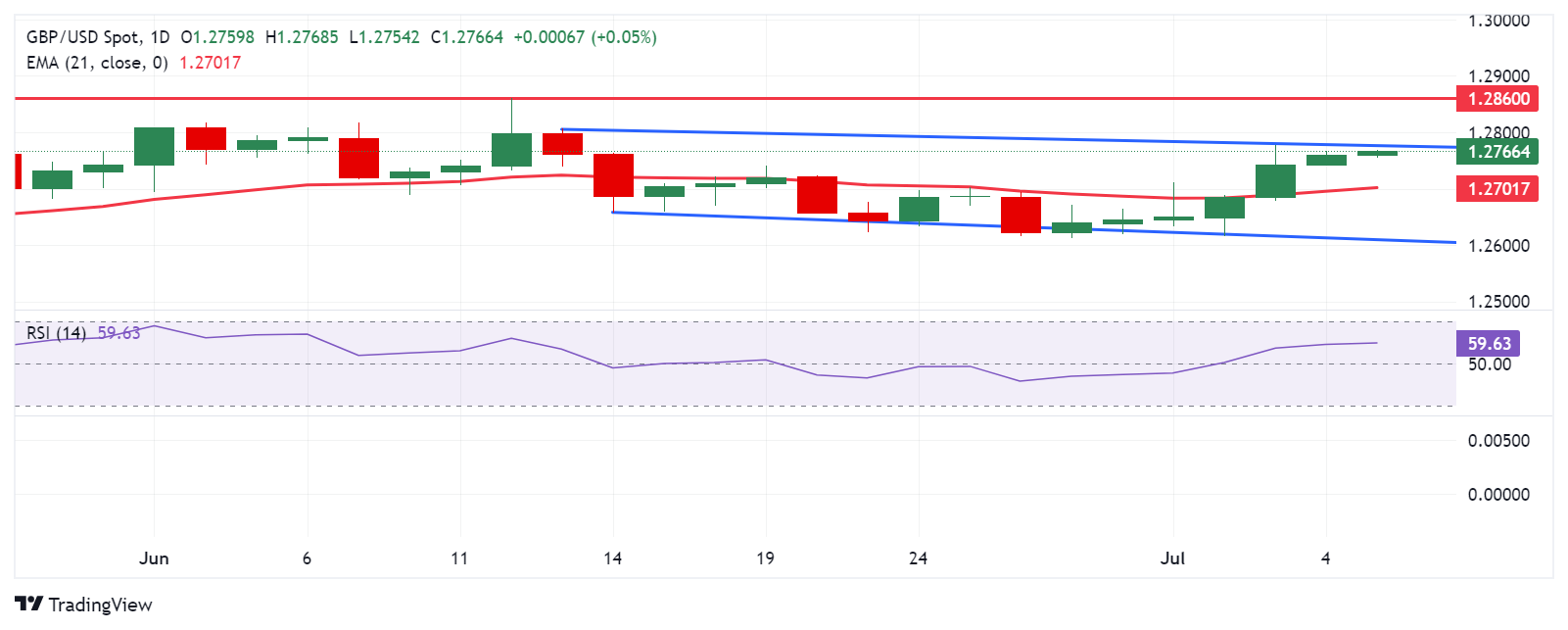
The GBP/USD pair trades around 1.2760 on Friday. The analysis of the daily chart indicates a bearish bias, with the pair consolidating within a descending channel. However, the 14-day Relative Strength Index (RSI) is above the 50 level, suggesting that any further increase could weaken the bearish outlook.
The GBP/USD pair may challenge the upper boundary of the descending channel near the 1.2780 level. A breakthrough above this level could potentially push the pair to test the June high around 1.2860.
On the downside, a significant support level is noted at the 21-day Exponential Moving Average (EMA) at 1.2701. If this level is breached, it may exert downward pressure on the GBP/USD pair toward the vicinity of the lower boundary of the descending channel, approximately around 1.2612.
GBP/USD: Daily Chart
British Pound PRICE Today
The table below shows the percentage change of British Pound (GBP) against listed major currencies today. British Pound was the strongest against the New Zealand Dollar.
| USD | EUR | GBP | JPY | CAD | AUD | NZD | CHF | |
|---|---|---|---|---|---|---|---|---|
| USD | -0.15% | -0.13% | -0.27% | -0.07% | -0.10% | -0.01% | -0.17% | |
| EUR | 0.15% | 0.00% | -0.14% | 0.09% | 0.04% | 0.15% | -0.03% | |
| GBP | 0.13% | -0.01% | -0.14% | 0.08% | 0.04% | 0.15% | -0.06% | |
| JPY | 0.27% | 0.14% | 0.14% | 0.21% | 0.19% | 0.26% | 0.10% | |
| CAD | 0.07% | -0.09% | -0.08% | -0.21% | -0.05% | 0.06% | -0.13% | |
| AUD | 0.10% | -0.04% | -0.04% | -0.19% | 0.05% | 0.09% | -0.07% | |
| NZD | 0.01% | -0.15% | -0.15% | -0.26% | -0.06% | -0.09% | -0.19% | |
| CHF | 0.17% | 0.03% | 0.06% | -0.10% | 0.13% | 0.07% | 0.19% |
The heat map shows percentage changes of major currencies against each other. The base currency is picked from the left column, while the quote currency is picked from the top row. For example, if you pick the British Pound from the left column and move along the horizontal line to the US Dollar, the percentage change displayed in the box will represent GBP (base)/USD (quote).
Pound Sterling FAQs
The Pound Sterling (GBP) is the oldest currency in the world (886 AD) and the official currency of the United Kingdom. It is the fourth most traded unit for foreign exchange (FX) in the world, accounting for 12% of all transactions, averaging $630 billion a day, according to 2022 data. Its key trading pairs are GBP/USD, aka ‘Cable’, which accounts for 11% of FX, GBP/JPY, or the ‘Dragon’ as it is known by traders (3%), and EUR/GBP (2%). The Pound Sterling is issued by the Bank of England (BoE).
The single most important factor influencing the value of the Pound Sterling is monetary policy decided by the Bank of England. The BoE bases its decisions on whether it has achieved its primary goal of “price stability” – a steady inflation rate of around 2%. Its primary tool for achieving this is the adjustment of interest rates. When inflation is too high, the BoE will try to rein it in by raising interest rates, making it more expensive for people and businesses to access credit. This is generally positive for GBP, as higher interest rates make the UK a more attractive place for global investors to park their money. When inflation falls too low it is a sign economic growth is slowing. In this scenario, the BoE will consider lowering interest rates to cheapen credit so businesses will borrow more to invest in growth-generating projects.
Data releases gauge the health of the economy and can impact the value of the Pound Sterling. Indicators such as GDP, Manufacturing and Services PMIs, and employment can all influence the direction of the GBP. A strong economy is good for Sterling. Not only does it attract more foreign investment but it may encourage the BoE to put up interest rates, which will directly strengthen GBP. Otherwise, if economic data is weak, the Pound Sterling is likely to fall.
Another significant data release for the Pound Sterling is the Trade Balance. This indicator measures the difference between what a country earns from its exports and what it spends on imports over a given period. If a country produces highly sought-after exports, its currency will benefit purely from the extra demand created from foreign buyers seeking to purchase these goods. Therefore, a positive net Trade Balance strengthens a currency and vice versa for a negative balance.
Author

Akhtar Faruqui
FXStreet
Akhtar Faruqui is a Forex Analyst based in New Delhi, India. With a keen eye for market trends and a passion for dissecting complex financial dynamics, he is dedicated to delivering accurate and insightful Forex news and analysis.