How could the UK general election impact the Pound Sterling?
- Polls show the Labour Party is likely to win the July 4 UK general election.
- Regardless of which party wins they will be limited fiscally leading to a reliance on monetary policy for stimulus.
- There is an argument that political stability from a Labour majority could benefit the Pound Sterling.

The UK’s general election on July 4 now looks like it will almost certainly lead to a victory for the left-leaning Labour Party. Bookmakers are giving Labour a 90% probability of winning a majority.
While the polls suggest a significant political change, analysts doubt whether the outcome will dramatically alter the economy.
Fiscal Shades of Gray
Regardless of who wins the UK election, any future government will be gagged and bound by a set of fiscal rules that will severely limit its borrowing and spending. These rules, combined with low economic growth, already high debt, and historically high taxes, will leave the government little room for maneuver.
As Benjamin Caswell, a Senior Economist for the National Institute of Economic and Social Research (NIESR), puts it: “The UK economy is marred by stagnant growth in productivity and output. This poor economic performance puts pressure on the public finances and reduces ‘fiscal headroom’ – the gap between the public finances and proposed spending plans.”
Minimum headroom
All the above means that the next government – regardless of political persuasion – will have its hands tied when it comes to driving growth.
“The lack of fiscal space for the incoming government leaves little room for bold tax and spend changes... The one non-fiscal policy lever that could make a difference – Brexit – remains a taboo subject. As such, while the election will herald a significant political shift, its economic impact is likely to be close to negligible,” says Philip Bokeloh, Senior Economist Netherlands.
The view is echoed by Ruth Gregory, Deputy Chief UK Economist at Capital Economics.
“As there won’t be much room for maneuver on fiscal policy for either party after the election, the fiscal plans of the winner are unlikely to significantly alter market interest rate expectations or Gilt yields,” Gregory told FXStreet.
Pound Sterling forecast: differing outlooks for inflation
Where economists differ in their views is on the future path of inflation after the election. Inflation dictates the level of interest rates set by the Bank of England (BoE), which, in turn, impacts the Pound Sterling.
Higher inflation forces the Bank of England to put up interest rates to encourage people to save rather than spend. Higher interest rates also have a positive impact on the Pound by attracting greater foreign capital inflows.
According to ABN Amro’s Bokeloh, the next government’s lack of fiscal headroom will put all the responsibility on monetary policy as the main source of growth stimulus.
However, higher-than-expected inflation will make it difficult for the BoE to cut interest rates as quickly as it would like. It is assumed, this, in turn, will support Sterling.
“This leaves monetary policy as the main potential source of stimulus, but here too, there are limits on the pace at which the Bank of England can lower rates. Wage growth, at over 6%, remains far above levels consistent with inflation staying at 2% over time. Inflation is a deeper-rooted problem in the UK that predates the pandemic and the energy crisis,” says Bokeloh.
Capital Economics, however, is more optimistic about inflation continuing to fall and allowing the BoE to lower interest rates, leading to a weaker Pound.
“We think the economic recovery will be stronger than most expect, but that lower inflation means interest rates will be cut by more than the markets currently expect, regardless of the election outcome,” says Alex Kerr, Assistant Economist at Capital Economics.
As a result of their view, Capital Economics expects GBP/USD to fall to 1.22 (from 1.26 currently) by the end of 2024 before rising again in 2025.
Sterling could rise due to increased political stability – MUFG
The Labour Party is likely to win a large majority of seats if the polls are accurate. In addition the Conservative vote is likely to be split by the rise in popular support for the Reform Party over recent weeks. A Labour landslide might, however, be a good thing for the Pound Sterling.
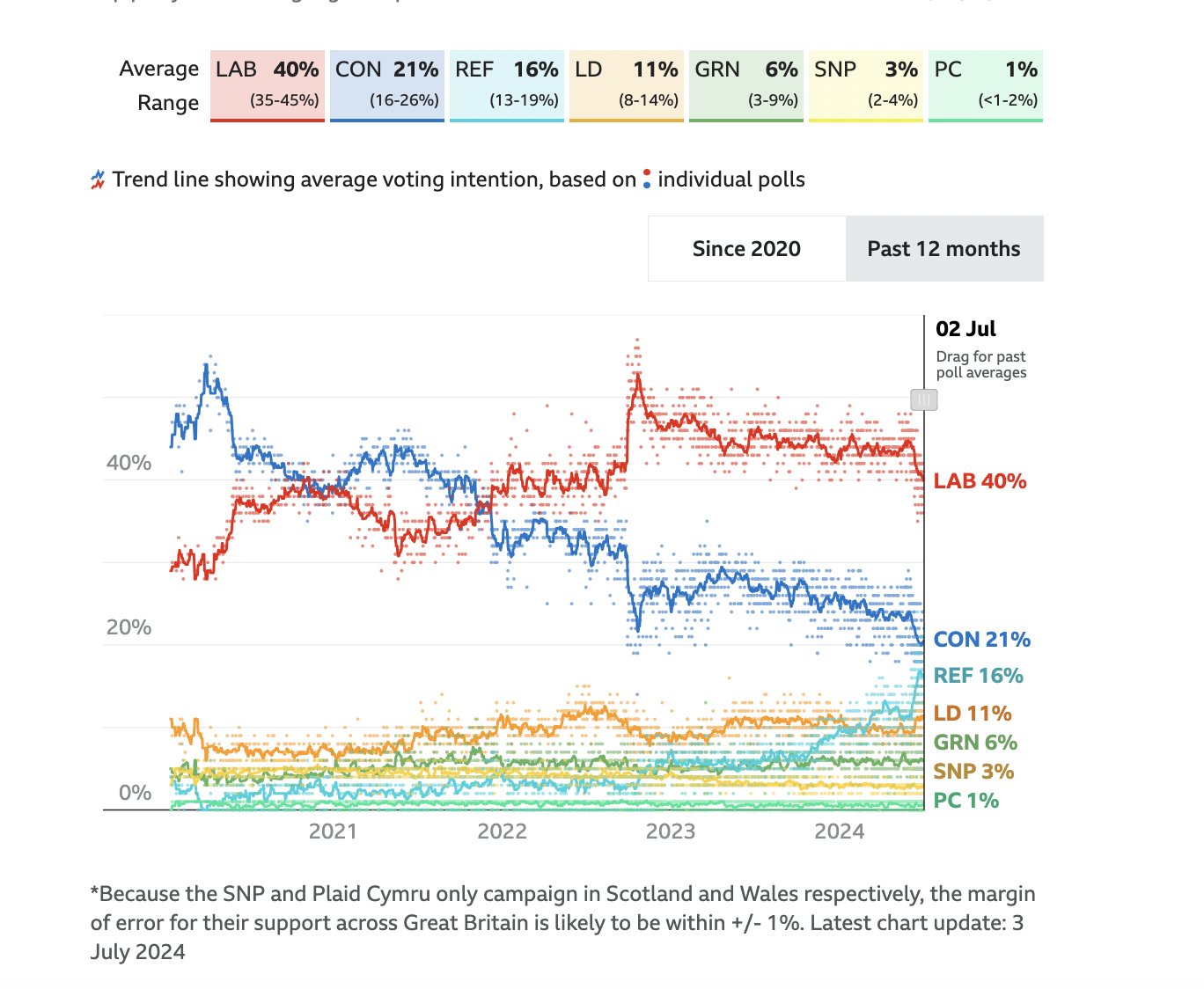
This is because a large majority will give Labour a strong mandate to rule and lead to more political stability. This factor is seen as positive for Sterling, according to Derek Halpenny, head of FX research at MUFG Bank Ltd.
“We see the Labour Party winning a large majority in the UK general election on 4th July. We have raised our GBP forecasts in part on better political stability ahead and in part on the signs of a stronger rebound in economic growth than we previously expected," says Halpenny.
"The economic policies put forward by Labour are very cautious and the strategy is clearly to strengthen trust with voters that it can govern and manage the economy. We certainly assume better political stability is on its way with Labour intending to focus on ‘wealth creation’," the analyst concludes.
In light of its views MUFG has lowered its EUR/GBP forecast for Q3 2024 from 0.8550 to 0.8400, and its end-of 2024 forecast from 0.8600 to 0.8400.
The bank more-or-less maintains its Pound to Dollar forecast for Q3 at 1.2860 from 1.2870, lowers its end-of 2024 target from 1.3020 to 1.2980, but lifts its Q1 2025 forecast from 1.2870 to 1.3250.
Author

Joaquin Monfort
FXStreet
Joaquin Monfort is a financial writer and analyst with over 10 years experience writing about financial markets and alt data. He holds a degree in Anthropology from London University and a Diploma in Technical analysis.

















