Pound Sterling falls back after BoE leaves interest rates at 4.75%
- The Pound Sterling drops after the BoE left borrowing rates steady at 4.75%.
- UK inflation has accelerated in the past two months, supporting the BoE's decision to keep interest rates steady.
- The Fed cut interest rates by 25 basis points to 4.25%-4.50% but delivered hawkish guidance for 2025.

The Pound Sterling (GBP) falls sharply against its major peers in Thursday's early North American after the Bank of England (BoE) leaves interest rates unchanged at 4.75%, as expected. The British currency faces a sell-off as three out of nine members of the Monetary Policy Committee (MPC) proposed a 25-basis points (bps) interest rate reduction. Only policymaker Swati Dhingra, who has been consistently supporting a more expansionary policy stance, was expected to propose an interest rate cut. However, policymaker Alan Taylor and Deputy Governor Dave Ramsden also supported a dovish decision.
The BoE was expected to keep interest rates steady as inflationary pressures in the United Kingdom (UK) have accelerated in the last two months. The UK Consumer Price Index (CPI) data for November showed that annual headline inflation accelerated to 2.6%, as expected, from 2.3% in October. The core CPI—which excludes volatile items such as food, energy, alcohol, and tobacco—rose to 3.5% from the former reading of 3.3%.
BoE Governor Andrew Bailey refrained from guiding the likely interest rate cuts next year. “Due to heightened uncertainty in the economy, we can't commit to when or by how much we will cut rates in 2025,” he said.
On the economic data front, investors will focus on the UK Retail Sales data for November, which will be released on Friday. Retail Sales, a key measure of consumer spending, are expected to rise by 0.5% on month after declining by 0.7% in October.
Daily digest market movers: Pound Sterling surrenders intraday gains against USD
- The Pound Sterling gives up its entire intraday gains and falls below 1.2600 from the intraday high of 1.2660 against the US Dollar (USD) after the BoE policy announcement. In the Asian session, the GBP/USD pair rebounded from a three-week low of 1.2560 as the US Dollar’s (USD) rally pauses for a while after refreshing a two-year high. The US Dollar Index (DXY), which gauges the Greenback’s value against six major currencies, edges lower but holds the key support of 108.00.
- The Greenback soared as the Federal Reserve (Fed) signaled fewer interest rate cuts for 2025 after cutting them by 25 bps to 4.25%-4.50%. The Fed’s dot plot showed that policymakers see Federal Fund rates heading to 3.9% in 2025, upwardly revising the projections from the 3.4% estimated in September.
- Fed Chair Jerome Powell said at the press conference that economic strength gives the Fed the ability to approach rate cuts cautiously. When asked about the inflation outlook, Powell said he expects “inflation to continue to come down toward the 2% goal, on a 'sometimes bumpy' path”. Meanwhile, the Federal Open Market Committee (FOMC) has also raised core Personal Consumption Expenditure inflation (PCE) projections for 2025 to 2.5% from 2.2% in its latest economic projections.
- Analysts at Monex Europe expect the Fed to hold interest rates at their current levels at least through the first half of 2025.
- On the economic front, the second estimate for the Q3 United States (US) Gross Domestic Product (GDP) data has shown that the economy rose at a faster pace of 3.1% than the preliminary estimate of 2.8%. Initial Jobless Claims for the week ending December 16 have come in lower at 220K than estimates of 230K and the former release of 242K.
Technical Analysis: Pound Sterling holds key support of 1.2550
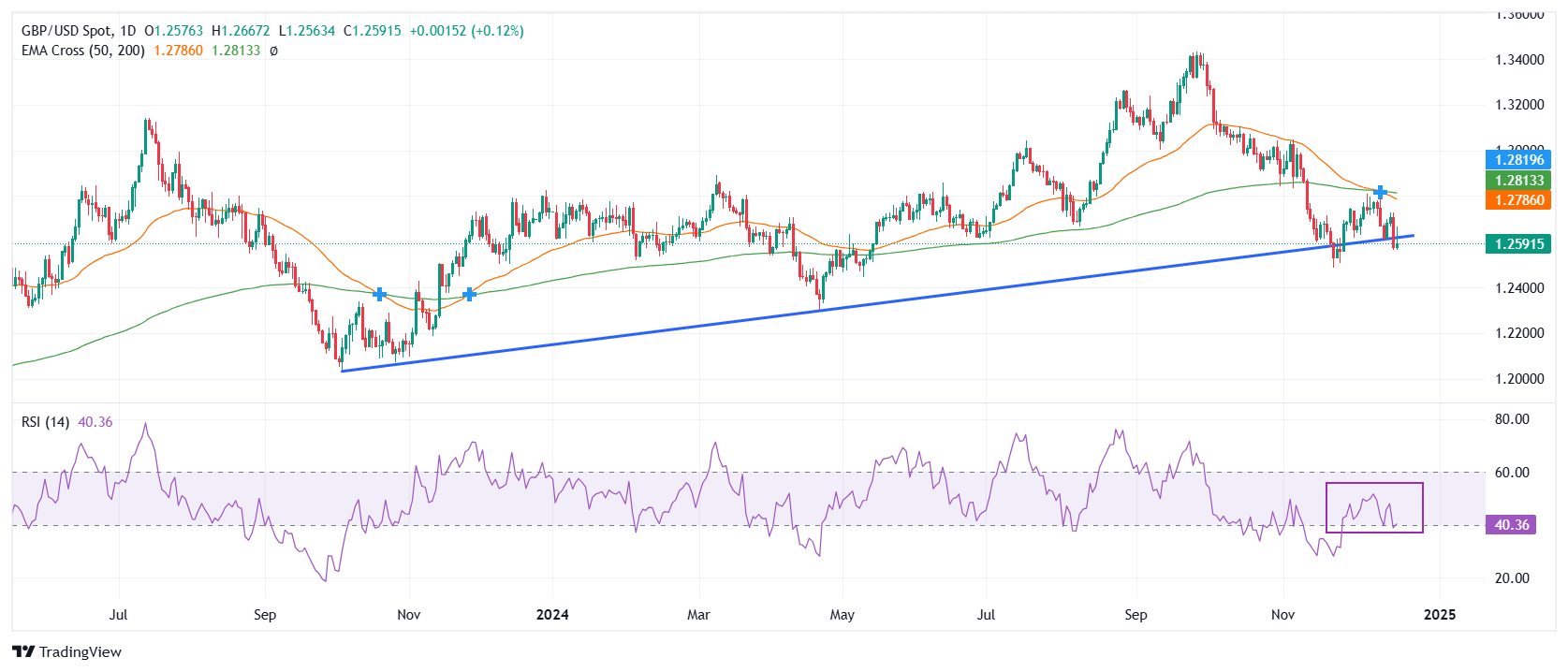
The Pound Sterling trades above a fresh three-week low near 1.2555 against the US Dollar on Thursday. The GBP/USD pair struggles to hold the upward-sloping trendline, which is plotted from October 2023 low around 1.2035, and remains a key support zone below 1.2600.
The 14-day Relative Strength Index (RSI) hovers near 40.00. A breakdown below the same could trigger a downside momentum.
A death cross, represented by the 50-day and 200-day Exponential Moving Averages (EMAs) near 1.2790, suggests a strong bearish trend in the long run.
Looking down, the pair is expected to find a cushion near the psychological support of 1.2500. On the upside, the 200-day EMA near 1.2815 will act as key resistance.
(The story was corrected at 13:35 GMT to say in the first bullet that "The Pound Sterling drops after the BoE left borrowing rates steady at 4.75% against gains against major peers")
Author

Sagar Dua
FXStreet
Sagar Dua is associated with the financial markets from his college days. Along with pursuing post-graduation in Commerce in 2014, he started his markets training with chart analysis.

















