Palantir Stock Forecast: PLTR drops 7.3% on Tuesday as Nvidia awaits
- Palantir stock declines on Tuesday after overtaking the $20-$21.15 resistance band.
- The UK’s NHS officially announced that Palantir will lead a corporate team to overhaul the public health system’s operating software.
- The contract will pay 330 million British Pounds over seven years.
- Bears will seek to push PLTR back to support at $18.

Palantir (PLTR) stock was rebuffed on Tuesday, receding 7.3%. PLTR stock looked like it had achieved escape velocity on Monday. Shares of the artificial intelligence company opened on Tuesday at $21.11 but closed at $19.79.
Palantir followed the lead of the broad market as the S&P 500 and Dow Jones both dropped close to 0.2%, while the NASDAQ pulled back about 0.6%. Tuesday’s stock market consolidation came after the S&P 500 put an end to its three-month correction in the shortest period of time in 50 years, according to Deutsche Bank analysts.
Nvidia (NVDA), the first semiconductor company to achieve a market cap of $1 trillion and probabaly the most popular stock of 2023, is scheduled to release third-quarter earnings after the close. Consensus has CEO Jensen Huang's company reporting $3.39 in adjusted EPS on $16.11 billion in revenue.
Palantir stock news: NHS contract is official
On Tuesday, Palantir announced what had been rumored for weeks – the company founded by Peter Thiel has been selected to lead a group of firms that will overhaul the public health service of the United Kingdom using a new digitized database.
Palantir has been chosen to head up the 330 million British Pound contract ($413 million), which is expected to last for seven years. Other consulting firms such as Accenture, PwC, NECS and Carnall Farrar will also contribute to the contract.
The contract is focused on a new software platform called the Federated Data Platform or FDP. The main thrust of the overall is to reduce patient waiting times and decrease hospital discharge delays at the National Health Service (NHS).
In a statement, the NHS said, “Pilot projects using the new data-sharing approach have seen a drop in waiting times for planned care and in discharge delays, and seen faster diagnosis and treatment times.”
In one such pilot project, the North Tees and Hartlepool Trust hospital system was able to reduce long-term stays by 36%, which allowed nearly 8% more patients to receive care than usual.
“This award is the culmination of 20 years of developing software that enables complex, sensitive data to be integrated in a way that protects security, respects privacy and puts the customer in full control,” said Palantir CEO Alex Karp in a statement.
Before the present contract, Palantir worked pro-bono to help the NHS schedule covid vaccinations and surgeries.
S&P 500 FAQs
What is the S&P 500?
The S&P 500 is a widely followed stock price index which measures the performance of 500 publicly owned companies, and is seen as a broad measure of the US stock market. Each company’s influence on the computation of the index is weighted based on market capitalization. This is calculated by multiplying the number of publicly traded shares of the company by the share price. The S&P 500 index has achieved impressive returns – $1.00 invested in 1970 would have yielded a return of almost $192.00 in 2022. The average annual return since its inception in 1957 has been 11.9%.
How are companies chosen to be included in the S&P 500?
Companies are selected by committee, unlike some other indexes where they are included based on set rules. Still, they must meet certain eligibility criteria, the most important of which is market capitalization, which must be greater than or equal to $12.7 billion. Other criteria include liquidity, domicile, public float, sector, financial viability, length of time publicly traded, and representation of the industries in the economy of the United States. The nine largest companies in the index account for 27.8% of the market capitalization of the index.
How can I trade the S&P 500?
There are a number of ways to trade the S&P 500. Most retail brokers and spread betting platforms allow traders to use Contracts for Difference (CFD) to place bets on the direction of the price. In addition, that can buy into Index, Mutual and Exchange Traded Funds (ETF) that track the price of the S&P 500. The most liquid of the ETFs is State Street Corporation’s SPY. The Chicago Mercantile Exchange (CME) offers futures contracts in the index and the Chicago Board of Options (CMOE) offers options as well as ETFs, inverse ETFs and leveraged ETFs.
What factors drive the S&P 500?
Many different factors drive the S&P 500 but mainly it is the aggregate performance of the component companies revealed in their quarterly and annual company earnings reports. US and global macroeconomic data also contributes as it impacts on investor sentiment, which if positive drives gains. The level of interest rates, set by the Federal Reserve (Fed), also influences the S&P 500 as it affects the cost of credit, on which many corporations are heavily reliant. Therefore, inflation can be a major driver as well as other metrics which impact the Fed decisions.
Palantir stock forecast
A pullback had to ensue at some point, since PLTR stock has continued rallying since its third-quarter earnings beat at the start of the month. The stock has rallied more than 46% since November 1.
Last Friday, Palantir’s stock price closed above the $20.24 range high from August 1. But the Relative Strength Index (RSI) showed that PLTR was overbought after such a brisk rally in the first half of November.
A likely support level at this point is the $18 handle, which acted as resistance in October and then as support in the first part of this month. Traders will give this level more credence since the 21-day Simple Moving Average (SMA) is cresting in the vicinity.
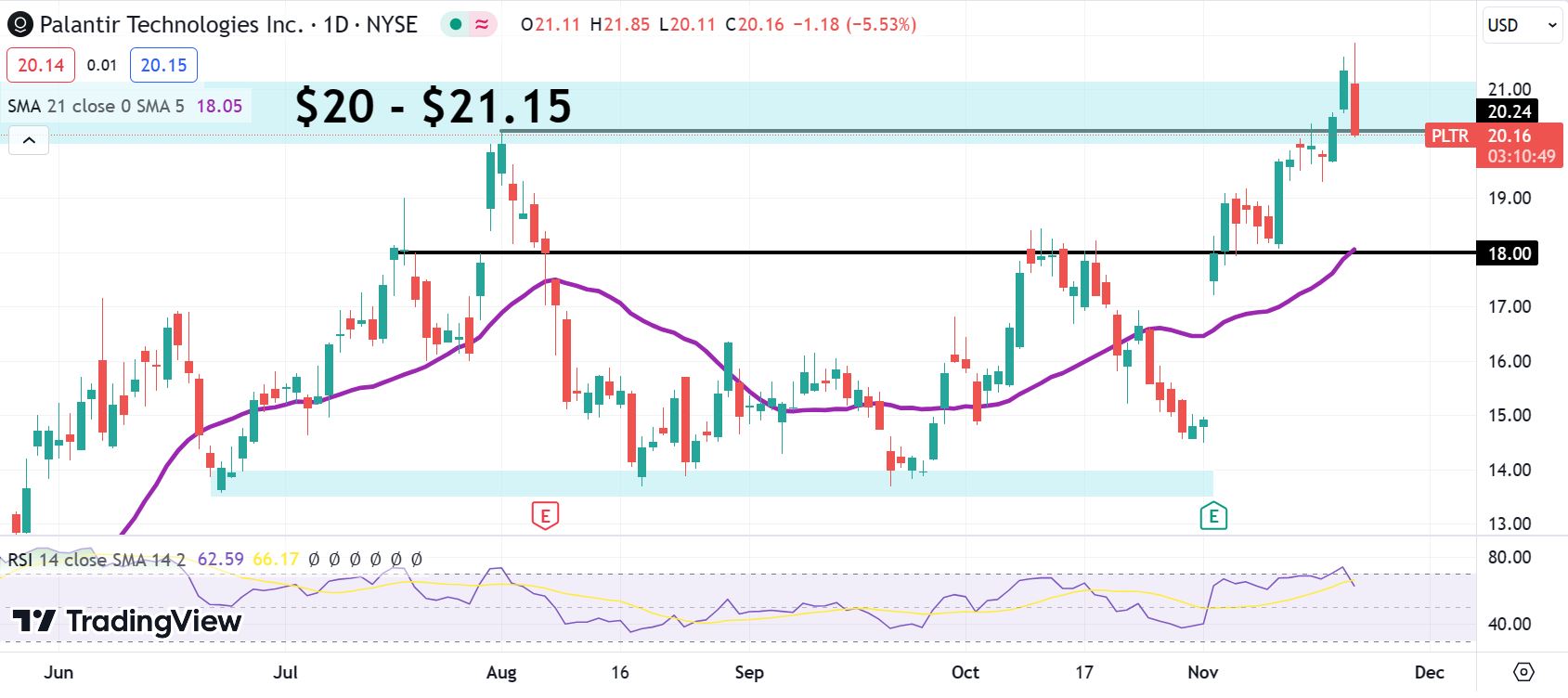
PLTR daily chart
On Monday, PLTR broke above the $20 to $21.15 support band that largely held up the share price during the March through July period of 2021, shortly after the company went public. That band might still have significance as PLTR was only able to break through it for the first time in more than two years for a single session before backtracking.
If PLTR breaks back above $21.15 as the market turns its expectations toward a Santa rally, then bulls may focus their energy on the $29 to $32 target that shareholders haven’t seen in two years.
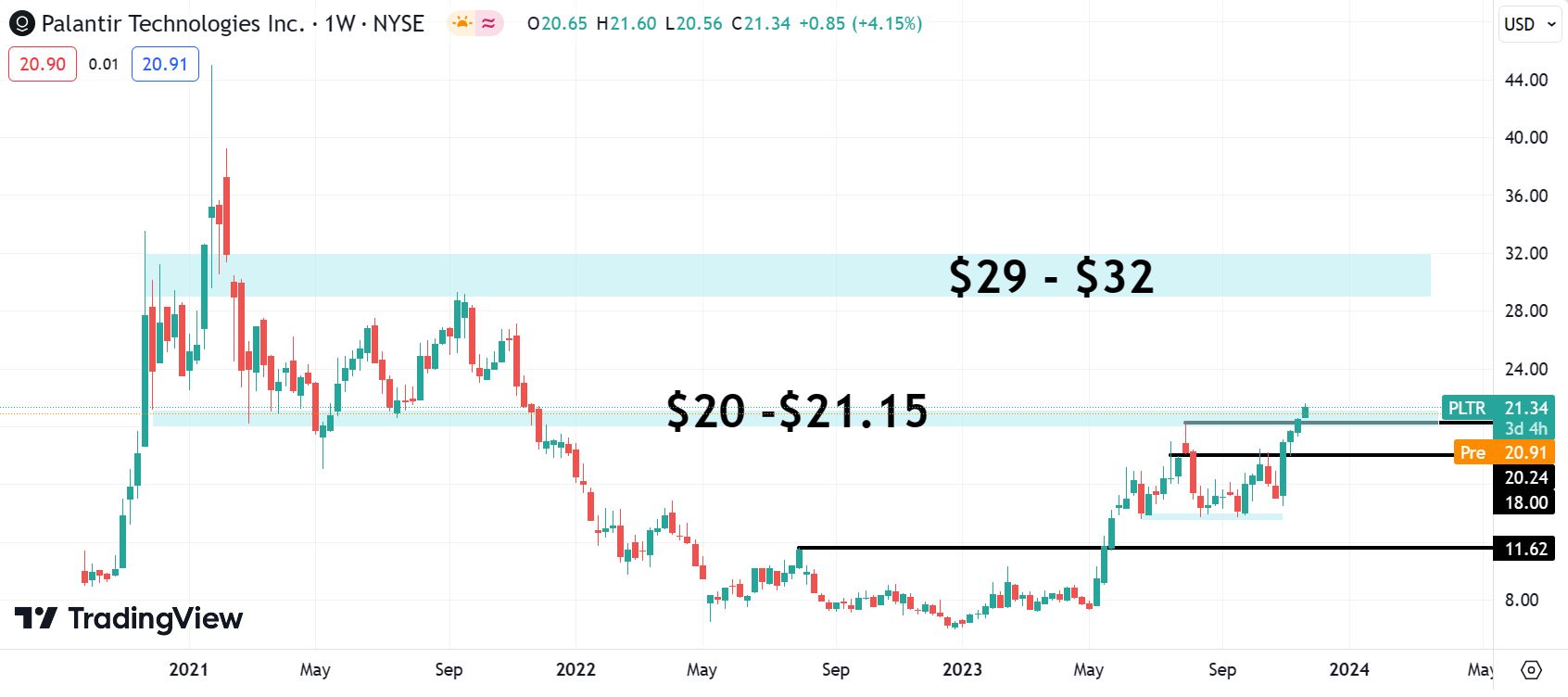
PLTR weekly chart
Author

Clay Webster
FXStreet
Clay Webster grew up in the US outside Buffalo, New York and Lancaster, Pennsylvania. He began investing after college following the 2008 financial crisis.