Oil dips further in red numbers near US trading session
- Oil retreats further away from $77.00, repricing the disappointing Sunday OPEC+ meeting.
- OPEC+ meeting sets the tone for more downside after the summer season despite the decision to extend production cuts.
- The US Dollar Index trades at mid-104.00 levels and is facing a heavy week full of economic data.


Oil prices are trading lower at the start of the US trading session this Monday with traders rather ignoring the OPEC+ decision to extend current production cuts into 2025 with the goal to support prices. Despite the broad commitment to keep a tight supply, some Oil producers within the organization will be able to ease some of the voluntary production cuts, which came as a surprise. The biggest winner was the United Arab Emirates, which can head back to markets and sell more barrels. Overall, Saudi Arabia and Russia will still take the bulk part of the effort and maintain that 2 million barrel draw per day, phasing it out from October.
Meanwhile, the US Dollar Index (DXY) is floating around a steady level near 104.63 with markets bracing for a very busy week. Several important data points are set to be released throughout the week in the run-up to the main event on Friday: the US Employment Report. Traders will be looking for clues over whether the US economy has topped out.
At the time of writing, Crude Oil (WTI) trades at $76.54 and Brent Crude at $80.77.
Oil news and market movers: Nothing new is not enough
- OPEC+ agreed to extend the cuts of 3.66 million barrels per day by a year until the end of 2025. However, voluntary production cuts, currently at around 2 million barrels per day, will start to be phased out from October after the recent OPEC+ production quota decision, Bloomberg reports.
- Goldman Sachs managing director and head of research Daan Struyven said in a note that the outcome of the OPEC+ meeting is bearish due to the decision to return supply to markets despite the recent surprise increase in inventories. Risks for Oil prices are now skewed to the downside, Bloomberg reports.
- Warren Patterson, head of commodity strategies at ING, sees a possible uptick in crude prices over the summer period. Still, the deficit is expected to widen by the third quarter.
Oil Technical Analysis: More downside
Oil prices are not feeling warm about the recent agreement on output from OPEC+. Despite several bearish headlines from analysts and traders, there might be the consideration that OPEC+ expects a pickup in demand will take place by 2025. After all, sooner or later, the US Federal Reserve will cut interest rates, and it looks like OPEC+ is starting to prepare for this scenario.
First, the Simple Moving Averages (SMA) need to be regained under control. The 100-day SMA at $79.09 and the 200-day SMA at $79.54 are the first levels on the upside. Next, the 55-day Simple Moving Average (SMA) at $81.13 and the descending trendline at $81.45 are an area with a lot of resistance where any recovery rally could pause. Once broken through there, the road looks quite open to head to $87.12.
On the downside, the $76.00 marker is coming back into focus with the $75.27 level playing a crucial role if traders still want to have an option to head back to $80.00. Should that $75.27 pivotal level snap, expect to see a risk-full nosedive move that could sprint all the way down to $68, below $70.00.
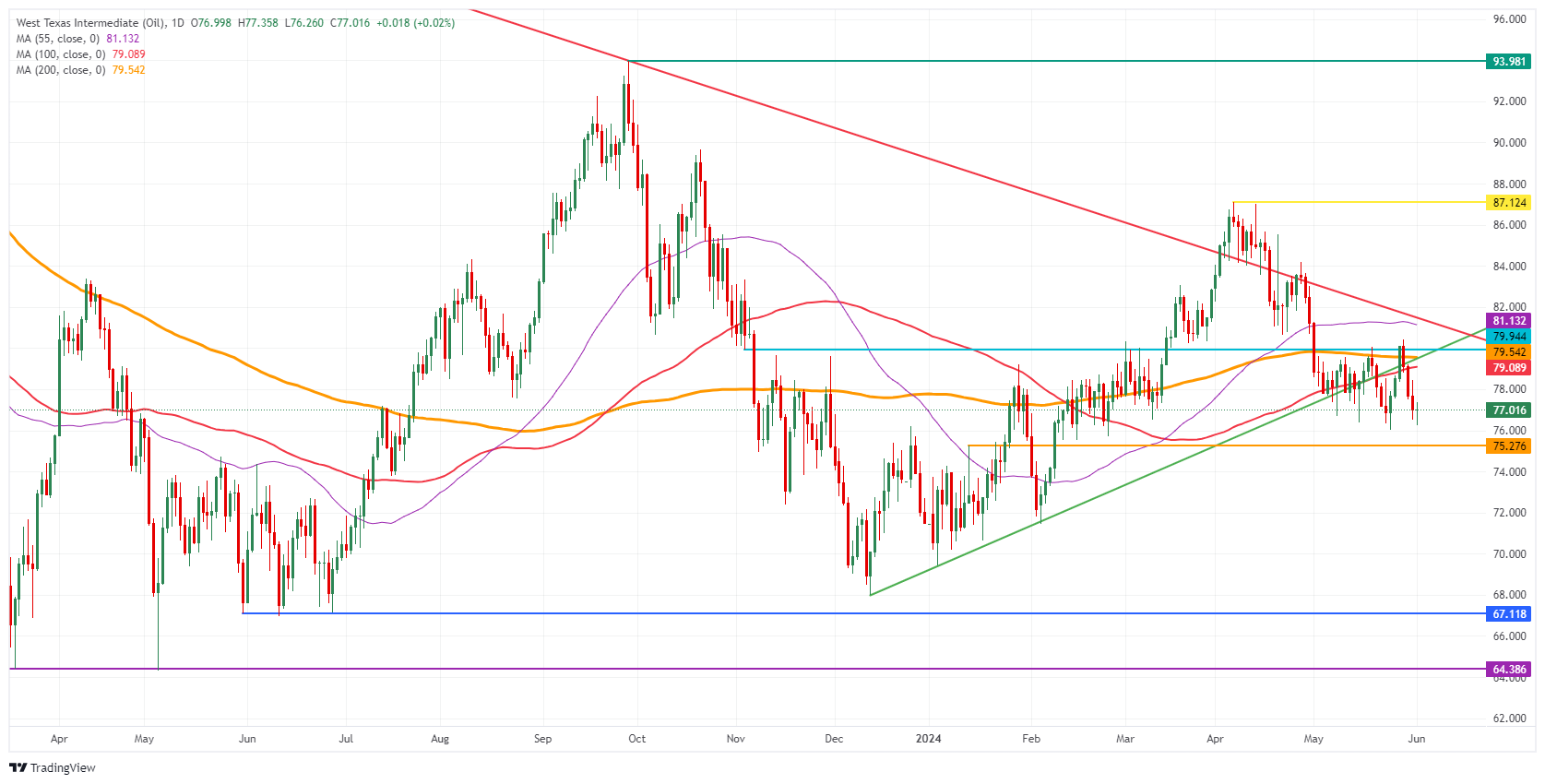
US WTI Crude Oil: Daily Chart
WTI Oil FAQs
WTI Oil is a type of Crude Oil sold on international markets. The WTI stands for West Texas Intermediate, one of three major types including Brent and Dubai Crude. WTI is also referred to as “light” and “sweet” because of its relatively low gravity and sulfur content respectively. It is considered a high quality Oil that is easily refined. It is sourced in the United States and distributed via the Cushing hub, which is considered “The Pipeline Crossroads of the World”. It is a benchmark for the Oil market and WTI price is frequently quoted in the media.
Like all assets, supply and demand are the key drivers of WTI Oil price. As such, global growth can be a driver of increased demand and vice versa for weak global growth. Political instability, wars, and sanctions can disrupt supply and impact prices. The decisions of OPEC, a group of major Oil-producing countries, is another key driver of price. The value of the US Dollar influences the price of WTI Crude Oil, since Oil is predominantly traded in US Dollars, thus a weaker US Dollar can make Oil more affordable and vice versa.
The weekly Oil inventory reports published by the American Petroleum Institute (API) and the Energy Information Agency (EIA) impact the price of WTI Oil. Changes in inventories reflect fluctuating supply and demand. If the data shows a drop in inventories it can indicate increased demand, pushing up Oil price. Higher inventories can reflect increased supply, pushing down prices. API’s report is published every Tuesday and EIA’s the day after. Their results are usually similar, falling within 1% of each other 75% of the time. The EIA data is considered more reliable, since it is a government agency.
OPEC (Organization of the Petroleum Exporting Countries) is a group of 13 Oil-producing nations who collectively decide production quotas for member countries at twice-yearly meetings. Their decisions often impact WTI Oil prices. When OPEC decides to lower quotas, it can tighten supply, pushing up Oil prices. When OPEC increases production, it has the opposite effect. OPEC+ refers to an expanded group that includes ten extra non-OPEC members, the most notable of which is Russia.
Author
Filip Lagaart
FXStreet
Filip Lagaart is a former sales/trader with over 15 years of financial markets expertise under its belt.