Oil sees accelerated decline with DXY back at session's low
- WTI Oil fails to consolidate above $80 for a third time in two weeks.
- Oil traders are surprised to see a very light auction ahead for the US Strategic Oil Reserve.
- The US Dollar Index sinks for a fifth straight day ahead of the ECB decision.


Oil prices see losses accelerating with the European Central Bank meeting coming to an end and traders seeing sentiment turning bearish for both the US and the EU. Meanwhile the US is seeking only 3 million barrels to add to its strategic Oil reserves by September, which, seeing its own production volume, is a very minor amount. A similar story is being portrayed in the European Gas market, where sluggish demand puts downward pressure on prices as the European Union needs less Gas to restock its reserves ahead of the next heating season.
Meanwhile, the US Dollar Index (DXY) has printed a new monthly low after US Federal Reserve Chairman Jerome Powell confirmed to the US Congress that rate cuts are coming this year. That confirmation for markets was enough to narrow the rate differential gap between the US Dollar and other currencies, which led to a substantial depreciation of the Greenback against most of its peers. Meanwhile the European Central Bank meeting held no surprises besides that the inflation forecast for 2025 has been revised down to 2%.
Crude Oil (WTI) trades at $77.65 per barrel, and Brent Oil trades at $81.82 per barrel at the time of writing.
Oil news and market movers: Tepid demand is starting to grow globally
- The US Energy Department already bought 26.28 million barrels this year for its Strategic Oil Reserves and is, for now, only looking to buy another 3 million barrels by September. This could point to tepid demand expectations for the coming months.
- BP Plc. is set to reduce the crude production at its German refineries in 2025. The main reason is the falling demand in the region.
- The Energy Information Administration (EIA) released on Wednesday its recent stockpile numbers, with Crude inventories printing another build by 1.37 million barrels.
- Several tanker companies are reporting substantially more bookings from China. The tankers are carrying crude from the Persian Gulf. The move coincides with the pickup in leisure and travelling by plane in China and Asia overall.
Oil Technical Analysis: Support cracks
Oil prices have difficulties to break above $80.This happens despite the improvement in sentiment and the fact that Russia is reducing its Oil supply, instead of limiting exports of certain oil derivatives. However, expectations for markets have always been that the US would need far more supply to restock its Strategic Oil Reserves, which now turns out not to be the case and creates a bit of headwinds in the current bullish stance of traders.
Oil bulls still clearly see more upside potential. The break above $80 though does not seem to be taking place that quickly, and $85 is offering quite quickly as the next cap. Further up, $86.90 quickly follows suit before targeting $89.64 and $90.00 as top levels.
On the downside, the 200-day Simple Moving average (SMA) near $77.89 is the first point of contact to provide some support. Quite close behind are the 100-day and the 55-day SMAs near $75.90 and $75.17, respectively. Add the pivotal level near $75.27, and it looks like the downside is very limited and well-equipped to resist the selling pressure.
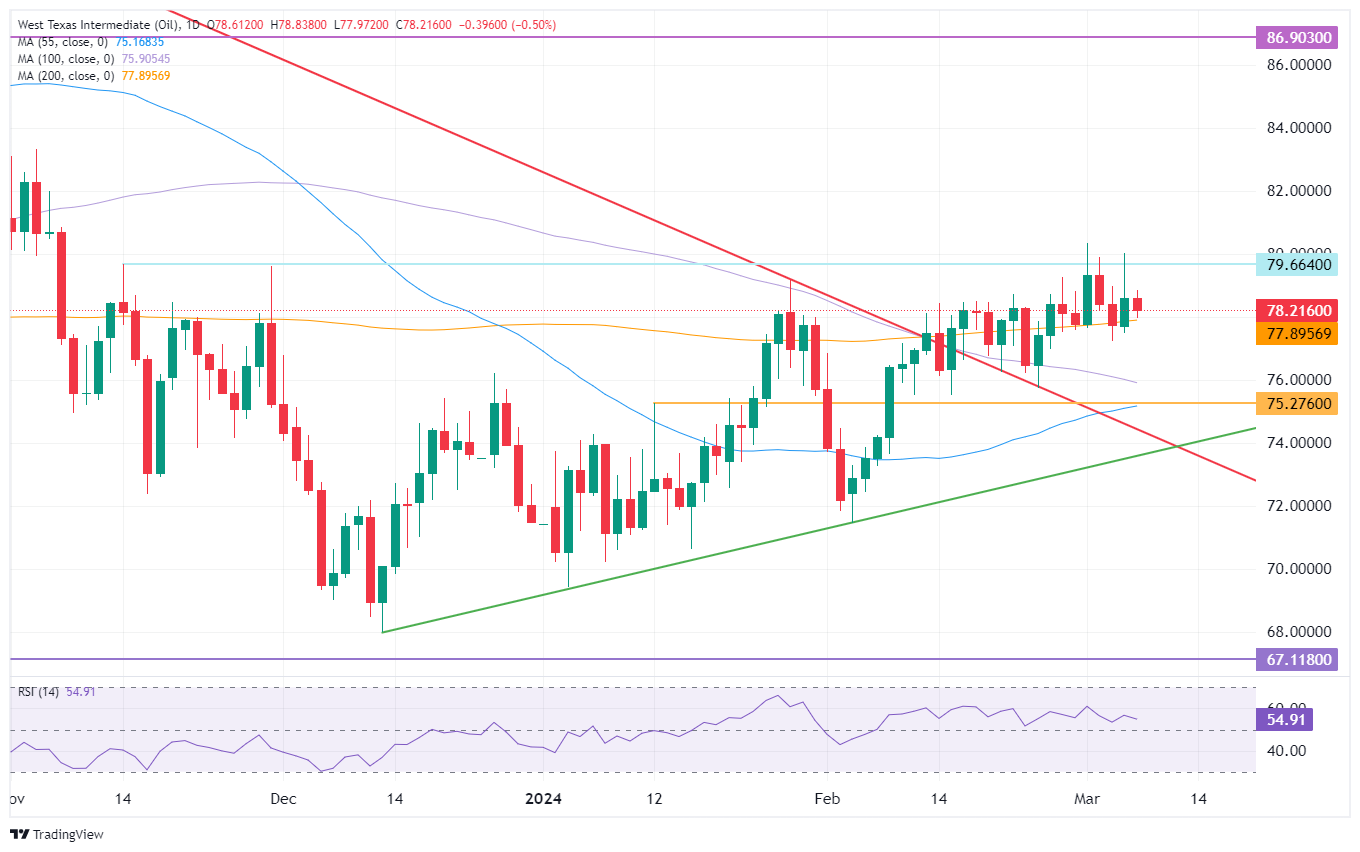
US WTI Crude Oil: Daily Chart
WTI Oil FAQs
WTI Oil is a type of Crude Oil sold on international markets. The WTI stands for West Texas Intermediate, one of three major types including Brent and Dubai Crude. WTI is also referred to as “light” and “sweet” because of its relatively low gravity and sulfur content respectively. It is considered a high quality Oil that is easily refined. It is sourced in the United States and distributed via the Cushing hub, which is considered “The Pipeline Crossroads of the World”. It is a benchmark for the Oil market and WTI price is frequently quoted in the media.
Like all assets, supply and demand are the key drivers of WTI Oil price. As such, global growth can be a driver of increased demand and vice versa for weak global growth. Political instability, wars, and sanctions can disrupt supply and impact prices. The decisions of OPEC, a group of major Oil-producing countries, is another key driver of price. The value of the US Dollar influences the price of WTI Crude Oil, since Oil is predominantly traded in US Dollars, thus a weaker US Dollar can make Oil more affordable and vice versa.
The weekly Oil inventory reports published by the American Petroleum Institute (API) and the Energy Information Agency (EIA) impact the price of WTI Oil. Changes in inventories reflect fluctuating supply and demand. If the data shows a drop in inventories it can indicate increased demand, pushing up Oil price. Higher inventories can reflect increased supply, pushing down prices. API’s report is published every Tuesday and EIA’s the day after. Their results are usually similar, falling within 1% of each other 75% of the time. The EIA data is considered more reliable, since it is a government agency.
OPEC (Organization of the Petroleum Exporting Countries) is a group of 13 Oil-producing nations who collectively decide production quotas for member countries at twice-yearly meetings. Their decisions often impact WTI Oil prices. When OPEC decides to lower quotas, it can tighten supply, pushing up Oil prices. When OPEC increases production, it has the opposite effect. OPEC+ refers to an expanded group that includes ten extra non-OPEC members, the most notable of which is Russia.
Author
Filip Lagaart
FXStreet
Filip Lagaart is a former sales/trader with over 15 years of financial markets expertise under its belt.

















