Oil slips below $85 on OPEC concerns for being to eager to lift current production cuts
- WTI slips below $85 with OPEC sounding eager to lift production cuts in its monthly report.
- Oil traders sees OPEC issuing warning over possible shortage in markets over the summer.
- The US Dollar Index sees pressure to snap back below 105.00 after uptick in unemployment and softer PPI data.

Oil prices are sliding lower on the back of the monthly OPEC report where the group is issuing a warning that it will closely monitor the Oil market balance with an expected surge in demand over the summer. On the geopolitical side, CNN reported that US intelligence expects a flare up in attacks from Iran on Israeli or US assets in the Middle East in response to the Israeli attacks in Damascus. The Iranian-backed Houthi rebels in Yemen, meanwhile, are targeting vessels again in the Gulf of Aden and are attacking a US destroyer, Reuters reported.
The US Dollar meanwhile is unable to hold on to gains in a double whammy of resistance with the European Central Bank unwilling to confirm June for a first rate cut. Additionally, the US Producer Price Index (PPI) release saw both Headline and Core elements all fall in line or below expectations. This took the wind out of the US Dollar strength which was rolling through markets on the idea all inflation elements would continue to jump higher or remain elevated, which on the producer side is not fully the case.
Crude Oil (WTI) trades at $84.86 and Brent Crude at $89.32 at the time of writing.
Oil news and market movers: Big Brother is watching
- The monthly OPEC report bears the message that OPEC will be closely monitoring the summer and will step in when needed.
- Mexican Oil exports are steady, though not recovering after Oil exports in March tumbled to the lowest levels since 2019, Bloomberg reports.
- US Intelligence believes major drone and missile strikes by Iran are set to take place, both Bloomberg and Reuters report.
- Occidental Petroleum Corp. is set to restart its Gulf of Mexico output after a pipe leak earlier.
- Saudi Aramco reports it will deliver full contractual volumes to Asian constumers. Global supply and demand looks tight, pointing to a fragile balance where an uptick in oil prices could be at hand once the equilibrium breaks down.
Oil Technical Analysis: OPEC takes wind out of bullish oil momentum
Oil prices are jumping higher with tensions in the Middle East nearing a new dynamic. After Iran vowed to retaliate against Israel or any US asset in the region, tensions are getting high as such an attack could drag the whole region back into a long drawn-out dispute with the risk of Oil delivery disruptions. These elements are enough for traders to price in more risk premium in crude, which is making its way to $90.
If the high of last week at $87.12 gets broken, the $90 handle should come into grasp. One small barrier in the way is $89.64, the peak from October 20. In case of further escalating tensions in the Middle East , expect even $94 to become a possibility, and a fresh 18-month high could be on the cards.
On the downside, $83.34 is the first level to have a look for after a very clean break and test for support on April 1 and 2. Should it not hold, $80.63 is the next best candidate as a pivotal supportive level. A touch softer, the convergence with the 55-day and the 200-day Simple Moving Averages (SMAs) at $79.32 should halt any further downturn.
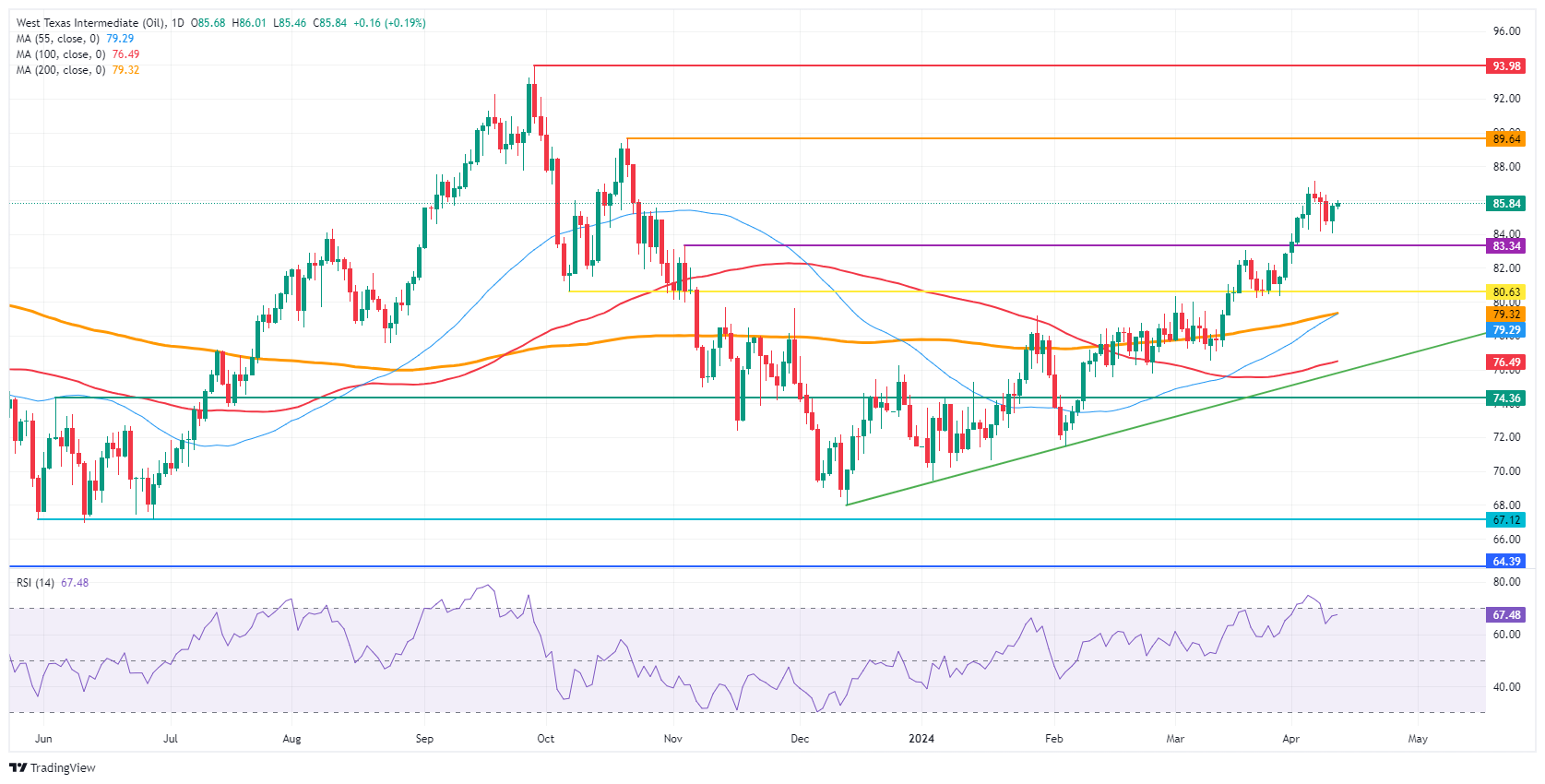
US WTI Crude Oil: Daily Chart
WTI Oil FAQs
WTI Oil is a type of Crude Oil sold on international markets. The WTI stands for West Texas Intermediate, one of three major types including Brent and Dubai Crude. WTI is also referred to as “light” and “sweet” because of its relatively low gravity and sulfur content respectively. It is considered a high quality Oil that is easily refined. It is sourced in the United States and distributed via the Cushing hub, which is considered “The Pipeline Crossroads of the World”. It is a benchmark for the Oil market and WTI price is frequently quoted in the media.
Like all assets, supply and demand are the key drivers of WTI Oil price. As such, global growth can be a driver of increased demand and vice versa for weak global growth. Political instability, wars, and sanctions can disrupt supply and impact prices. The decisions of OPEC, a group of major Oil-producing countries, is another key driver of price. The value of the US Dollar influences the price of WTI Crude Oil, since Oil is predominantly traded in US Dollars, thus a weaker US Dollar can make Oil more affordable and vice versa.
The weekly Oil inventory reports published by the American Petroleum Institute (API) and the Energy Information Agency (EIA) impact the price of WTI Oil. Changes in inventories reflect fluctuating supply and demand. If the data shows a drop in inventories it can indicate increased demand, pushing up Oil price. Higher inventories can reflect increased supply, pushing down prices. API’s report is published every Tuesday and EIA’s the day after. Their results are usually similar, falling within 1% of each other 75% of the time. The EIA data is considered more reliable, since it is a government agency.
OPEC (Organization of the Petroleum Exporting Countries) is a group of 13 Oil-producing nations who collectively decide production quotas for member countries at twice-yearly meetings. Their decisions often impact WTI Oil prices. When OPEC decides to lower quotas, it can tighten supply, pushing up Oil prices. When OPEC increases production, it has the opposite effect. OPEC+ refers to an expanded group that includes ten extra non-OPEC members, the most notable of which is Russia.
Author

Filip Lagaart
FXStreet
Filip Lagaart is a former sales/trader with over 15 years of financial markets expertise under its belt.















