|

NZD/USD rallies to multi-week highs after soft US NFPs

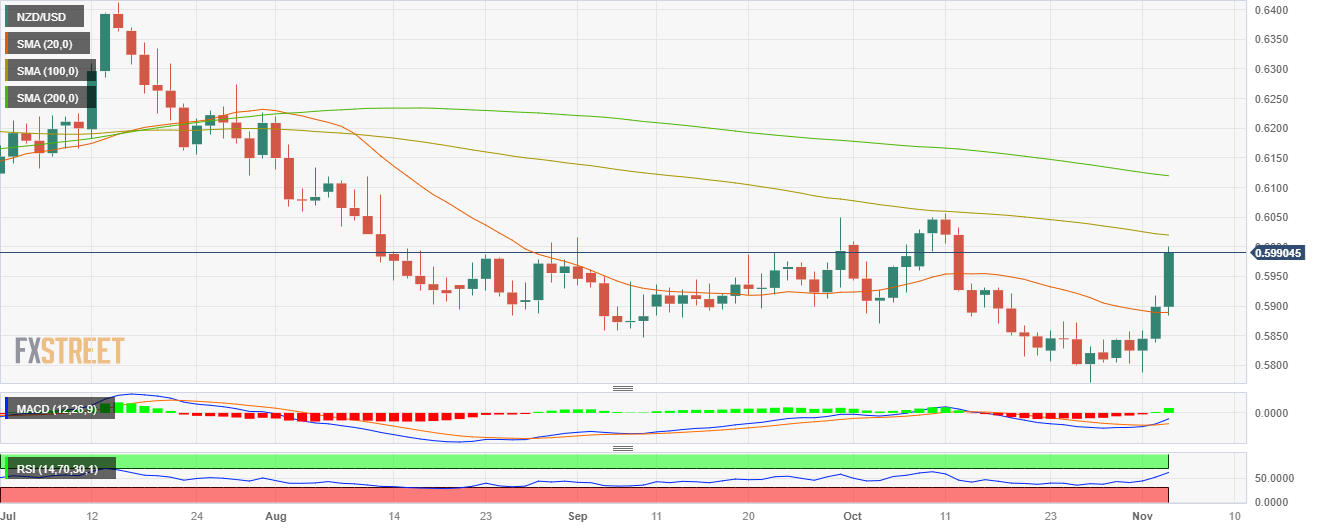
  • NZD/USD rose by more than 1% to 0.5990, its highest since mid October.
  • The US reported weak NFPs, which triggered a sharp decline in US yields and hawkish bets on the Fed.
  • Eyes on inflation figures from the US from October.


On Friday, the NZD/USD rallied, driven by the US Dollar facing notable selling pressure after the release of the soft labour market, which triggered a decline in US Treasury yields and hawkish bets on the Federal Reserve (Fed) for the December meeting. On the Kiwi’s side, no relevant data was released.

The latest data from the US Bureau of Labor Statistics delivered a blow to market expectations, with the Nonfarm Payrolls for October falling short of projections. The report revealed an addition of 150,000 jobs in the US economy, trailing the anticipated 180,000 and showing a slowdown from the revised prior figure of 297,000. Additionally, the Unemployment Rate for the same period rose to 3.9%, surpassing the projected 3.8%.

Moreover, the Average Hourly Earnings for October exhibited a sluggish monthly growth of 0.2% but managed to climb to 4.1% YoY, surpassing the expected 4% and outpacing the previous figure of 4.3%.

Simultaneously, the US Treasury yields continue to decline, with the 2-year rate hitting its lowest mark since early September at 4.83%. Correspondingly, the longer-term 5 and 10-year rates retreated to approximately 4.50% and 4.54%. Regarding the December meeting of the Fed, the CME FedWatch Tool shows that the probability of a 25 basis points hike in declined to a mere 9%, exacerbating the selling pressure on the Greenback.

On November 14th, the US will report inflation rate figures from October, which investors will closely watch to continue modelling their expectations.

NZD/USD Levels to watch 

Based on the daily chart, NZD/USD maintains a neutral to bullish technical perspective, indicating that the bulls are making strides in regaining control and gathering significant momentum. The Relative Strength Index (RSI) maintains a positive slope above its midline, while the Moving Average Convergence (MACD) histogram exhibits bigger green bars.

However, despite being above the 20-day Simple Moving Average (SMA), the pair is still below the 100 and 200-day, indicating that on the broader outlook, the bears are in command.

 Support levels: 0.5930, 0.5910, 0.5900.

 Resistance levels: 0.6000, 0.6020 (100-day SMA), 0.6050.

 NZD/USD Daily Chart
NZD/USD

Overview
Today last price0.5984
Today Daily Change0.0085
Today Daily Change %1.44
Today daily open0.5899
 
Trends
Daily SMA200.5889
Daily SMA500.5913
Daily SMA1000.6022
Daily SMA2000.6122
 
Levels
Previous Daily High0.5918
Previous Daily Low0.5838
Previous Weekly High0.5874
Previous Weekly Low0.5772
Previous Monthly High0.6056
Previous Monthly Low0.5772
Daily Fibonacci 38.2%0.5887
Daily Fibonacci 61.8%0.5868
Daily Pivot Point S10.5852
Daily Pivot Point S20.5805
Daily Pivot Point S30.5772
Daily Pivot Point R10.5932
Daily Pivot Point R20.5965
Daily Pivot Point R30.6012

Author

Patricio Martín

Patricio is an economist from Argentina passionate about global finance and understanding the daily movements of the markets.


More from Patricio Martín
Share:

Editor's Picks

GBP/USD flirts with two-day lows near 1.3180

GBP/USD remains on the back foot in the latter part of Tuesday’s session, sliding to the sub-1.3200 area and challenging weekly lows. Cable’s decline comes as investors assess the political uncertainty in the UK, coupled with softer-than-expected UK PMI data and the better tone in the Greenback.

EUR/USD weakens below 1.1400 on stronger Dollar

EUR/USD adds to Monday’s losses and recedes below the 1.1400 support to clinch fresh 13-month lows in the latter part of Tuesday’s NA session. The pair’s marked sell-off comes on the back of the persistent move higher in th US Dollar, always propped up by rising bets of further tightening by the Fed.

Gold appears supported near $4,100 for now

Gold rapidly reverses Monday's bounce and is trading sharply lower on Tuesday. The yellow metal, however, manages well to keep business above the $4,100 mark per troy ounce despite a firmer US Dollar and expectations that the Fed will keep rates higher for longer.

Bittensor and Near Protocol Outlook: AI-linked tokens face deeper sell-off
The cryptocurrency market trades amid increasing sell-side pressure on Tuesday, reflecting a broader deterioration in sentiment and appetite for risk assets. Artificial Intelligence (AI)-linked tokens such as Bittensor (TAO) and Near Protocol (NEAR) exhibit both fundamental and technical weaknesses, trading at $217 and $1.99, respectively.
"Rearranging the deckchairs on the Titanic": UK's fiscal crisis outlasts another Prime Minister

Keir Starmer's resignation as the UK Prime Minister comes ten years after the Brexit referendum vote, a coincidence that financial markets have been quick to note. The British Pound trades around 1.3220 against the US Dollar on Thursday.

Regime change: Inside Kevin Warsh's first move to make the Fed unreadable on purpose

The rate did not move. That was the least interesting thing about Kevin Warsh's first meeting in charge of the Fed. The FOMC held its benchmark at 3.50%-3.75% for the fourth straight meeting, exactly as priced, and then the new chair used his first press conference to dismantle the machinery the market has leaned on for a decade.














