NZD/USD Price Forecast: Bulls need to wait for strength beyond 0.6200 before placing fresh bets
- NZD/USD regains positive traction on Monday amid broad-based USD weakness.
- A sustained move beyond the 0.6200 mark should pave the way for further gains.
- Traders, however, might wait on the sidelines ahead of the Fed on Wednesday.

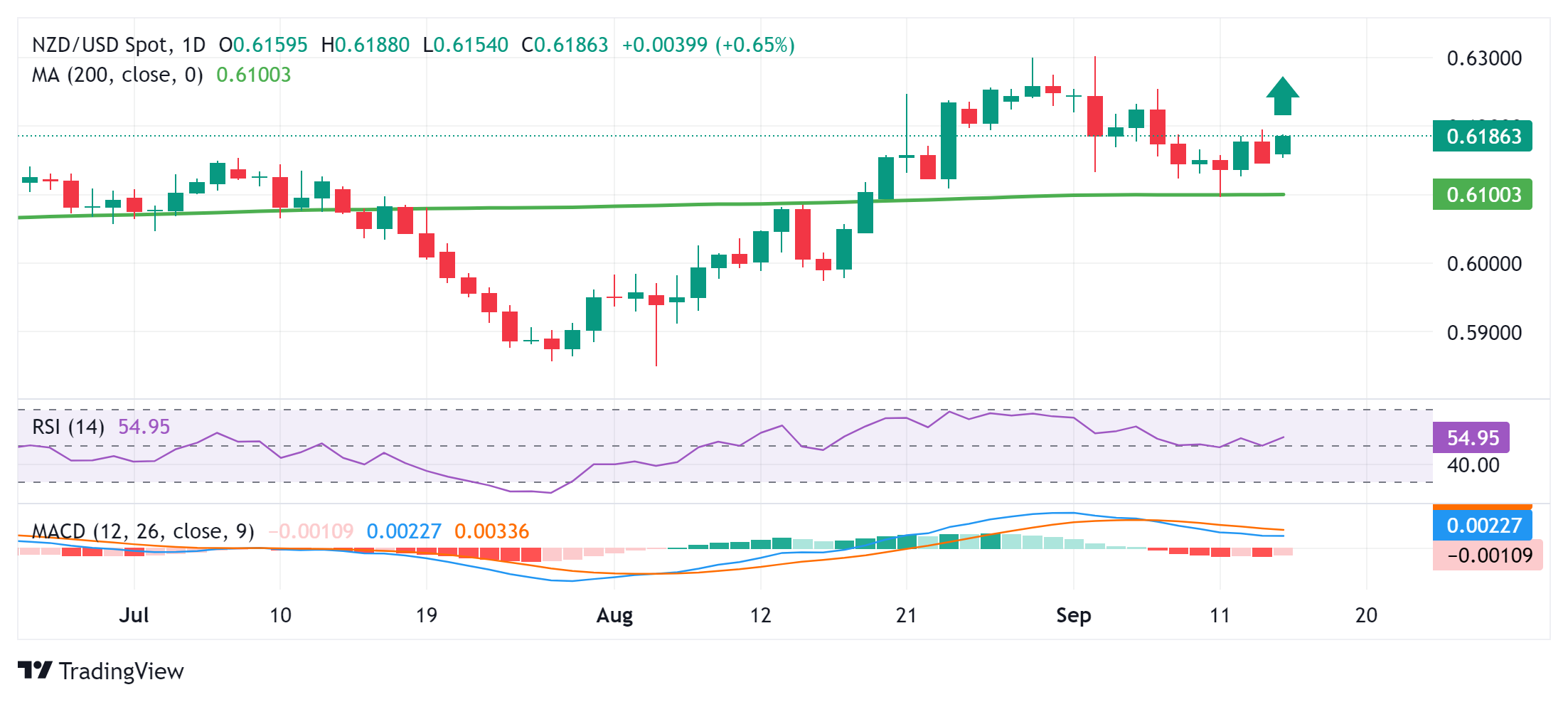
The NZD/USD pair attracts some dip-buying on the first day of a new week and reverses a major part of Friday's pullback from the 0.6200 neighborhood, or a one-week high renewed US Dollar (USD) selling bias. Spot prices climb to the 0.6180-0.6185 region during the first half of the European session and seem poised to build on last week's bounce from the very important 200-day Simple Moving Average (SMA).
Rising bets for an oversized 50-basis points interest rate cut by the Federal Reserve (Fed) drag the USD Index (DXY) back closer to the year-to-date (YTD) low and lend support to the NZD/USD pair. Apart from this, a generally positive tone around the equity markets is seen undermining the safe-haven buck, which helps offset a string of dismal Chinese macro data released over the weekend and benefits the risk-sensitive Kiwi.
From a technical perspective, oscillators on the daily chart – though they have been recovering from lower levels – have yet to confirm a positive bias. This makes it prudent to wait for some follow-through buying beyond the 0.6200 mark before placing bullish fresh and ahead of the FOMC decision on Wednesday. The NZD/USD pair might then climb to the 0.6255 area en route to the 0.6300 mark or a multi-month high touched in August.
On the flip side, the 0.6155 region now seems to protect the immediate downside ahead of the Asian session low, around the 0.6135 area. This is followed by the 0.6100 mark, or the 200-day SMA, which, if broken decisively, will be seen as a fresh trigger for bearish traders. The downward trajectory could then extend towards the 0.6045 intermediate support before the NZD/USD pair eventually drops to the 0.6000 psychological mark.
NZD/USD daily chart
New Zealand Dollar FAQs
The New Zealand Dollar (NZD), also known as the Kiwi, is a well-known traded currency among investors. Its value is broadly determined by the health of the New Zealand economy and the country’s central bank policy. Still, there are some unique particularities that also can make NZD move. The performance of the Chinese economy tends to move the Kiwi because China is New Zealand’s biggest trading partner. Bad news for the Chinese economy likely means less New Zealand exports to the country, hitting the economy and thus its currency. Another factor moving NZD is dairy prices as the dairy industry is New Zealand’s main export. High dairy prices boost export income, contributing positively to the economy and thus to the NZD.
The Reserve Bank of New Zealand (RBNZ) aims to achieve and maintain an inflation rate between 1% and 3% over the medium term, with a focus to keep it near the 2% mid-point. To this end, the bank sets an appropriate level of interest rates. When inflation is too high, the RBNZ will increase interest rates to cool the economy, but the move will also make bond yields higher, increasing investors’ appeal to invest in the country and thus boosting NZD. On the contrary, lower interest rates tend to weaken NZD. The so-called rate differential, or how rates in New Zealand are or are expected to be compared to the ones set by the US Federal Reserve, can also play a key role in moving the NZD/USD pair.
Macroeconomic data releases in New Zealand are key to assess the state of the economy and can impact the New Zealand Dollar’s (NZD) valuation. A strong economy, based on high economic growth, low unemployment and high confidence is good for NZD. High economic growth attracts foreign investment and may encourage the Reserve Bank of New Zealand to increase interest rates, if this economic strength comes together with elevated inflation. Conversely, if economic data is weak, NZD is likely to depreciate.
The New Zealand Dollar (NZD) tends to strengthen during risk-on periods, or when investors perceive that broader market risks are low and are optimistic about growth. This tends to lead to a more favorable outlook for commodities and so-called ‘commodity currencies’ such as the Kiwi. Conversely, NZD tends to weaken at times of market turbulence or economic uncertainty as investors tend to sell higher-risk assets and flee to the more-stable safe havens.
Author

Haresh Menghani
FXStreet
Haresh Menghani is a detail-oriented professional with 10+ years of extensive experience in analysing the global financial markets.