Nordstrom (JWN) Stock Forecast: Ryan Cohen's stake helps AMC rally
- Ryan Cohen has reportedly taken a large stake in the company.
- AMC stock is up 3% against a declining NASDAQ.
- US Dollar strength caused by a hot NFP figure is hurting equities.
- JWN stock has traded up as much as 35% in Friday's premarket.

As if there was not enough news this week, meme stock empresario Ryan Cohen – famous for founding Chewy (CHWY) and investing in GameStop (GME), AMC Entertainment (AMC) and Bed Bath & Beyond (BBBY) – has taken a stake in upscale fashion retailer Nordstrom (JWN). The stock has sailed up more than 35% in Friday's premarket, and this excitement has lent itself to one of his earliest investments, AMC stock.
Shares of AMC have rallied 3% in the premarket, which would usually not be all that interesting, except that NASDAQ futures have spent much of the day down more than 1% due to a poor earnings showing late Thursday from Apple (AAPL), Amazon (AMZN) and Alphabet (GOOGL). In addition, the nonfarm payrolls data came out hot for January at 517,000 new jobs. That was way ahead of expectations for 185,000 and has pushed the US Dollar value much higher, which is typically inversely correlated with rallies in the equity market. Market observers are also worried that the hot job market will lead to more inflation and thus Federal Reserve interest rate hikes.
Nordstrom stock news
News outlets like Reuters and Bloomberg appear to be relying on a source from inside the company, but so far there has been no certainty about how large Ryan Cohen's stake is. Bloomberg's reporting says that the stake already makes Ryan Cohen a top-five shareholder among non-family members.
"While Mr. Cohen hasn’t sought any discussions with us in several years, we are open to hearing his views, as we do with all Nordstrom shareholders," wrote a Nordstrom spokeswoman.
In the past Ryan Cohen has acted as an activist shareholder with many of his investments. Just recently he asked Alibaba (BABA) to increase their share repurchases. Before that he became Chairman of GameStop and pushed then Bed Bath & Beyond CEO Mark Tritton out the door. Tritton may actually be the reason for Cohen's interest in Nordstrom now since he serves on the board and heads up their compensation committee.
Could Cohen be motivated to give Tritton the boot once more? Tritton worked as an executive at Nordstrom from 2009 to 2016, and the reporting thus far signals that Cohen is interested in a board seat. The board may be less willing to help Cohen on this one, however, after his investment in Bed Bath & Beyond was short-lived, he left retail investors holding the bag after dashing off with a $60 million profit, and the firm is now openly contemplating bankruptcy.
Nordstrom stock forecast
It should not be surprising that JWN stock ran into a wall above $27. In March, June and August of 2022, Nordstrom stock seems to have found stubborn resistance surounding $27.42. That resistance barrier was only beaten for long in April of last year when it stalled out at $29.50 or so. That being said, I do not find this chart to be amenable to much more upside, at least not easily.
Anything can happen in a meme-induced environment and retail traders have entered the market in full force since the start of the year, but entering above $27 does not provide an easy road higher to say the least. Secondly, the market appears to have turned lower with the big three FAANG stocks selling off late Thursday and the higher value of the US Dollar giving most market bulls the willies. From this perch at the beginning of February, it looks all downhill for the month.
If bulls and fans of Ryan Cohen refuse to give up, however, then expect Nordstrom stock to retest the November 2021 resistance high at $36.
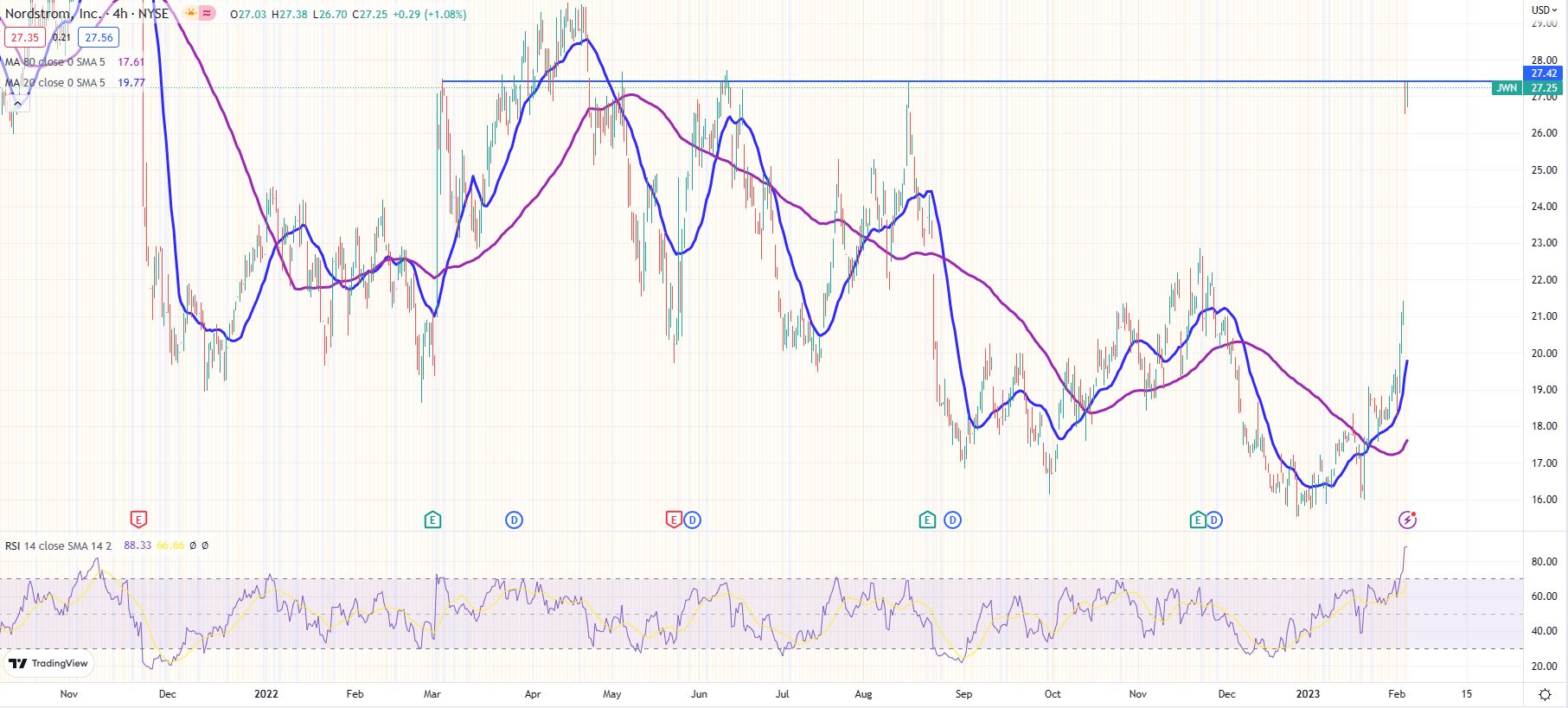
JWN 4-hour chart
Author

Clay Webster
FXStreet
Clay Webster grew up in the US outside Buffalo, New York and Lancaster, Pennsylvania. He began investing after college following the 2008 financial crisis.