Nike Stock Forecast: NKE gets big tick from investors after earnings beat
- Nike beat earnings consensus for FQ1 results.
- The quarter ending in August witnessed better pricing power.
- Nike earned $0.94 per share on revenue of $12.94 billion.
- NKE stock has conquered the 21-day SMA, signaling a new uptrend.
- August PCE data shows core inflation slowing its growth trajectory.

Nike (NKE) stock has surged over 9% in Friday’s premarket, climbing above $98 per share, following late Thursday’s fiscal first-quarter earnings release. Nike got a big tick from investors after it beat pessimistic earnings expectations by more than 23% and hiked its dividend by 9%.
The US Personal Consumption Expenditures (PCE) Price Index for August was released before Friday's open and is already benefiting equity prices. Monthly Core PCE grew by 0.1% from July as consensus had been 0.2%. Annual Core PCE rose by 3.9% as expected. This data confirms the market's thesis that inflation is slowing and the Federal Reserve (Fed) is unlikely to raise rates any higher this year.
The entire market is making gains before the bell as the NASDAQ 100 futures rise 0.7% and the S&P 500 and Dow futures both advance above 0.5%. Nike’s positive outlook has aided trader enthusiasm, but many observers also expected Core Personal Consumption Expenditures data to show declining inflation.
Nike earnings news: Nike still has pricing power
Oregon-based Nike reported $0.94 in GAAP earnings per share (EPS) on revenue of $12.94 billion. The market ignored that the footwear king missed consensus on sales by over $60 million, instead viewing Nike’s 18-cent beat on EPS as a seachange event.
Nike management said they had used better pricing strategies, reduced their reliance on markdowns, and lowered inventory in an attempt to streamline the operations. A stronger US Dollar was still a problem for Nike in the quarter ending in August, but the brand benefited from lower ocean freight costs.
The revenue shortfall was primarily due to sales in Greater China that were $90 million below analyst expectations, but the region still provided double-digit sales growth YoY.
Morgan Stanley analyst Alex Straton retained his $126 price target on Nike shares and his Overweight rating. Straton said the vigor and optimism from management would seem to mean that the worst is now behind the athletic wear giant.
For the second fiscal quarter, which will be reported in December, Nike management expects single-digit annual gains in sales with at least a one percentage point increase in gross margin, and CFO Matt Friend said that there would be ongoing growth in operating margin as well.
“We are building on a strong foundation for sustainable and more profitable long-term growth," Friend said.
Inflation FAQs
What is inflation?
Inflation measures the rise in the price of a representative basket of goods and services. Headline inflation is usually expressed as a percentage change on a month-on-month (MoM) and year-on-year (YoY) basis. Core inflation excludes more volatile elements such as food and fuel which can fluctuate because of geopolitical and seasonal factors. Core inflation is the figure economists focus on and is the level targeted by central banks, which are mandated to keep inflation at a manageable level, usually around 2%.
What is the Consumer Price Index (CPI)?
The Consumer Price Index (CPI) measures the change in prices of a basket of goods and services over a period of time. It is usually expressed as a percentage change on a month-on-month (MoM) and year-on-year (YoY) basis. Core CPI is the figure targeted by central banks as it excludes volatile food and fuel inputs. When Core CPI rises above 2% it usually results in higher interest rates and vice versa when it falls below 2%. Since higher interest rates are positive for a currency, higher inflation usually results in a stronger currency. The opposite is true when inflation falls.
What is the impact of inflation on foreign exchange?
Although it may seem counter-intuitive, high inflation in a country pushes up the value of its currency and vice versa for lower inflation. This is because the central bank will normally raise interest rates to combat the higher inflation, which attract more global capital inflows from investors looking for a lucrative place to park their money.
How does inflation influence the price of Gold?
Formerly, Gold was the asset investors turned to in times of high inflation because it preserved its value, and whilst investors will often still buy Gold for its safe-haven properties in times of extreme market turmoil, this is not the case most of the time. This is because when inflation is high, central banks will put up interest rates to combat it.
Higher interest rates are negative for Gold because they increase the opportunity-cost of holding Gold vis-a-vis an interest-bearing asset or placing the money in a cash deposit account. On the flipside, lower inflation tends to be positive for Gold as it brings interest rates down, making the bright metal a more viable investment alternative.
Nike stock forecast
Nike stock has been in a serious downtrend since February 2 of this year. The stock was so oversold that it registered at 19.8 on the Relative Strength Index (RSI) prior to Thursday’s earnings.
In just one session though, the NKE price has now risen nearly $10 to overtake the 21-day Simple Moving Average (SMA). Expect Nike stock to rise out of the oversold conditions on the RSI next. Immediate resistance comes from the $102 to $104 range that has worked as both support and resistance at different times throughout 2023.
After that, the $114 to $118.50 band will arrive next as the bulls' main priority. On the way higher, traders will know that the rally is still ongoing if pullbacks only descend to the 9-day SMA. Pullbacks that test or break through the 21-day SMA will be reason enough to sell.
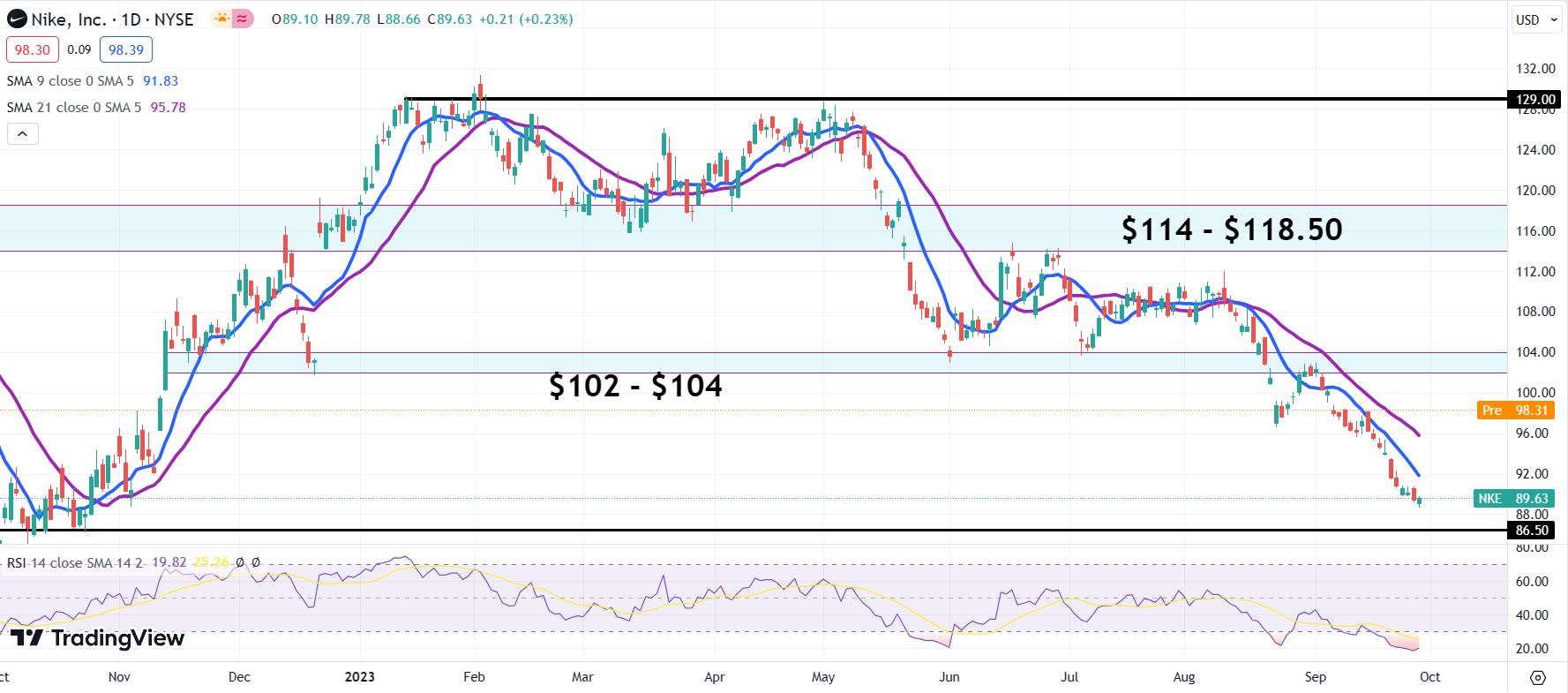
NKE daily chart
Author

Clay Webster
FXStreet
Clay Webster grew up in the US outside Buffalo, New York and Lancaster, Pennsylvania. He began investing after college following the 2008 financial crisis.














