Natural Gas dips with traders nervous on recession risk
- Natural Gas snaps $2.13 with selling pressure picking up in US session.
- Markets see Europe well-equipped for the next heating season, while New Zealand faces issues ahead.
- The US Dollar index recovers slightly ahead of Nvidia's earnings.

Natural Gas (XNG/USD) snaps out of its thigh range between $2.13 and $2.36 and heads lower again with US markets seeing a recession fear again. Demand still looks bleak, with Europe and China needing less Liquified Natural Gas (LNG), while New Zealand has decided to remove regulatory hurdles to import LNG and reverse a ban on offshore exploration projects to solve its energy crisis.
Meanwhile, the US Dollar Index (DXY), which tracks the Greenback's value against six major currencies, is busy erasing one of its worst weeks in nearly a year. The US Dollar appears to have found some support and sees some mild inflows on the back of nervousness ahead of Nvidia (NVDA) earnings after the US closing bell. Any underperformance of the tech giant could spark a sell-off in equities, further supporting the US Dollar.
Natural Gas is trading at $2.13 per MMBtu at the time of writing.
Natural Gas news and market movers: No upside potential
- Bloomberg reports that Norwegian Gas exports to Europe are at a two-month low. The main reason for the drop in supply is seasonal maintenance in Norway.
- Reuters reports from Australia that Inpex has canceled at least four LNG shipments scheduled for next month from its Ichthys facility due to an ongoing outage.
- Reuters reports that New Zealand's government vowed to lift a six-year-old ban on the issue of Oil and Gas exploration permits and wants to fast-track an LNG import project. The country has been facing serious energy disruptions in recent months.
- Recent retaliations and now the introduction of a new ballistic missile for Ukraine could mean that Russian President Vladimir Putin could even consider completely cutting off Europe from its gas supply.
Natural Gas Technical Analysis: A catalyst is missing
Natural Gas prices have eased after a volatile summer. With a ceasefire deal on the table in Gaza, European Gas storage levels above 90%, and sluggish demand from China, not many catalysts exist for prices to surge. It looks like Gas prices will be stuck in this sideways action for some time until a new catalyst comes in to shake things up.
Should more bullish headlines emerge, moving averages are the first upside resistances. First, the 200-day Simple Moving Average (SMA) and the 55-day SMA, near $2.30 and $2.36, respectively, would already represent significant moves higher. Further up, the 100-day SMA at $2.41 could be tested.
On the downside, pressure is building on $2.13 to a breakdown. In case this level snaps, $2.00 comes back into play for a test. Although still far away, a dip under $2.00 could mean a test of the August low at $1.93.
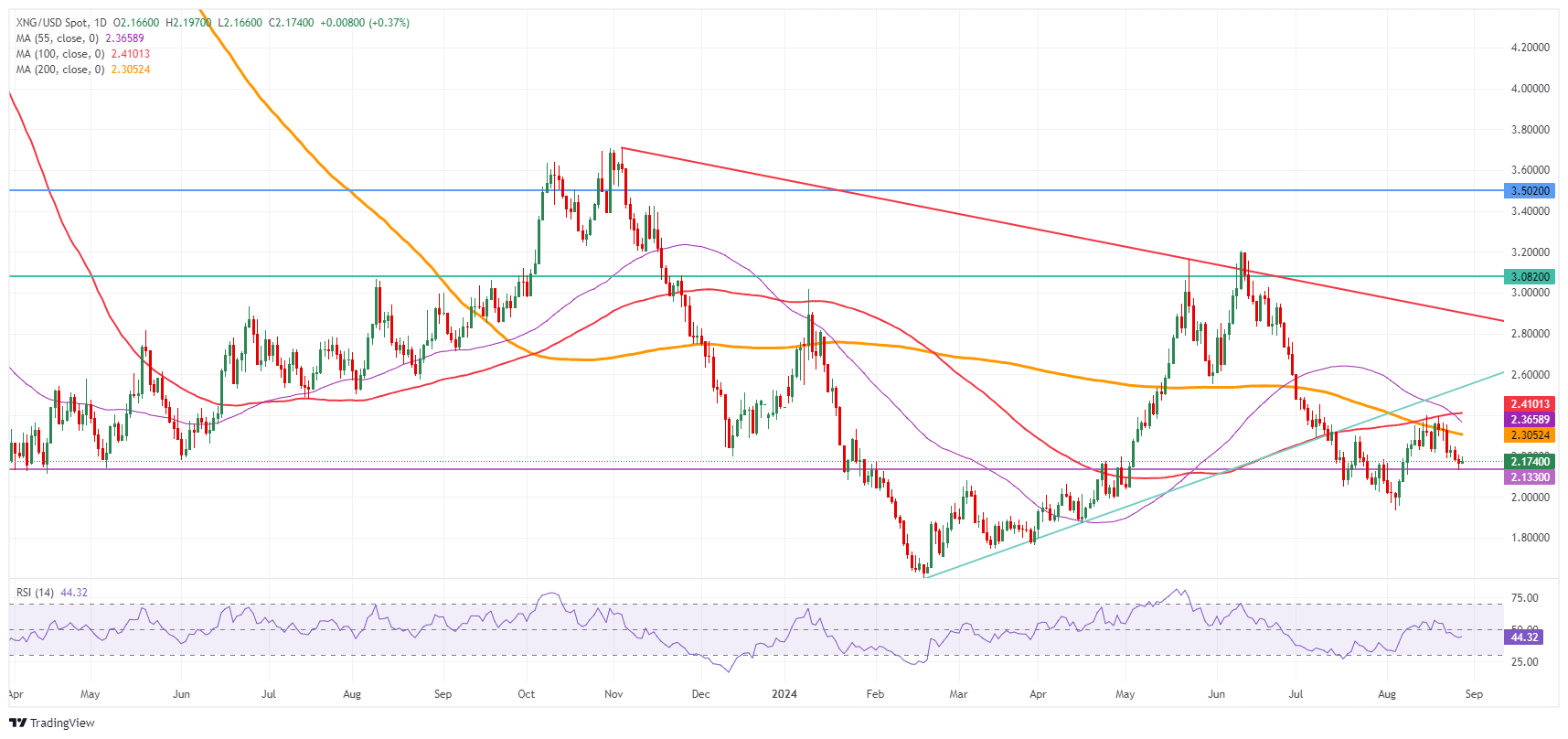
Natural Gas: Daily Chart
(This story was corrected on August 28 at 11:45 GMT to say that New Zealand will pass a law that will clear regulatory hurdles to import liquefied Natural Gas, not remove a ban on LNG imports. The ban to be removed is on offshore Oil and Gas exploration.)
Natural Gas FAQs
Supply and demand dynamics are a key factor influencing Natural Gas prices, and are themselves influenced by global economic growth, industrial activity, population growth, production levels, and inventories. The weather impacts Natural Gas prices because more Gas is used during cold winters and hot summers for heating and cooling. Competition from other energy sources impacts prices as consumers may switch to cheaper sources. Geopolitical events are factors as exemplified by the war in Ukraine. Government policies relating to extraction, transportation, and environmental issues also impact prices.
The main economic release influencing Natural Gas prices is the weekly inventory bulletin from the Energy Information Administration (EIA), a US government agency that produces US gas market data. The EIA Gas bulletin usually comes out on Thursday at 14:30 GMT, a day after the EIA publishes its weekly Oil bulletin. Economic data from large consumers of Natural Gas can impact supply and demand, the largest of which include China, Germany and Japan. Natural Gas is primarily priced and traded in US Dollars, thus economic releases impacting the US Dollar are also factors.
The US Dollar is the world’s reserve currency and most commodities, including Natural Gas are priced and traded on international markets in US Dollars. As such, the value of the US Dollar is a factor in the price of Natural Gas, because if the Dollar strengthens it means less Dollars are required to buy the same volume of Gas (the price falls), and vice versa if USD strengthens.
Author
Filip Lagaart
FXStreet
Filip Lagaart is a former sales/trader with over 15 years of financial markets expertise under its belt.