Natural Gas roars over 10% in biggest uprising in 2024
- Natural Gas up over 11% intraday in European trading.
- Traders are sending Gas higher as the supply side is set to get shaken up.
- The US Dollar Index is back above 104 after its decline Tuesday and ahead of the Fed Minutes.

Natural Gas (XNG/USD) is having a field day with a firm rally which is holding on to over 10% of gains into the US opening bell. One of the major Shale drillers, Chesapeake, is planning to cut its Natural Gas production already in 2024. The recent crash in Gas prices makes its Gas mining operations nearly unprofitable, and forces the company to cut its output, which means the global supply side will become tighter.
The US Dollar (USD) is turning red, unable to hold on to its European gains ahead of the US opening bell and US Fed FOMC Minutes. The turn comes with a Wall Street Journal article that points to move in SOFR (Secured Overnight Financing Rate Data) which looks to be tilted to a rate hike in the coming three months. Quite a surprise of course, while meanwhile mortgage applications are sinking by 10% against last week, which could point to a decline in the housing market activities.
Natural Gas is trading at $1.84 per MMBtu at the time of writing.
Natural Gas market movers: Tensions added
- Geopolitical tensions are being added in the equasion with the UK Navy reporting explosion and a bright flash in the Red Sea with possible Houthi attacks taking place again.
- The overall Gas supply just got smaller with Chesapeake reducing its output production for 2024. It is set to reduce nearly 20% of its total output for 2024 already.
- LNG is flowing above average with more than 17% inflow on top of the normal 30-day average.
- The bullet point above shows that Europe is busy refilling and restocking its Gas stores with its eye on the next heating season.
- Several benchmark futures are soaring with that active buying taking place in the Natural Gas futures markets.
Natural Gas Technical Analysis: Turning into perfect storm
Natural Gas is finding some reasoning to jump higher, back to the $1.80 pivotal level. The move comes with finally the supply side seeing some disruption ahead for 2024 and which means a repricing (higher) is needed to factor this event in. It becomes very clear that should Gas prices want to move further up, any supply side disruption will be key to accomplish this.
On the upside, Natural Gas is facing some pivotal technical levels to get back to. Once $1.80 is surpassed, the next stop is $1.99, – the level which, when broken, saw an accelerated decline. After that the blue line at $2.13 comes into view, with the triple bottoms from 2023. In case Natural Gas sees sudden demand pick up, possibly $2.40 could come into play.
Keep an eye on $1.80, which was a pivotal level back in July 2020 and acts as a cap with a firm rejection earlier this Wednesday. Should the recent headlines start to fade, or more supply emerge in the markets from other firms or countries to fill the gap, $1.64 and $1.53 (the low of 2020) are targets to look out for.
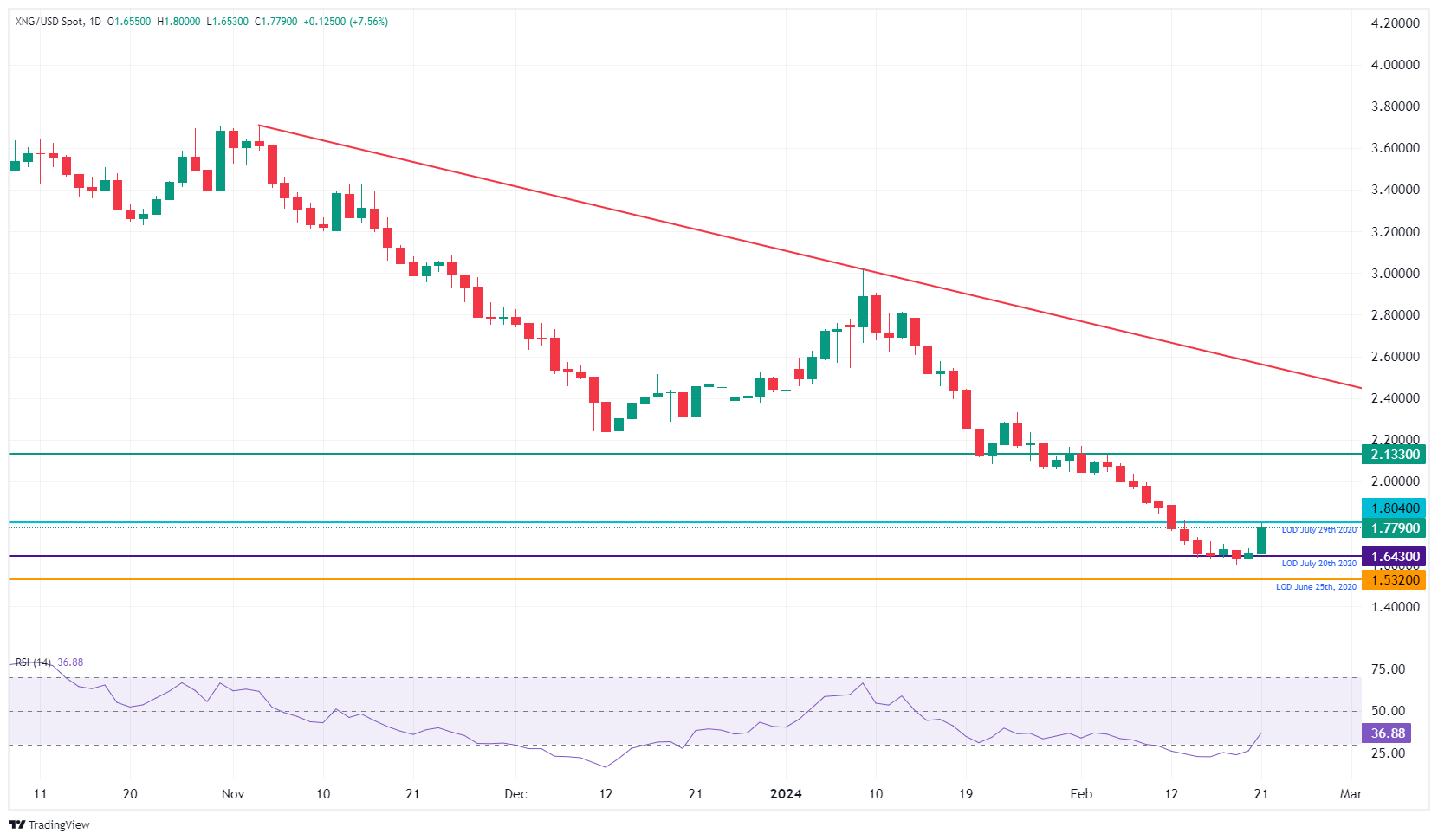
XNG/USD (Daily Chart)
Natural Gas FAQs
What fundamental factors drive the price of Natural Gas?
Supply and demand dynamics are a key factor influencing Natural Gas prices, and are themselves influenced by global economic growth, industrial activity, population growth, production levels, and inventories. The weather impacts Natural Gas prices because more Gas is used during cold winters and hot summers for heating and cooling. Competition from other energy sources impacts prices as consumers may switch to cheaper sources. Geopolitical events are factors as exemplified by the war in Ukraine. Government policies relating to extraction, transportation, and environmental issues also impact prices.
What are the main macroeconomic releases that impact on Natural Gas Prices?
The main economic release influencing Natural Gas prices is the weekly inventory bulletin from the Energy Information Administration (EIA), a US government agency that produces US gas market data. The EIA Gas bulletin usually comes out on Thursday at 14:30 GMT, a day after the EIA publishes its weekly Oil bulletin. Economic data from large consumers of Natural Gas can impact supply and demand, the largest of which include China, Germany and Japan. Natural Gas is primarily priced and traded in US Dollars, thus economic releases impacting the US Dollar are also factors.
How does the US Dollar influence Natural Gas prices?
The US Dollar is the world’s reserve currency and most commodities, including Natural Gas are priced and traded on international markets in US Dollars. As such, the value of the US Dollar is a factor in the price of Natural Gas, because if the Dollar strengthens it means less Dollars are required to buy the same volume of Gas (the price falls), and vice versa if USD strengthens.
Author

Filip Lagaart
FXStreet
Filip Lagaart is a former sales/trader with over 15 years of financial markets expertise under its belt.

















