Mullen Automotive Stock Forecast: After 19% gain on Thursday, MULN consolidates

- Mullen Automotive stock gained 19% on Thursday.
- The company unveiled its commercial vehicles at a major fleet conference.
- On Tuesday, Mullen partnered with Amerit Fleet Solutions for commercial maintenance.
- MULN stock was down slightly in Friday’s premarket.
Mullen Automotive (MULN) stock is holding onto most of its Thursday rally in early Friday trading. MULN stock is down less than 1% in the premarket following Thursday’s impressive 19% gain.
MULN traded up to $0.9531 on Thursday after the company appeared in what it said was a successful demonstration at the Government Fleet Expo & Conference. NASDAQ 100 futures have gained 0.3% early Friday.
MULN stock news: Commercial vehicles remain the focus
Held at the Kay Bailey Hutchison Convention Center in Dallas, Texas, the Government Fleet Expo is the nation’s largest conference for large fleet operators.
Mullen officials spent the four-day event showing off the Mullen ONE, its electric Class 1 cargo van, and the Mullen THREE, its electric Class 3 cab chassis truck.
“Our objective with these events is to provide fleet managers all over the US the ability to check out and test our commercial vehicles first-hand to see the incredible value we offer,” said CEO David Michery.
Mullen will next present at the Electric Utility Fleet Managers Conference in Virginia in early June.
On Tuesday, Mullen announced that it is partnering with Amerit Fleet Solutions to provide all mechanical service and warranty work nationwide on its commercial vehicles. It will commence commercial production of its truck chassis, the Mullen THREE, in August of this year. To date, Mullen has received purchase orders valued at $279 million from Randy Marion Automotive Group, a nationwide commercial dealership.
Mullen stock forecast
Despite its 19% rally on Thursday, MULN stock has been in a downtrend since at least February 17. That is when the 9-day moving average crossed below the 21-day average – a signal of short-term pullbacks. Now more than three months since then, the downturn has seemed anything but short-term in nature.
At the moment, MULN needs to break back above the 9-day at $1.06 and then the 21-day at $1.36. However, this seems like a tall order for a stock that continues to be diluted as the company needs loads of more cash to get its vehicle designs through production.
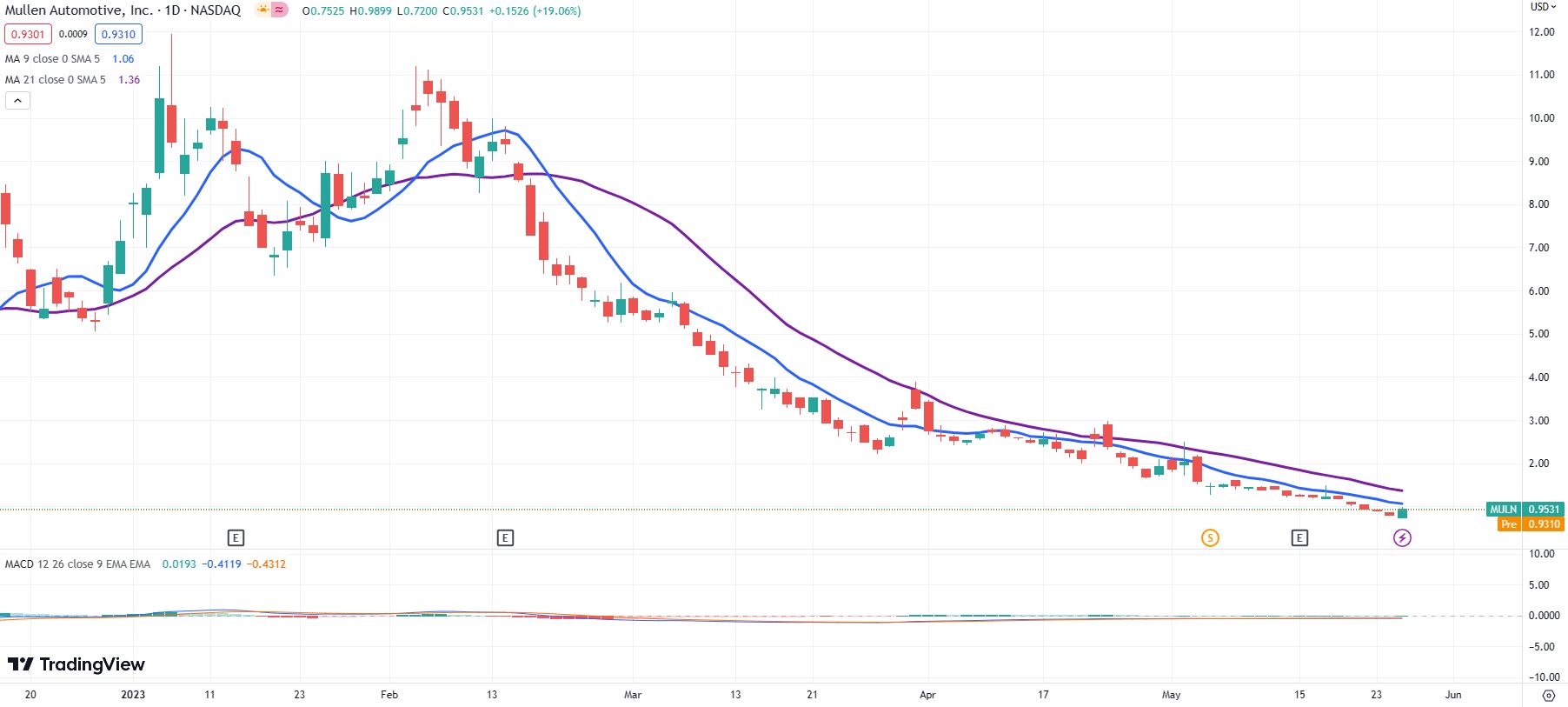
MULN daily chart
Author

Clay Webster
FXStreet
Clay Webster grew up in the US outside Buffalo, New York and Lancaster, Pennsylvania. He began investing after college following the 2008 financial crisis.
















