Mexican Peso approaches post-election lows as markets fear reform

Most recent article here: Mexican Peso tanks to eight-month low amid AMLO’s comments, US data
- The Mexican Peso declines towards post-election lows as markets fret about newly elected government reforms.
- Critics say they are anti-democratic and market-negative.
- USD/MXN shoots higher after US Nonfarm Payrolls and average hourly earnings beat expectations.
The Mexican Peso (MXN) weakens to close to its post election lows in its most heavily-traded pairs on Friday. Investor fears regarding the market impact of radical changes to the Mexican constitution proposed by the country’s recently-re-elected left-wing administration are a key driver.
USD/MXN trades back above 18.10 after US Nonfarm Payrolls data released on Friday shows a higher-than-expected 246K new employees started work in May, beating expectations of 185K and a downwardly revised 165K previously.
Average Hourly Earnings rose by 4.1% YoY and 0.4% MoM, also beating expectations of 3.9% and 0.3% respectively, as well as the previous month's 4.0% and 0.2%. This further reduces expectations the Federal Reserve (Fed) will move to cut interest rates in the US. That, in turn, strengthens the US Dollar (USD) as maintaining higher interest rates attracts more foreign capital inflows.
USD/MXN trades at 18.12 at the time of writing, EUR/MXN at 19.62 and GBP/MXN at 23.11.
Mexican Peso weakens again due to politics
The Mexican Peso’s renewed bout of weakness started following comments from the head of the ruling Morean party in Congress, Ignacio Mier, who said on Thursday that he would be submitting controversial constitutional reforms to a discussion and vote in Congress. The reforms were proposed by outgoing president Andres Manuel Lopez Obrador (AMLO) back in February. Critics say they are anti-democratic and market-unfriendly.
Sunday’s elections saw AMLO’s protege, President-elect Claudia Sheinbaum and her Morena party win a landslide victory. Although not all the votes have been counted yet, it looks like the party has probably won a supermajority (over two-thirds) in the Congress and also possibly in the Senate. If so, this would give it the power to push through AMLO’s radical reforms.
The Peso lost 5% on Monday and Tuesday as early estimates showed the scale of the victory. Midweek it found a floor and recovered after the Mexican Finance Minister tried to reassure investors the government would continue to act with fiscal discipline and be pro-investment. Mier’s comments late Thursday, however, renewed concerns about the proposed constitutional changes.
On the data front, 12-Month Inflation data in May rose to 4.69% from 4.65% previously. On a month-over-month basis, headline inflation declined by 0.19% compared to the 0.20% rise in April. Core Inflation rose 0.17% in May versus the 0.20% in April, according to data from INEGI.
Technical Analysis: USD/MXN resumes uptrend
USD/MXN – the value of one US Dollar in Mexican Pesos – is rallying again, suggesting the short and intermediate-term trends are still bullish. Given “the trend is your friend”, the odds favor a continuation higher.
The fact that bulls have managed to push the price back above 17.54 (the last higher low) and another key level at 17.72 marks key victories and indicates lessening probabilities of bearish pressure.
USD/MXN 4-hour Chart
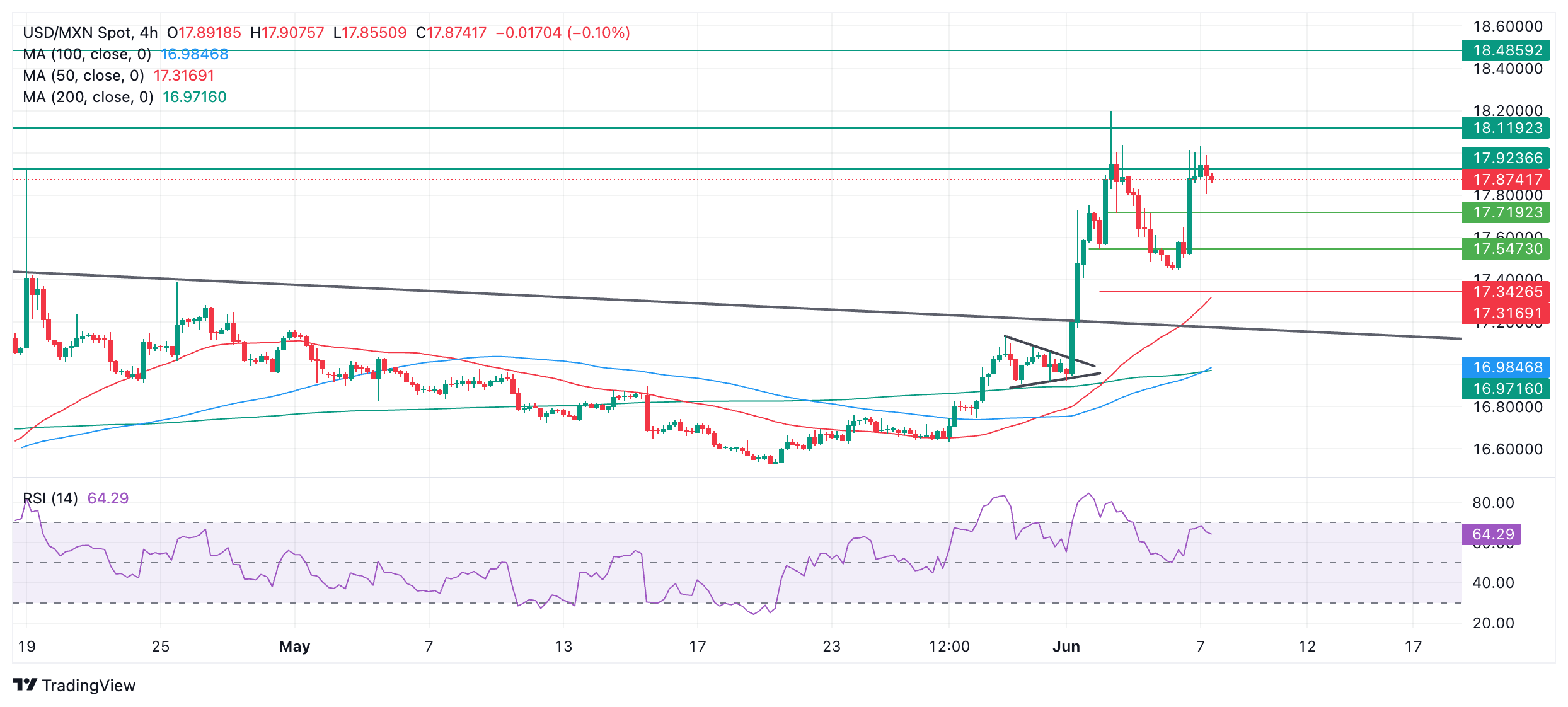
The pair is now close to touching resistance at 18.20, the June 4 high. A break above that level would add confirmation of a continuation higher to the next target at 18.49 (October 2023 high).
The long-term trend is probably still bearish, suggesting moderate background risks continue.
Economic Indicator
Nonfarm Payrolls
The Nonfarm Payrolls release presents the number of new jobs created in the US during the previous month in all non-agricultural businesses; it is released by the US Bureau of Labor Statistics (BLS). The monthly changes in payrolls can be extremely volatile. The number is also subject to strong reviews, which can also trigger volatility in the Forex board. Generally speaking, a high reading is seen as bullish for the US Dollar (USD), while a low reading is seen as bearish, although previous months' reviews and the Unemployment Rate are as relevant as the headline figure. The market's reaction, therefore, depends on how the market assesses all the data contained in the BLS report as a whole.
Read more.Last release: Fri Jun 07, 2024 12:30
Frequency: Monthly
Actual: 272K
Consensus: 185K
Previous: 175K
Source: US Bureau of Labor Statistics
America’s monthly jobs report is considered the most important economic indicator for forex traders. Released on the first Friday following the reported month, the change in the number of positions is closely correlated with the overall performance of the economy and is monitored by policymakers. Full employment is one of the Federal Reserve’s mandates and it considers developments in the labor market when setting its policies, thus impacting currencies. Despite several leading indicators shaping estimates, Nonfarm Payrolls tend to surprise markets and trigger substantial volatility. Actual figures beating the consensus tend to be USD bullish.
Author

Joaquin Monfort
FXStreet
Joaquin Monfort is a financial writer and analyst with over 10 years experience writing about financial markets and alt data. He holds a degree in Anthropology from London University and a Diploma in Technical analysis.