Mexican Peso depreciates on political risk despite positive tariff news
- The Mexican Peso trades lower from political risk due to planned changes to the constitution
- Critics say new laws will compromise the independence of the judiciary.
- News of Canadian tariffs on Chinese EVs and Mexican monetary policy, support MXN.
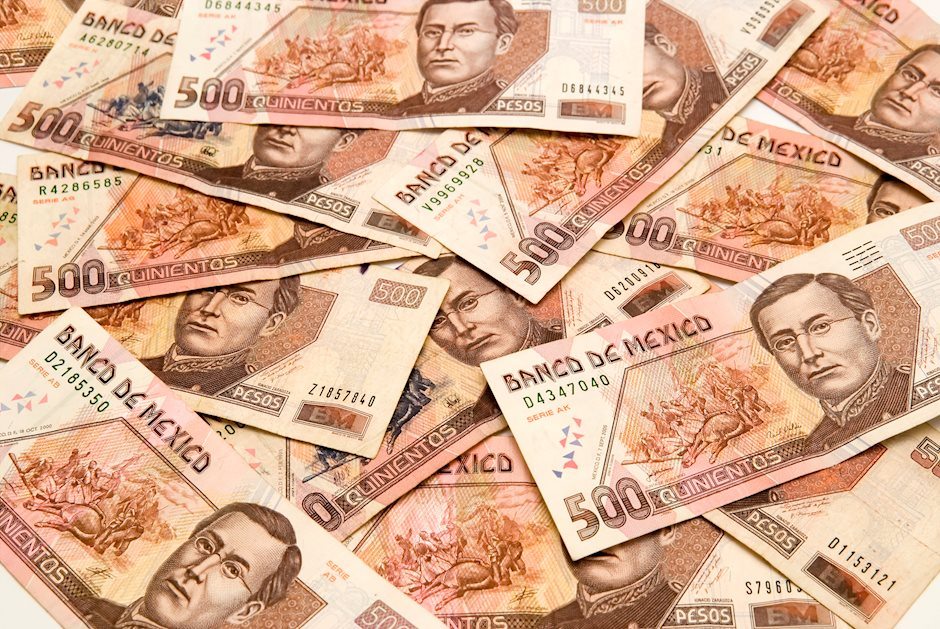

The Mexican Peso (MXN) trades lower on Tuesday extending the downtrend of the last few days as political risk weighs. Investors are worried about the impact of proposed reforms to the judiciary that critics argue will compromise its independence. This, however, is counter-balanced by positive news regarding international trade and commentary from Bank of Mexico officials that support the Peso.
At the time of writing, one US Dollar (USD) buys 19.51 Mexican Pesos, EUR/MXN trades at 21.77, and GBP/MXN at 25.78.
Mexican Peso impacted by political risk
The Mexican Peso is depreciating due to investors' concerns over the newly-approved Mexican government’s planned changes to the constitution, in particular in the way the judiciary is appointed. The newly approved Morena-ruled government wants to make judges elected rather than appointed. Critics say the changes will compromise the independence of the judiciary, undermining justice and democracy.
The proposed reforms have already impacted investor sentiment with Morgan Stanley recommending to its clients not to invest in shares in Mexico, citing fears that the judiciary reform could increase risk premiums in the country.
News of tariffs helps support Peso
The Mexican Peso gains some relief from the news of Canada’s decision to increase tariffs on Chinese electric vehicle (EV) and steel imports, by 100% and 25%, respectively. This may benefit Mexico in a roundabout way because of its existing role as an intermediary manufacturer of Chinese EVs destined for the North American market and the free-trade agreement it has with Canada, according to Bloomberg News.
Further support for the Peso comes from commentary from Banxico Deputy Governor Galia Borja who said in an interview with Economista on Monday, that despite the bank making cuts in March and August, this did not imply the abandonment of restrictive policy. The “cuts in March and August do not mean that we are going to the neutral or accommodative territory. That will take some time. So, from now on, there will still be another period in which the restrictive monetary stance will continue,” said Borja.
Cooler-than-expected Mexican inflation data for August, weaker retail sales in July and carry trade flows out of the Mexican Peso might have been other background factors weighing on the currency at the start of the week.
Technical Analysis: USD/MXN trades within a rising channel
USD/MXN is consolidating in a broad uptrend within a rising channel. The established uptrend overall favors longs over shorts.
More recently, the pair has been oscillating within a mini-range between 19.52 and 19.01. It may well fall temporarily to close the gap that opened on August 26 between 19.11 and 19.15. However, the general direction of the trend is up and suggests an eventual ascent towards the channel highs at roughly 20.50.
USD/MXN 4-hour Chart
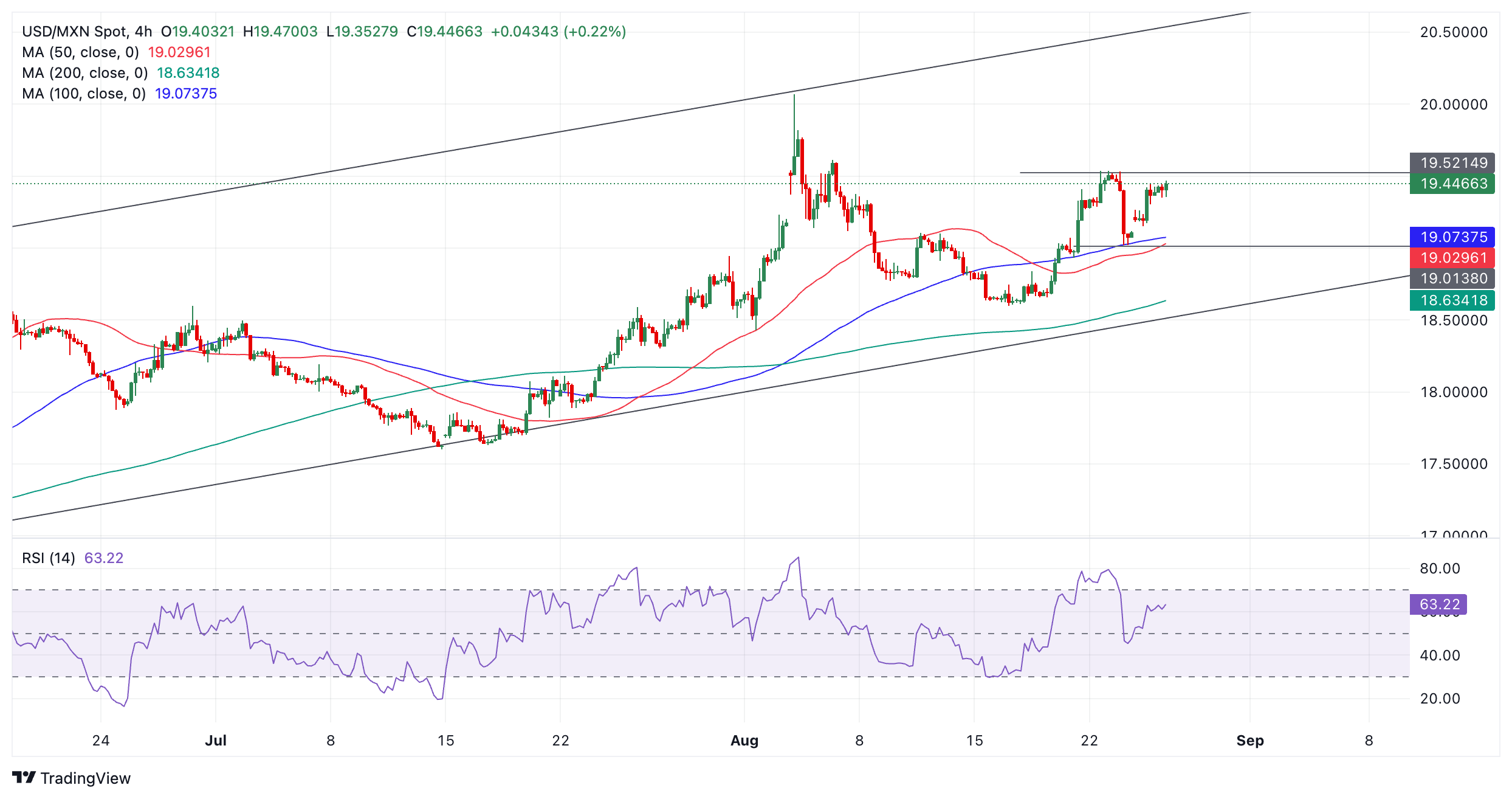
A break above the 19.53 swing high would provide additional confirmation of the continuation of the up leg towards the channel highs.
Banxico FAQs
The Bank of Mexico, also known as Banxico, is the country’s central bank. Its mission is to preserve the value of Mexico’s currency, the Mexican Peso (MXN), and to set the monetary policy. To this end, its main objective is to maintain low and stable inflation within target levels – at or close to its target of 3%, the midpoint in a tolerance band of between 2% and 4%.
The main tool of the Banxico to guide monetary policy is by setting interest rates. When inflation is above target, the bank will attempt to tame it by raising rates, making it more expensive for households and businesses to borrow money and thus cooling the economy. Higher interest rates are generally positive for the Mexican Peso (MXN) as they lead to higher yields, making the country a more attractive place for investors. On the contrary, lower interest rates tend to weaken MXN. The rate differential with the USD, or how the Banxico is expected to set interest rates compared with the US Federal Reserve (Fed), is a key factor.
Banxico meets eight times a year, and its monetary policy is greatly influenced by decisions of the US Federal Reserve (Fed). Therefore, the central bank’s decision-making committee usually gathers a week after the Fed. In doing so, Banxico reacts and sometimes anticipates monetary policy measures set by the Federal Reserve. For example, after the Covid-19 pandemic, before the Fed raised rates, Banxico did it first in an attempt to diminish the chances of a substantial depreciation of the Mexican Peso (MXN) and to prevent capital outflows that could destabilize the country.
Author
Joaquin Monfort
FXStreet
Joaquin Monfort is a financial writer and analyst with over 10 years experience writing about financial markets and alt data. He holds a degree in Anthropology from London University and a Diploma in Technical analysis.