Mexican Peso appreciates, records strongest week since mid-June

Most recent article: Mexican Peso tumbles as US Dollar appreciates on Trump’s attack
- Mexican Peso extends gains as USD/MXN reaches 17.68 after hitting five-week low of 17.62.
- Mexico’s Industrial Production rebounds in May, indicating resilience amid economic slowdown.
- Banxico minutes suggest potential rate adjustments, while US producer inflation rises and consumer sentiment deteriorates.
The Mexican Peso extended its rally for the ninth consecutive trading day against the Greenback on Friday following the release of Mexico’s Industrial Product figures and June’s US inflation data on the producer side. The USD/MXN trades at 17.68, refreshing five-week lows of 17.62.
Despite the annual weakening, Mexico’s Industrial Production showed resilience by recovering in May, following April’s plunge in monthly figures. This recovery underscores a positive outlook amidst the country’s ongoing economic slowdown.
In the meantime, the latest Bank of Mexico (Banxico) minutes revealed that the disinflation process has evolved and may spark discussions to adjust interest rates at upcoming meetings. The board acknowledged the labor market's strength, yet stated that growth has shown signs of weakness.
Meanwhile, Jose Luis Ortega, CIO of Black Rock Mexico, commented that inflation in Mexico wouldn’t return to Banxico’s 3% goal by the end of 2025. He added that Banxico’s easing cycle will be gradual, though adjustments will continue.
Across the border, further inflation data revealed by the US Bureau of Labor Statistics (BLS) showed that prices paid by producers picked up above economists' estimates, while US Consumer Sentiment revealed by the University of Michigan (UoM) deteriorated.
In the meantime, Federal Reserve (Fed) officials grabbed the headlines and remained cautious in regard to monetary policy shifts. Chicago Fed President Goolsbee said that recent inflation data is “favorable” and might shorten the Fed’s last mile on inflation.
St. Louis Fed President Alberto Musalem said that the current interest rate level is appropriate for current conditions and sees the economy growing between 1.5% and 2% this year.
Daily digest market movers: Mexican Peso prolongs its gains, despite Banxico's dovish tilt
- Banxico board members project growth to be lower than expected, as Mexico’s economic activity has been weak since the end of 2023. Most policymakers mentioned that inflation will converge toward the target in the last quarter 2025.
- They added that services inflation does not show a clear downward trend, which was one of the reasons for keeping rates unchanged at the June meeting.
- Mexico’s Industrial Production (IP) in May came at 0.7% MoM, higher than April’s -0.4% and estimates of 0.4%. In the 12 months to May, IP was 1%, which fell sharply from 5.1% in April and missed the 1.2% projected.
- Mexico’s June inflation figures were higher than expected due to a rise in food prices when most economists expect Banxico to resume lowering interest rates.
- June US Producer Price Index (PPI) expanded by 0.2% MoM, higher than the 0.1% expected and above May’s 0%. Core PPI was hotter than the 0.2% foreseen, at 0.4% MoM.
- Annually based, PPI ticked up from 2.4% to 2.6%, above forecasts of 2.3%. Underlying inflation was 3%, up from 2.6%.
- UoM Consumer Sentiment declined from 68.2 in June to 66.0 in July. Inflation expectations for one year came as expected at 2.9%, down from 3%.
- US Dollar Index (DXY), which tracks the value of a basket of six currencies against the US Dollar, tumbled more than 0.30% and is down at 104.12.
- According to the CME FedWatch Tool data, the odds for a September cut are 88%, up from 85% on Thursday.
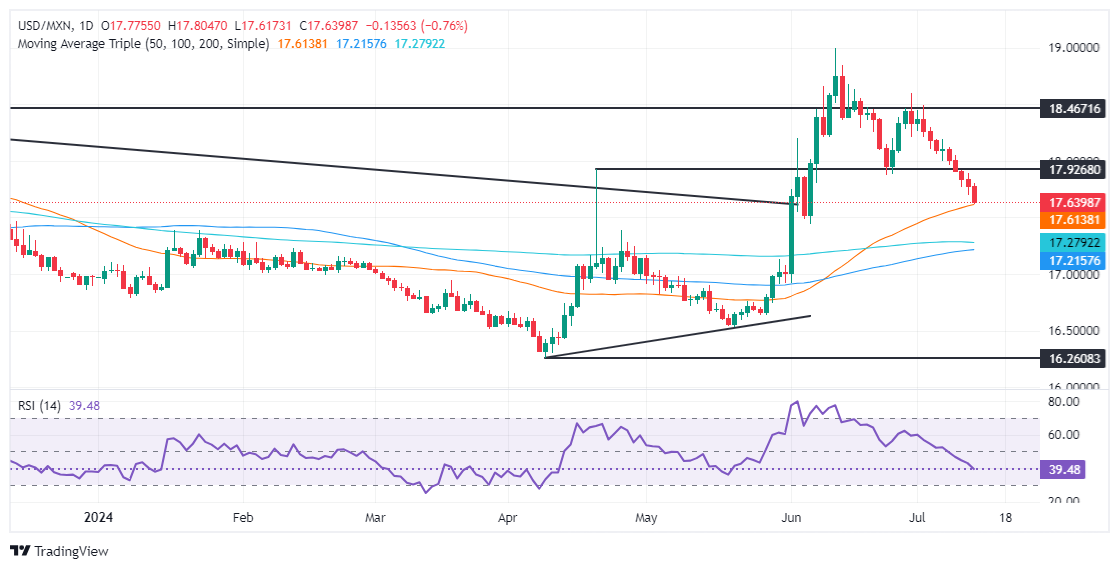
Technical analysis: Mexican Peso capitalizes USD weakness as USD/MXN drops below 17.70
The USD/MXN continues to slip further, with traders eyeing a test of the 17.50 psychological level. Momentum remains on the seller's side, as depicted by the Relative Strength Index (RSI), though key support levels in the exotic pair will be tested soon.
If USD/MXN drops below 17.60, the next support would be the confluence of the December 5 high and the 50-day Simple Moving Average (SMA) near 17.56/60, followed by the 200-day SMA at 17.28. Further losses would test the 100-day SMA at 17.20.
Conversely, USD/MXN buyers need to clear the June 24 cycle low of 17.87, which has turned into resistance, before challenging the 18.00 figure. Further upside potential is seen above the July 5 high at 18.19, followed by the June 28 high of 18.59, allowing buyers to aim for the YTD high of 18.99.
Mexican Peso FAQs
The Mexican Peso (MXN) is the most traded currency among its Latin American peers. Its value is broadly determined by the performance of the Mexican economy, the country’s central bank’s policy, the amount of foreign investment in the country and even the levels of remittances sent by Mexicans who live abroad, particularly in the United States. Geopolitical trends can also move MXN: for example, the process of nearshoring – or the decision by some firms to relocate manufacturing capacity and supply chains closer to their home countries – is also seen as a catalyst for the Mexican currency as the country is considered a key manufacturing hub in the American continent. Another catalyst for MXN is Oil prices as Mexico is a key exporter of the commodity.
The main objective of Mexico’s central bank, also known as Banxico, is to maintain inflation at low and stable levels (at or close to its target of 3%, the midpoint in a tolerance band of between 2% and 4%). To this end, the bank sets an appropriate level of interest rates. When inflation is too high, Banxico will attempt to tame it by raising interest rates, making it more expensive for households and businesses to borrow money, thus cooling demand and the overall economy. Higher interest rates are generally positive for the Mexican Peso (MXN) as they lead to higher yields, making the country a more attractive place for investors. On the contrary, lower interest rates tend to weaken MXN.
Macroeconomic data releases are key to assess the state of the economy and can have an impact on the Mexican Peso (MXN) valuation. A strong Mexican economy, based on high economic growth, low unemployment and high confidence is good for MXN. Not only does it attract more foreign investment but it may encourage the Bank of Mexico (Banxico) to increase interest rates, particularly if this strength comes together with elevated inflation. However, if economic data is weak, MXN is likely to depreciate.
As an emerging-market currency, the Mexican Peso (MXN) tends to strive during risk-on periods, or when investors perceive that broader market risks are low and thus are eager to engage with investments that carry a higher risk. Conversely, MXN tends to weaken at times of market turbulence or economic uncertainty as investors tend to sell higher-risk assets and flee to the more-stable safe havens.
Author

Christian Borjon Valencia
FXStreet
Markets analyst, news editor, and trading instructor with over 14 years of experience across FX, commodities, US equity indices, and global macro markets.

















