Mexican Peso stages late recovery, finishes week down
- Mexican Peso makes a late session recovery, supported by strong Q3 GDP figures and lower mid-month inflation.
- Concerns linger as Mexico’s legislative changes could impact its status in the USMCA agreement, potentially affecting trade dynamics.
- Banxico Governor indicates readiness to cut rates further if inflation trends continue downward, influencing Peso's strength.
- US economic data, including better-than-expected S&P Global Flash PMIs and UoM Consumer Sentiment, bolstered the US Dollar.

The Mexican Peso stages a recovery late in the North American session and registers minimal gains against the US Dollar. Upbeat economic data in Mexico and the US, ultimately boosted the Peso, which would end the day positively, yet down 0.26&% in the week. At the time of writing, the USD/MXN trades at 20.39, down 0.04%.
In Mexico, the Instituto Nacional de Estadistica Geografía e Informatica (INEGI) revealed the final Reading of the Gross Domestic Product (GDP) for Q3 2024, which exceeded estimates in quarterly and yearly numbers. At the same time, November’s Mid-month inflation was below the previous month’s reading and estimates in headline and core, hinting that the Bank of Mexico (Banxico) could continue to ease policy.
The US economic docket revealed that business activity improved, according to S&P Global Flash PMIs for November. Meanwhile, the University of Michigan (UoM) Consumer Sentiment in November improved compared to its previous reading, while inflation expectations for one year dipped.
This and geopolitical jitters underpinned the USD/MXN toward new weekly highs of 20.55. It is worth noting that Mexico’s Chamber of Deputies approved the dissolution of autonomous bodies, which, according to experts, puts Mexico at risk of being taken out of the USMCA free trade agreement.
Bank of Mexico Governor Victoria Rodriguez Ceja said they’re ready to slash interest rates if inflation continues downward. This would exert downward pressure on the Peso, which has depreciated after former US President Donald Trump’s victory boosted the Greenback. Since then, the Federal Reserve (Fed) has adopted a cautious stance on easing policy, as some of Trump’s proposals exert upward inflation pressure.
Money market players had grown more cautious about the Fed cutting rates. The CME FedWatch Tool suggests that investors see a 56% chance of a 25-basis-point rate cut at the December meeting, down from 59% a day ago.
Next week, Mexico’s economic schedule will feature Current Account data for Q3, the Balance of Trade for October, and the Bank of Mexico's latest policy meeting minutes. On the US front, the docket would feature the release of the Fed’s last meeting minutes, Durable Goods Orders, and the release of the Fed’s favorite inflation gauge, the Core Personal Consumption Expenditures (PCE) Price Index.
Daily digest market movers: Mexican Peso falls as bets for Banxico rate cuts increased
- Mexico’s mid-month inflation rate eased in early November, increasing bets that Banxico would ease policy.
- Headline inflation hit 4.56% YoY, down from 4.69% in the previous month, after rising in the previous pair of two-week periods. Economists expected inflation to remain unchanged, according to a Reuters poll.
- Core inflation, usually seen as a better gauge of price trends because it strips out volatile energy and food prices, came in below the forecast of 3.72% at 3.58% YoY.
- Mexico's GDP for the third quarter of 2024 expanded by 1.1% in the third quarter compared to Q2 and is almost in line with the 1.0% increase expected by economists.
- In annual terms, the economy expanded by 1.6% compared to a year earlier, slower than the previous reading and slightly above the 1.5% foreseen by economists.
- US S&P Global Services and Composite PMIs for November expanded by 57.0 and 55.3, exceeding the previous month's reading; the Manufacturing PMI improved from 48.5 to 48.8, as expected.
- The UoM Consumer Sentiment in November improved from 70.5 to 71.8 but missed the mark. Inflation expectations for one year dipped from 2.7% to 2.6% as projected.
- Data from the Chicago Board of Trade, via the December fed funds rate futures contract, shows investors estimate 22 bps of Fed easing by the end of 2024.
- Last week, Moody’s changed Mexico’s credit outlook to negative, mentioning constitutional reforms that could negatively impact Mexico’s economic and fiscal strength.
USD/MXN technical outlook: Mexican Peso slumps as USD/MXN climbs past 20.45
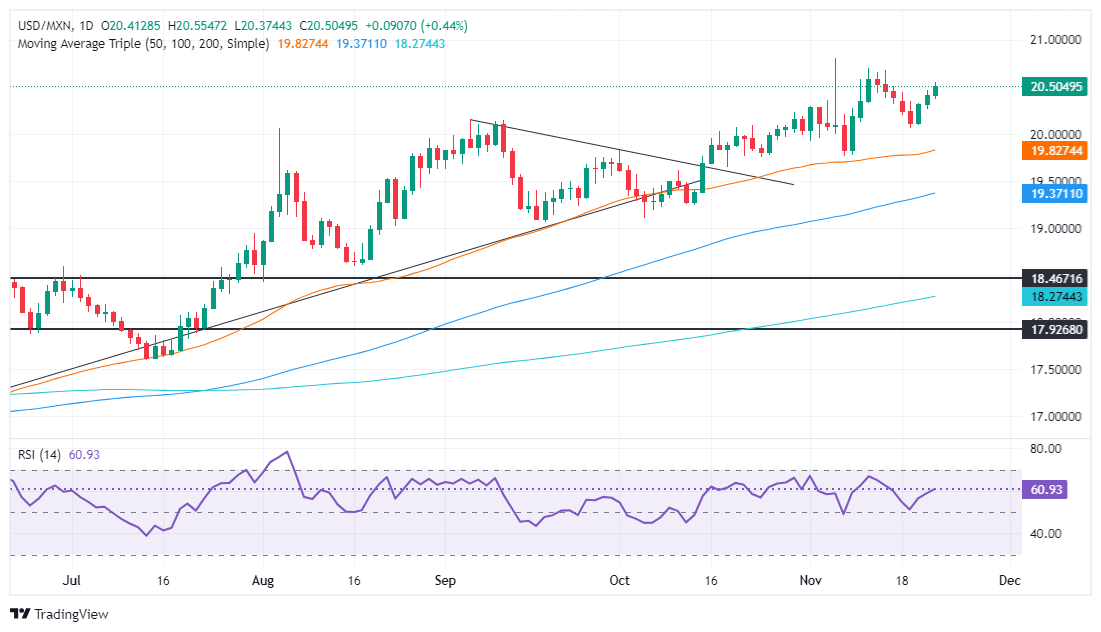
The USD/MXN remains upwardly biased despite retreating below the psychological 20.50 figure. A breach of the latter will expose the current day high at 20.55, followed by the November 12 peak at 20.69. Once cleared, the next resistance would be the year-to-date (YTD) high of 20.80.
If sellers push the exchange rate below 20.00, they could test the 50-day Simple Moving Average (SMA) and the November 7 low around 19.75/78, followed by the 19.50 mark.
Indicators such as the Relative Strength Index (RSI) remain bullish in the short and medium term, hinting that further upside is available.
Banxico FAQs
The Bank of Mexico, also known as Banxico, is the country’s central bank. Its mission is to preserve the value of Mexico’s currency, the Mexican Peso (MXN), and to set the monetary policy. To this end, its main objective is to maintain low and stable inflation within target levels – at or close to its target of 3%, the midpoint in a tolerance band of between 2% and 4%.
The main tool of the Banxico to guide monetary policy is by setting interest rates. When inflation is above target, the bank will attempt to tame it by raising rates, making it more expensive for households and businesses to borrow money and thus cooling the economy. Higher interest rates are generally positive for the Mexican Peso (MXN) as they lead to higher yields, making the country a more attractive place for investors. On the contrary, lower interest rates tend to weaken MXN. The rate differential with the USD, or how the Banxico is expected to set interest rates compared with the US Federal Reserve (Fed), is a key factor.
Banxico meets eight times a year, and its monetary policy is greatly influenced by decisions of the US Federal Reserve (Fed). Therefore, the central bank’s decision-making committee usually gathers a week after the Fed. In doing so, Banxico reacts and sometimes anticipates monetary policy measures set by the Federal Reserve. For example, after the Covid-19 pandemic, before the Fed raised rates, Banxico did it first in an attempt to diminish the chances of a substantial depreciation of the Mexican Peso (MXN) and to prevent capital outflows that could destabilize the country.
Author

Christian Borjon Valencia
FXStreet
Markets analyst, news editor, and trading instructor with over 14 years of experience across FX, commodities, US equity indices, and global macro markets.