Mexican Peso sinks as USD/MXN approaches psychological 18.00 mark

Most recent article: Mexican Peso falls amid safe-haven flows, sour mood
- Mexican Peso plummets more than 1% as USD/MXN trades above 17.90.
- Fitch reaffirms Mexico's BBB- rating, highlighting judicial reform and fiscal deficit concerns.
- US unemployment claims rise, boosting the US Dollar Index above 104.00, gaining 0.25%.
The Mexican Peso begins Thursday’s session on the backfoot against the Greenback as investors turn risk-averse, while the Greenback remains bid and trims some of Wednesday’s losses. The USD/MXN trades at 17.92, 1.30 % above its opening price.
Mexico’s economic docket remains absent, leaving traders adrift to market mood and US Dollar dynamics. Meanwhile, Fitch ratings reaffirmed Mexico’s BBB- qualification with a stable outlook.
In further comments, Fitch revealed that the proposed judicial reform would negatively affect Mexico’s institutional profile, but it's too early to gauge the impact. The credit rating agency stated there’s uncertainty in the upcoming administration to narrow the fiscal deficit, expects a slight economic slowdown in 2025, and added that trade tensions with the US could leave Mexico vulnerable.
Fitch reviews came after the International Monetary Fund (IMF) adjusted Mexico’s Gross Domestic Product (GDP) expectations for 2024 from 2.4% to 2.2% due to the country’s economic slowdown and the US economic downturn.
Across the border, the US Bureau of Labor Statistics (BLS) revealed that US unemployment claims rose above estimates and last week’s reading, indicating some slack in the labor market. Continuing claims also increased and hit its highest level since November 2021.
The Greenback rose after the data, with the US Dollar Index (DXY), which tracks the buck’s value against the other six currencies, climbing back above 104.00, gaining 0.25%.
Daily digest market movers: Mexican Peso trips down on US Dollar strength
- Mexico’s economic docket will be absent during the week, resuming on July 22, when the National Statistics Agency (INEGI) reveals growth figures for the month of May. Nevertheless, Bank of Mexico (Banxico) policymakers and political developments could rock the boat.
- US Initial Jobless Claims revealed by the BLS showed that the number of Americans filing for unemployment benefits in the week ending July 13 rose above estimates of 230K, coming at 243K, and exceeded the previous week's reading of 223K.
- Bloomberg’s interview of Donald Trump spooked investors as the former US President commented that he favors tax reductions, lower interest rates, and tariffs, including a 60% to 100% increase in China’s products and a 10% in the general rate in other countries.
- The CME FedWatch Tools show the chances for a quarter of a percentage rate cut to the federal funds rate in September are at 98%.
- June consumer inflation figures were lower than expected in the United States, increasing the chances that the Federal Reserve would lower borrowing costs in 2024 by at least 52 basis points, according to the December 2024 fed funds rate futures contract.
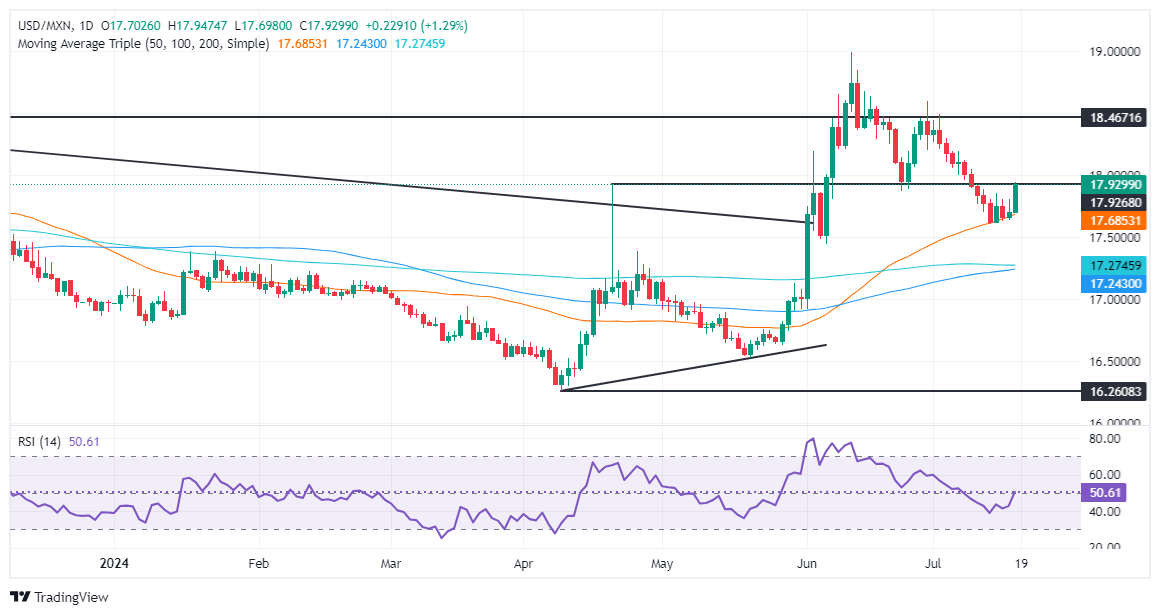
Technical analysis: Mexican Peso depreciates further as USD/MXN rallies above 17.90
On Wednesday, I wrote, "The USD/MXN has bottomed at around the 50-day Simple Moving Average (SMA) after the pair tumbled more than 2.50% as the Mexican currency appreciated. However, buyers had stepped in, forming a floor at around 17.58-17.60.”
As of writing, the exotic pair is rallying sharply above the 17.90 figure after bouncing around the above-mentioned area, putting into play a test of the psychological 18.00 mark.
Momentum changed and favored buyers as the Relative Strength Index (RSI) aimed upward and pierced above its neutral line, hinting that bulls are stepping in.
If USD/MXN extends its gains above the psychological 18.00 figure, that will expose key resistance levels. Once breached, the next stop would be the July 5 high at 18.19, followed by the June 28 high of 18.59, allowing buyers to aim for the YTD high at 18.99.
On further weakness, if USD/MXN clears the 50-day SMA at 17.63, that would pave the way to challenge the December 5 high at 17.56, followed by the 200-day SMA at 17.27. Further losses would test the 100-day SMA at 17.21.
Mexican Peso FAQs
The Mexican Peso (MXN) is the most traded currency among its Latin American peers. Its value is broadly determined by the performance of the Mexican economy, the country’s central bank’s policy, the amount of foreign investment in the country and even the levels of remittances sent by Mexicans who live abroad, particularly in the United States. Geopolitical trends can also move MXN: for example, the process of nearshoring – or the decision by some firms to relocate manufacturing capacity and supply chains closer to their home countries – is also seen as a catalyst for the Mexican currency as the country is considered a key manufacturing hub in the American continent. Another catalyst for MXN is Oil prices as Mexico is a key exporter of the commodity.
The main objective of Mexico’s central bank, also known as Banxico, is to maintain inflation at low and stable levels (at or close to its target of 3%, the midpoint in a tolerance band of between 2% and 4%). To this end, the bank sets an appropriate level of interest rates. When inflation is too high, Banxico will attempt to tame it by raising interest rates, making it more expensive for households and businesses to borrow money, thus cooling demand and the overall economy. Higher interest rates are generally positive for the Mexican Peso (MXN) as they lead to higher yields, making the country a more attractive place for investors. On the contrary, lower interest rates tend to weaken MXN.
Macroeconomic data releases are key to assess the state of the economy and can have an impact on the Mexican Peso (MXN) valuation. A strong Mexican economy, based on high economic growth, low unemployment and high confidence is good for MXN. Not only does it attract more foreign investment but it may encourage the Bank of Mexico (Banxico) to increase interest rates, particularly if this strength comes together with elevated inflation. However, if economic data is weak, MXN is likely to depreciate.
As an emerging-market currency, the Mexican Peso (MXN) tends to strive during risk-on periods, or when investors perceive that broader market risks are low and thus are eager to engage with investments that carry a higher risk. Conversely, MXN tends to weaken at times of market turbulence or economic uncertainty as investors tend to sell higher-risk assets and flee to the more-stable safe havens.
Author

Christian Borjon Valencia
FXStreet
Markets analyst, news editor, and trading instructor with over 14 years of experience across FX, commodities, US equity indices, and global macro markets.

















