Mexican Peso is heavy amid Fed officials cautious comments on high US inflation

Most recent article: Mexican Peso stabilizes amid US holiday as Mexican economy contracts
- Mexican Peso drops amid strong Dollar, fueled by ongoing inflation signs and upbeat consumer sentiment.
- Anticipation for Mexico's Retail Sales, Q4 GDP and mid-February inflation data could influence Banxico's policy direction.
- US PPI surge in January and positive consumer sentiment sponsor USD/MXN upside.
The Mexican Peso (MXN) depreciated against the US Dollar (USD) on Friday but is set to finish the week with minuscule losses of 0.17%. Inflation in the United States (US) remains high, according to the Bureau of Labor Statistics (BLS), while consumer sentiment improved. Federal Reserve speakers remained cautious when speaking about rate cuts, indicating “patience” is required. At the time of writing, the USD/MXN trades at 17.05, up by 0.09%.
Mexico’s economic docket will gather pace until next week, with the release of Retail Sales and the final Gross Domestic Product (GDP) figures for the last quarter of 2023. The February inflation report will be greatly scrutinized by the Bank of Mexico (Banxico), which is eyeing the beginning of its easing cycle.
In the meantime, USD/MXN traders gathered cues on the release of January’s Producer Price Index (PPI) from the US, which exceeded estimates and previous readings, while Consumer Sentiment continued to improve. Federal Reserve officials crossed the wires, with Atlanta’s Fed President Raphael Bostic and San Francisco Fed President Mary Daly leading the way.
Bostic said patience is required and foresees two rate cuts, which could begin in the summer if the data justifies it. Daly commented there’s work to do, adding, “We will need to resist the temptation to act quickly when patience is needed and be prepared to respond agilely as the economy evolves.”
Daily digest market movers: Mexican Peso on the defensive following US PPI data
- The US Bureau of Labor Statistics (BLS) disclosed that the January Producer Price Index (PPI) witnessed a MoM increase of 0.3%, surpassing expectations. Additionally, the core PPI, which excludes volatile food and energy prices, exceeded forecasts by rising sharply to 0.5% MoM, a significant increase from -0.1% in December. Over the 12 months leading up to January, the PPI rose 0.9%, which is lower than the previous month's figure. However, the core PPI for the same period increased by 2%, exceeding both the estimates of 1.6% and December's figure of 1.8%.
- US consumer sentiment improved slightly to 79.5 from 79.0 in January’s last reading, according to the UoM poll. Analysts foresaw an improvement to 80.0 on its preliminary reading.
- Inflation expectations in the US remained steady with one-year inflation at 3%, up from 2.9%, while for a five-year period it stood at 2.9%, unchanged.
- “The fact that sentiment lost no ground this month suggests that consumers continue to feel more assured about the economy, confirming the considerable improvements in December and January across various aspects of the economy," commented Surveys of Consumers Director Joanne Hsu in a statement.
- The US data release triggered a reaction in the USD/MXN, which was hovering near 17.04 before the data but soared to a daily high at 17.09 afterward. As traders digested the data, the exotic pair stabilized near the current exchange rate.
- Other data from the US revealed that Building Permits experienced a decline of -1.5%, moving from 1.493 million to 1.47 million. Simultaneously, Housing Starts saw a significant decrease of -14.8%, dropping from 1.562 million to 1.331 million.
- Market players are expecting the first rate cut by the Federal Reserve at the June monetary policy meeting as they have trimmed odds for March and May.
- US 10-year Treasury note yields climbed seven basis points to 4.315%, while the US Dollar Index (DXY) edged higher to 104.37, up 0.08%.
- At its latest monetary policy decision, Banxico revised its inflation expectations to the upside for the period from Q1 to Q3 of 2024, expecting inflation to converge toward 3.5% in Q4, based on the latest monetary policy statement.
Technical analysis: Mexican Peso stays firm and holds key level despite posting losses
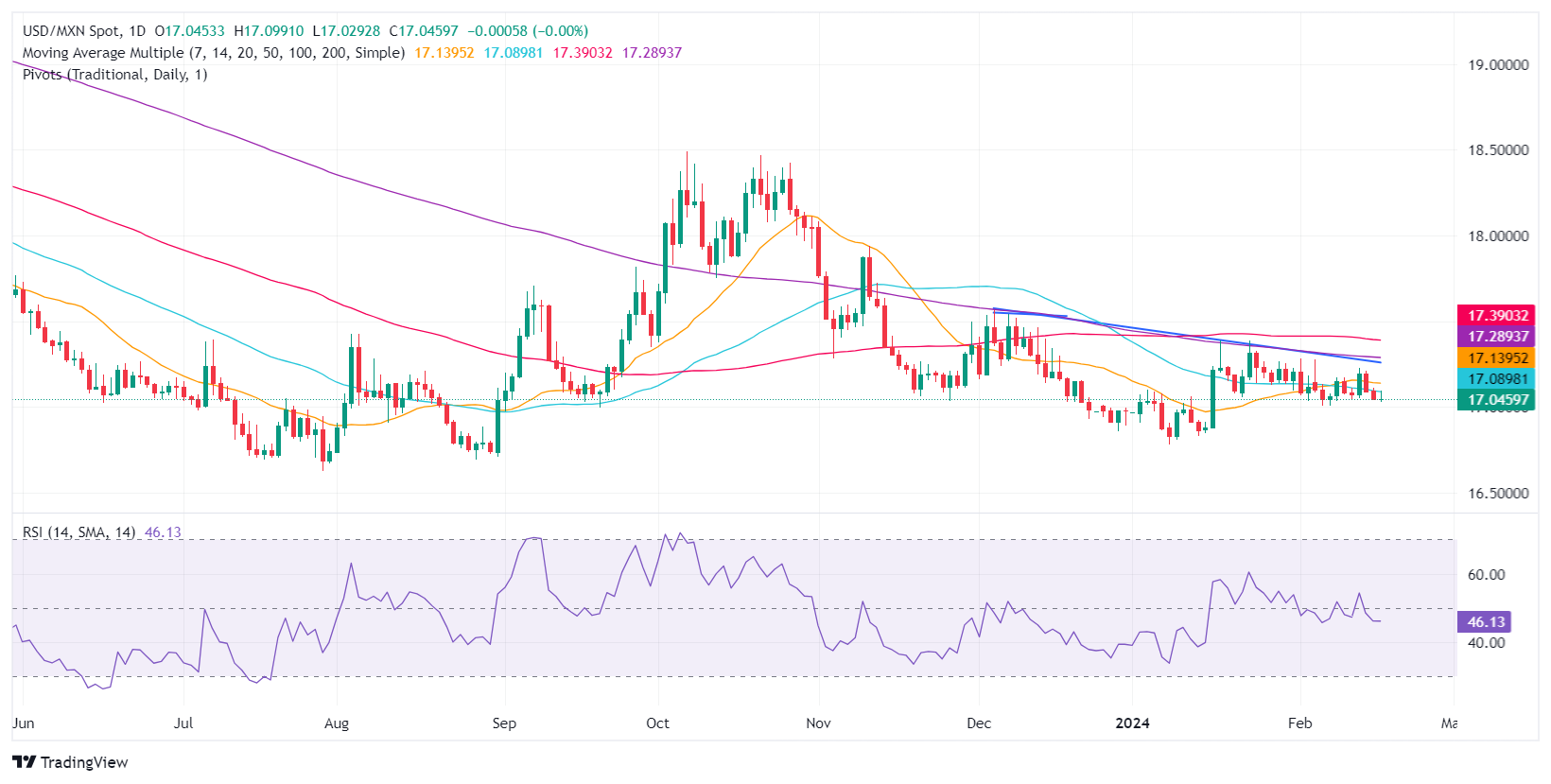
As I wrote in a previous article, “the USD/MXN consolidated in the 17.05-17.10 area during the last couple of days, holding near the 50-day Simple Moving Average (SMA) at 17.09.” However, the pair has tilted toward the bottom of the range, with sellers aiming to push spot prices below the 17.05 figure. Once that level is cleared, there would be nothing on the way to challenge the psychological 17.00 figure before diving toward last year's low of 16.62.
Conversely, if buyers reclaim the 50-DMA, that could sponsor a leg up toward the current week’s high at 17.20-17.22. If those levels are taken, the USD/MXN could rally to the 200-day SMA at 17.29 before aiming toward the 100-day SMA at 17.39.
USD/MXN Price Action – Daily Chart
Mexican Peso FAQs
What key factors drive the Mexican Peso?
The Mexican Peso (MXN) is the most traded currency among its Latin American peers. Its value is broadly determined by the performance of the Mexican economy, the country’s central bank’s policy, the amount of foreign investment in the country and even the levels of remittances sent by Mexicans who live abroad, particularly in the United States. Geopolitical trends can also move MXN: for example, the process of nearshoring – or the decision by some firms to relocate manufacturing capacity and supply chains closer to their home countries – is also seen as a catalyst for the Mexican currency as the country is considered a key manufacturing hub in the American continent. Another catalyst for MXN is Oil prices as Mexico is a key exporter of the commodity.
How do decisions of the Banxico impact the Mexican Peso?
The main objective of Mexico’s central bank, also known as Banxico, is to maintain inflation at low and stable levels (at or close to its target of 3%, the midpoint in a tolerance band of between 2% and 4%). To this end, the bank sets an appropriate level of interest rates. When inflation is too high, Banxico will attempt to tame it by raising interest rates, making it more expensive for households and businesses to borrow money, thus cooling demand and the overall economy. Higher interest rates are generally positive for the Mexican Peso (MXN) as they lead to higher yields, making the country a more attractive place for investors. On the contrary, lower interest rates tend to weaken MXN.
How does economic data influence the value of the Mexican Peso?
Macroeconomic data releases are key to assess the state of the economy and can have an impact on the Mexican Peso (MXN) valuation. A strong Mexican economy, based on high economic growth, low unemployment and high confidence is good for MXN. Not only does it attract more foreign investment but it may encourage the Bank of Mexico (Banxico) to increase interest rates, particularly if this strength comes together with elevated inflation. However, if economic data is weak, MXN is likely to depreciate.
How does broader risk sentiment impact the Mexican Peso?
As an emerging-market currency, the Mexican Peso (MXN) tends to strive during risk-on periods, or when investors perceive that broader market risks are low and thus are eager to engage with investments that carry a higher risk. Conversely, MXN tends to weaken at times of market turbulence or economic uncertainty as investors tend to sell higher-risk assets and flee to the more-stable safe havens.
Author

Christian Borjon Valencia
FXStreet
Markets analyst, news editor, and trading instructor with over 14 years of experience across FX, commodities, US equity indices, and global macro markets.